Sunday, 3 May 2009

Go Backwards To Go Forwards - Refit Week 34

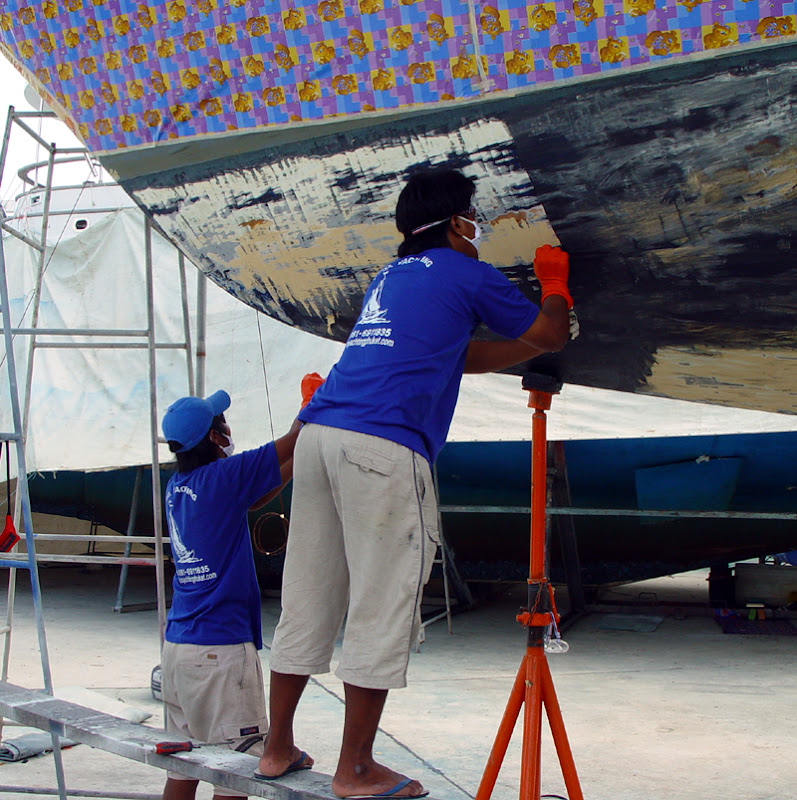
Rugby is a football code where going backwards, away from the goal, is an accepted part of play. Despite the glossy hull and newly applied signwriting, this week our boat refit feels like rugby. "Bum" & "On" our painters from Pro Yachting, have started power-sanding off the brand new non-skid deck paint.

Two weeks ago Ley & I started re-installing the deck fittings and the new railings on Crystal Blues. Whilst screwing down all those turning blocks, jammers and line organisers we noticed a few defects in the new grey paint areas - and another defect in the white non-skid. It turns out that a thunderstorm moved through the area not long after the grey paint was applied. The winds blew dust onto some areas of the paint, whilst the moisture in the air caused the gloss to diminish. After discussing the situation with Jill & Pro they made the logical decision - to sand it off and start again. This was a fairly serious decision - linear polyurethane paint is wildly expensive.

However Pro has shown his dedication to quality by taking the hard road this time. So the guys started, initially hand sanding the grey with 400 grit and then power sanding the non-skid. What a job .... we expect they'll respray the grey sometime next week, and the non-skid a week later. Looks like we spend another few weeks in "paradise" .....

Yat lining out the forward hold
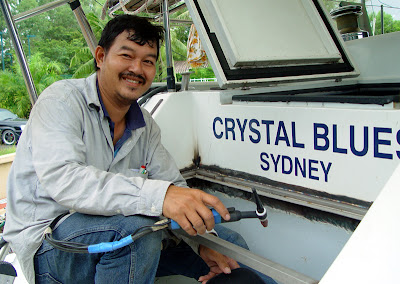
Meanwhile, work continues on other parts of the refit, where I've completed the overhaul and re-build of our steering system. This involved new bearings and sleeving for the bronze axle in the binnacle, plus a new sprocket, chain and wire. Ley is now working on the paint trim for our deck hatches, whilst I'm completing the priming and finishing in the machinery space and lazarette. "Yat", a carpenter from Pro Yachting, is almost finished re-lining the forward hold and locker area. Next week we'll start putting fittings and rigging back onto the mast & boom, whilst Yat will move into the galley to re-install our freezer and galley cabinets.

Holidays In Paradise

This is the hottest month of the year in Phuket. After starting work at 8.00am we're usually dripping by lunchtime and very glad to spend most afternoons at home, compiling and editing video for our "other life" (see the story here). The impressive website for Private Homes & Villas has now been launched (click here to link), so all 25 of our Bali villa videos can now be viewed online, along with the first few samples from Koh Samui. Next month we'll be filming more properties here in Phuket.

Our good friend Danny Kildare, a pro photographer from Sydney, stayed with us for almost two weeks last month. I worked with Danny years back, and he hasn't changed a bit. Still food crazy and an expert on fine wines. It was inevitable that he'd love the local food, but be disappointed with the ice we liberally add to our wine - both white and red. Its a Thai thing ....

Also staying with us this month was Robert Goh, a sailing friend and mountaineer from Singapore. Robert was in town to scout locations for his wedding to Elaine, later this year.

Tuesday, 10 March 2009

Now Its All Crystal Clear .....

Forgive the play on words, but our new video enterprise finally has a name - Crystal Clear Video. OK, its not even registered yet and it doesn't have a website, but we are churning through some work, and may even pay for some of the refit to Crystal Blues here in Thailand.

We're recording everything in a very high quality, high definition digital format - our new camera has taken a while to get used to but is proving its worth. We do all the post production, video editing, titling and sound mixing on a Hewlett Packard notebook computer, linked to 4.5TB (terabytes) of online network storage (still working out where I'm going to mount all that when we move back onto the boat). The video files are huge - it takes 30 minutes to simply load a project from one disk to another, across the network.

So far everything has been working smoothly, and we've completed production on 23 of the 25 short video films we recorded in Bali. We've uploaded some of these to the YouTube video service, so now you can see some of the early edits (though at much reduced quality). Thanks to Jon Stonham (whom many of you will know from SV Tui Tai), CEO of Private Homes and Villas, for permission to post these.

My favourite place was Villa Pushpapuri, in Sanur Bali - watch that video here. The very modern villa style can be seen at Villa Asante, close to the famous Echo Beach in Canggu, Bali - watch that video here.

For those interested in the technicalities, the original video was recorded at 1440x1080i PAL format, and the files uploaded to YouTube were 720x576p PAL format. I absolutely promise to film some sailing video as soon as I can, hopefully to make this dry topic a little more interesting to our world of cruising friends. You can also expect some nice images to come out of Borneo this year. We just have to get the boat put back together ....... in the interim we leave Phuket today for two weeks in Koh Samui, filming nine more villas there.

Sunday, 1 March 2009

The Brightest Star - Ali van Os

Ali van Os, the daughter of Lex Silvester and Joanne van Os, died last week, five days after receiving terrible injuries in a tragic marina accident. Lex, Joanne and Ali had anchored their yacht SV Malaika (website here) at Chalong Bay in Phuket. We had planned to share dinner with the family when the accident occurred, and were shocked when Lex called to tell us that Ali had been hurt.

Whilst visiting friends at Yacht Haven Marina, Ali went to watch the berthing of a large (50 metre) super yacht - the motor yacht MY JeMaSa (image below). I've been told that the JeMaSa berthed perfectly, and was stationary with all lines firmed up on the dock when the accident occurred. Apparently the master had berthed the vessel using remote controls on a wing bridge on port side. After berthing he left the wing bridge, however the engines were not shut down. A crew member then came along to replace the weather cover on the controls and pushed the throttles forward as was required to fit the covers (!). It apparently took some time for the engines to surge to maximum revolutions, during which time the onlookers on the dock were desperately trying to raise the attention of the crew on the vessel. As the tension increased people started to move away - someone tried to warn young Ali but the cleat on the dock failed first, releasing the loop in a heavy spring line that whipped past Ali and threw her many metres along the dock. Other people were also injured, with one man suffering a broken leg.

Despite the best efforts of local doctors and emergency services, Ali never recovered consciousness. After exhaustive medical testing, her family and consulting doctors turned off life support five days later. Ali's organs were donated via the Thailand Red Cross, and we know that one 15 year old girl who was close to death now has a new heart- and what a great heart it is ! Ali was one of the world's enthusiasts - a very bright star. She loved what she did, and tackled life head on with great enthusiasm. You always knew when Ali was in the room. As her mother Joanne observed, she was doing what she loved.

Since the accident Joanne and Lex have received many messages from friends, and some from people they didn't know - people that Ali had befriended in towns, anchorages and marinas over recent months. She was unforgettable.

Ali was cremated yesterday after a beautiful Buddhist ceremony at Wat Rattiwanaram here in Phuket. Some of her ashes were spread on the Andaman Sea today, and the remainder are heading home with her family tomorrow, for a further ceremony in Darwin, Australia. The owner and crew of MY JeMaSa, and the local agents Seal Superyachts, have been incredibly supportive since the accident, arranging medical services, travel and accommodation for the family and completing all the funeral arrangements.

For more information on this tragic accident, see the Sailing Anarchy web site, the Northern Territory News and The Australian newspaper.

Friday, 27 February 2009

Refit Week 25 - Glossy Paint At Last !

The team here at Pro Yachting are doing a very good job .... despite myriad delays (all caused by us) they remain focussed on the main game, which is to put a high quality paint system on the outside of Crystal Blues.

It took five guys almost a full week clean and mask the deck before they applied the Grey deck paint - an incredibly detailed masking job, with every square inch of the deck either primed and cleaned (ready to paint) or covered with tape and garish pink (but effective) vinyl flooring. After the grey was sprayed they settled down to cleaning and masking over all of it again, for the application of the white non-skid surfaces (see the photos). The new non-skid paint is really grippy, quite a change from the ineffective surface we've lived with for ten years.

This week the deck was completed, and they'll now move onto the topsides of the hull (above the waterline), which are primed and waiting. Then they have the mast and boom, plus all the hatch covers and loose fittings to paint. However by the end of this week we should have access to the boat again, and will be able to start replacing all the deck fittings and fitting out the forward hold. Onwards & upwards ...

Bush Fire Commentary

People here in Phuket often ask us about the terrible bushfires that have ravaged our home state, and taken so many lives. For many it is difficult to comprehend how a fire disaster of this magnitude can occur. The Age newspaper (who provided the amazing little images at right) has an excellent site devoted to the fires - you can access it here, and we've now added two impressive files to our public storage site that say it all. Bushfire Images is a compact .pdf file containing a powerful collection of photographs. Written by an acknowledged fire expert, Anatomy Of A Firestorm is a fascinating and detailed news story on how seasonal climate, geography and localised weather conditions combined to set the disaster in train.

Tuesday, 17 February 2009

Recipes From The Squiggly Line

You just never know where life will lead. Twelve months ago I had no idea that I'd be back working this year. Never the less Ley and I were surprised when good friends Jacqueline and Malcolm Holt of SV Aeolus XC announced they were selling the boat and returning to Canada. We had met them on Sydney Harbour many years ago, and shared many strange (and wonderful) experiences in Australia and Asia.

Not ones to muck around, they made the life change happen in rapid time, then set about building new careers and a new home on beautiful Vancouver Island. Then Jacqui announced that she'd written a book (in her spare time no doubt), which was duly published. "Recipes From The Squiggly Line" is a cruising, cooking and recipe memoir, in which Jackie shares food reminiscences, recipes and travel memoirs from her nine years and 25,000 miles afloat.

From personal experience I know what a fantastic cook she is, and we were thrilled to see one of Ley's recipes included in the book. Check it out on their new website here.

Monday, 16 February 2009

Refit Week 23 - Life After Sand Blasting

We're very glad that's over - for 15 days my world consisted of a hand held light, a small sand blasting gun and a tangle of airhoses. Hooded and fully clothed I worked in a confined, noisy darkness, constantly bruising myself and getting smothered in grit. Ley sat on deck, controlling the sand flow. She was sitting next to a huge (& noisy) extractor fan, staring into a vortex of sand and making sure the sand supply was working. For her it was both mind and bottom numbing - over 40 bags of sand went into the hold, and then were shovelled out again.

Now we have to finish the painting - we already have two coats of Jotamastic 87 epoxy on everything in the hold, applied with a small 1" brush, making sure we get in and around all the frames and stringers, without missing any small areas. Of course we hand sanded between each coat. The next three coats will be sprayed - I bought a mini spray gun this week and our contractor Pro-Yachting has no shortage of compressors.

Back at home, our house guests Jon & Pam Choate, SV Tweed, were a great help in keeping us fed, watered and (reasonably) sane. We celebrated Pam's 60th Birthday with a big night out at Nai Yang Seafood.

Then it ended - for the first day of no blasting or grinding we walked around the house in a daze, really feeling like lost sheep. Normality returned, and Ley has settled down to varnishing our cockpit table, bread making and turning out a great batch of Green Mango Chutney (get the recipe here, or from the download panel in the right hand colum). She also finished servicing and re-building our big primary winches. I've started editing and compiling the video from our Bali travels last year.

My bruises are slowly fading, I have a very painful trigger finger and Ley never wants to look into a bag of sand again! We both agree that this project was the toughest job we have ever tackled on Crystal Blues. With us (finally) out of the way, Pro yachting have sprayed the final primer coats onto Crystal Blues hull and deck, and are now doing the final sanding and masking. Their attention to detail is amazing - lucky for us as both Neil and Pro are very fussy! We expect the AwlGrip gloss top coats to be sprayed over the next two weeks.

Sunday, 18 January 2009

Refit Week 19 - Nothing Ever Goes To Plan

After a slow recovery from Dengue Fever we celebrated Christmas with cruising friends at Nai Harn Bay here in Phuket. Then our good friends Jon and Pam Choate brought SV Tweed onto the hardstand here at Boat Lagoon, and we had house guests. We all spent New Year's Eve aboard SV Taipan at Panwa Bali Bay, with Chris and David, plus Chris's parents Edna and Colin. It turns out that Chris's mother's maiden name was Langford, so she and I spent hours searching for family links. From that very calm anchorage the midnight fireworks and floating lanterns were brilliant.

Pro Yachting, our painting contractor, was closed for 10 days over the New Year break, so Ley and I caught up on painting projects inside the boat. Ley completed painting all the saloon lockers and lids, using 2 pack polyurethane inside and out, and they now look spectacular. Meanwhile I finished blasting and priming in the aft machinery space, where the heat from welding had blown the paint off the inside of the metal. Then I moved to the forward hold and chain locker, expecting to do some more touch up work.

Unfortunately I found some decent corrosion sites where salt water had come into the boat, before we fixed all the leaks during our last refit 8 years ago. I first cut out some small inspection panels in the lining of the hold, and then decided the strip out the entire thing. The carpenters from Pro Yachting ripped it out in 3 days, and then I spent a whole week angle grinding all the dirty bits and cleaning off as much paint as I could. This was VERY MESSY work, and I resorted to using our Powerdive hooka (an underwater breathing system) to supply breathing air. Try chewing on a diving regulator for 7 days straight - your gums and teeth get really sore.

Then, for the last 8 days, we've been sand blasting all the frames, stringers and adjacent hull areas, taking it back to that lovely dull grey colour before priming with 2 coats of Jotun Jotamastic 87. The team at Pro Yachting have been kind enough to provide all the compressed air we need, and they've obtained over 40 (!) bags of sand for us to throw at the steel. Each day the guys lift 5 fresh bags onto the deck and then shovel out the 5 bags of sand sitting in the bottom of the hold from the day before .... then I dispappear into the hold, which is now fitted with a mega extraction fan and disappear under full covers. With a small hand held fluoresscent light I can see what I'm doing, and so we start. Ley keeps the suction tube clear and sand feeding to the gun - she pulses the power to my light to communicate in primitive code. After 4 hours we stop, clean and vacuum the surfaces, then paint. Another 5 days will see us complete, then we'll spray a third coat overall and put the lining back in.

I had planned to be editing video for all of January, whilst the painting team finished the deck preparation. Of course that hasn't happened, and I now have a backlog of editing to get into as soon as we finish the priming. We're looking forward to some clean work for the next month or so, and the video will fit the bill perfectly.

Thanks to all the people who've emailed, called and even visited the yard to see how we are going. Between the Dengue Fever and the steelwork our web updates have had to take a back seat, and some folks were worried about us. We do appreciate your concern - fact is we are both fit and well, and several kilograms lighter.

Wednesday, 17 December 2008

Video Work In Bali Leads To Dengue Fever

I'm writing this update from a hospital bed in Phuket, where I'm being treated for Dengue fever. This is not a lot of fun.

Ley and I have just spent three weeks filming (high definition video) in Bali, working with our friend Jon Stonham, CEO of Private Homes and Villas. We managed to cover 25 luxury villas in 21 days, working at a cracking pace. OK, so we did enjoy the services of a private chef and a butler at almost every villa, and the food was fantastic. However the pace of work prevented us from relaxing at all, and the delights of the villas flashed past us without being sampled.

We captured lots of video, requiring over 200 gigabytes of hard disk storage space. Our new camera equipment records onto solid state memory cards, instead of video tape. At the end of each day we download from the camera directly onto a laptop computer. The high definition video is good enough to extract decent still photos - thats where these two images have come from. Whilst it was great to be behind a viewfinder again, the last few days in Bali proved difficult.

I started showing a range of symptoms including fever, joint pain, lethargy, headache and dizziness. A subsequent week in Singapore brought no improvement, and I spent our last day there in the "fever" department at Singapore General Hospital. Then it was straight to the airport for our flight back to Phuket, and then straight back into hospital again. This morning the doctors assured me I would be out of this in 24 hours or so. Both Ley and Jon also managed to contract the virus, with Jon spending several days in hospital in Singapore. Ley is made of tougher stuff - her symptoms were very mild until the last day of the fever when she broke out in a typical Dengue rash.

After six days in hospital it will be nice to feel normal again, and I'm very keen to see Crystal Blues. So, apologies for the delay in refreshing this weblog. We do have lots of updates to post, but they need to wait until I'm clear of the Dengue.

Friday, 7 November 2008

Refit Week 11 - Good, Bad, & Then Very Different

Just over 11 years ago we bought a boat, and yes, it was life changing. At the time I thought I was quite the technician - I even owned a (small) tool kit. Nowadays my assembled tool collection will only just fit into the trunk of a modern car (see the photo).

So here we are in Thailand, and for once we are enjoying the refit process ... obviously we have the tools, and the local contractors have the labour and tools whenever we don't.

Living ashore, in a house, is a bit weird for us - who ever imagined they needed so many keys to live a normal life ? Onboard Crystal Blues we have just two keys - one that starts the engine and one that does everything else. Now we've got house keys, car keys, shed keys, window keys, safe keys and the rest. Its way too confusing....and every time we drive into a parking lot, or even into the marina, they give us another security pass.

This place is security crazy. We live in a gated & guarded community, but Crystal Blues is even better off - she gets guards on patrol, guards nearby with 2 way radios, guards on bicycles and of course guards asleep - oops !

Life ashore is very different to life afloat, though its amazing how fast you adapt (regress?). I "go to work" at 8.00am every day, not even thinking that I'm supposed to be retired ... OK, that'll come later. So I dodge the Soi (street) dogs, the buffalo, chickens, children etc until I hit the main road, when all hell finally breaks loose. This I can deal with - its only traffic. Except that half of Thailand's drivers think they're Ayrton Senna and the other half can't find second gear. Did I mention the motor bikes ? It seems that road rules, traffic lights and road markings are only "a suggestion" here... you can drive down the wrong side of the road, you can drive through a red light or cross straight into a busy traffice lane without looking. Thats life. Your periheral vision gets a good work out here!

Its only 3km to the boat from home, though in the mornings we divert to dodge the heavy traffic and its then about 5km, but a relaxing and scenic forest drive. Which is just as well, because the boatyard is not relaxing. Phuket Boat Lagoon has a massive hardstand (right now its kind of empty - only 98 boats on the hard). We're right at one end, under a big tent and sweating it out as the last of the spot blasting and priming happens today. Tomorrow the sides will come up and things will cool down on deck.

Steel Work Problems

In our last blog posting we said that the steel work was almost completed - unfortunately we spoke too soon. Our "friend" Mr Nop, who had made new stainless railings and parts for us, managed to mess up his final job on deck. His boys put way too much heat into one area and severely distorted the roof of our hard dodger. The really unfortunate part was that he wanted me to pay him to fix it ..... extortionate stuff. Clearly, I can't recommend him to anybody now.

Much embarrasment among our Thai hosts, and with their help we found a better contractor, Mr Luk, who has a skillful and patient metal working team that are Lloyds certified. After cutting out the mess, they've created a very beautiful replacement, better than the original, as its now all built in 316 stainless. A work of art, pity we had to sandblast and coat it with 4 coats of epoxy. If you're planning any sort of steel or stainless work in Phuket, Mr Luk is definitely your man (details in our Thailand Marine Directory - download it here).

Divide and conquer was our war cry over the last 2 weeks. I went to the boat each day and worked with the guys on site, sandblasting, welding, painting and expoxy fairing. Ley became the winch wench, stripping and servicing all seven Wilkie winches in a week, as well as completing sewing work on the boom bag and a million other jobs. Some folks have written to ask us for a list of the work we're doing - if you're interested there are now two documents you can download. Firstly, the Main Contract Works schedule, being carefully undertaken by Pro Yachting. Secondly the Other Works schedule, most of this undertaken or at least project managed by us. Read 'em and weep. The hull is now completely sealed, primed and partially faired, and we certainly don't need to tell Jill & Pro (or their team) how to finish the topsides - they're experts.

Something Different

This week, we're entering a new and exciting mind space, leaving Thailand for a month to do something different - we're producing video recordings in Bali, Phuket, Koh Samui and Sri Lanka. We have 3 days in Singapore to collect, test and commission our new video equipment, then 3 weeks in Bali filming. This will be followed by 5 days in Singapore working with the client's production team, before returning to Phuket on December 9. The other regions will follow over the next few months, in between the boat work. Wish us luck ... if the web posts are slow over the next few weeks it's because we're busy !

Monday, 27 October 2008

AIS Part 3 - Safety At Sea, With AIS Onboard

AIS helps us avoid the cruising sailors greatest danger - a collision at sea. Of course the system isn't perfect, however it is a powerful ally in collision avoidance and I wouldn't want to be without it. Our previous two stories (read them here and here) introduced the system and discussed a typical cruising boat installation - in this story we share our operational experiences.

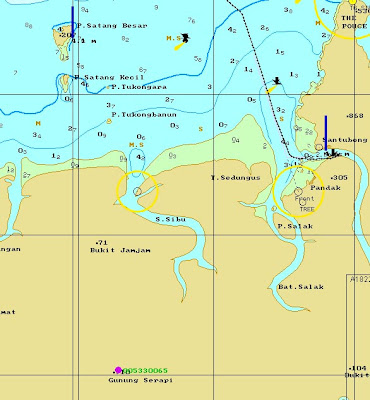
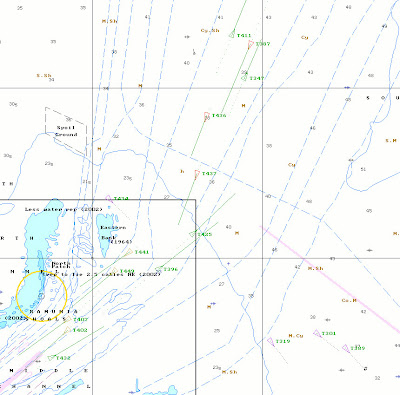
The Singapore Straits is the busiest shipping lane in the world, and the nearby Malacca Straits are not far behind in the traffic stakes. These two waterways provided a strenuous testing ground for our new Comar AIS installation. Our very first test was conducted on a three day passage from Sarawak (northern Borneo) to Singapore. Departing Kuching, capital of Sarawak, we tracked several ships on screen that were well over our visual (and radar) horizon. We also noted a fixed AIS base station on a mountain top near Kuching, reporting itself as being highly accurate in its position. As a newcomer to AIS this puzzled me, however we could see that base station for over 100 nautical miles into the Sth China Sea, so it was a welcome reference. You can see it in this image, the purple dot near the bottom, with its own MMSI number of course.

Travelling from Borneo to Singapore there are not a lot of ships - hence not a lot of AIS traffic and therefore a great signal to noise ratio. In that low noise / low traffic environment our system was receiving and plotting ship locations more than 120 nautical miles away. It was great to know well in advance the traffic that was likely to cross our path. We also noted that military support vessels don't have to run their transponder all the time - we passed within 1/4 mile of a small fleet oiler that didn't exist on AIS - though I'm pretty sure they knew where we were, and we had her on radar for hours. Whilst military vessels have a nominated identity in the AIS world, they don't always broadcast their location, for obvious reasons.

As we approached Singapore the traffic density (and target numbers) increased, and the maximum receiving range fell off. This is a logical consequence of the increased traffic levels, and illustrates how good the system really is - when traffic is dense the closer vessels dominate - which is exactly what we want for effective collision avoidance. In this image you can see vessels arriving and departing the Straits (red & green triangles) plus anchored vessels (purple triangles).

Departing Singapore for Langkawi, we cleared immigration at the Western Quarantine Anchorage. Already we had hundreds of vessels showing on our display, but the software handled things well and it was never confusing - at all times the closest and most threatening targets were clearly visible. In a dense traffic situation (harbour / river / channel) it pays to zoom in close on the chart plotter display screen, so that only local targets are visible - the ones that matter. One hour out we plotted a Class B transponder, the first we'd seen on screen, and watched this small motor vessel cross two shipping lanes and then run past our port side. Despite several hundred Class A transponders broadcasting close by, the Class B vessel was consistently visible. The 30 second reporting frequency of Class B systems was just evident - this was a quick motor boat, and the Class B position updates were just a little lumpy.

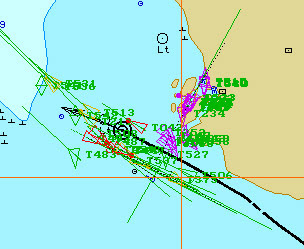
Moving into Malaysian waters we headed north west up the Malacca Straits, estimating three days for our passage to Langkawi. This was our sixth transit of the Malacca Straits, but our first with AIS, and what a great difference it makes. Every large commercial vessel showed up on our chart plotter, giving us very early warning of their speed and course. We habitually stick to the eastern edge of the main shipping channel in the straits, hoping to keep out of the ships way and also to avoid the fish nets and fish traps that pepper the inshore waters. Passing Port Klang has always been a challenge - it's a major shipping port and many ships turn into and out of the Straits channel, but this time it was easy. This image, zoomed out on the chart display, shows the traffic density - we're the black circle and arrow in the middle. Seriously, the traffic just parted for us - ships running up the straits turned early or late and always gave us plenty of sea room - it was very clear that our AIS transmissions were being watched. What a joy. We usually keep a dual lookout in that region, one of us on port and the other on starboard, however this time it simply wasn't necessary - I slept soundly for that part of the passage. Amazingly, in that three day transit the AIS system logged over 2000 targets. That's a lot of ships.

I've always found that most commercial mariners will try to be cooperative if they have the right information - AIS certainly gives them that. More importantly, on most large vessels the voyage data recorder (info here), like the one at left, will securely record your yacht's transmissions - no one can deny your existence. This has to encourage larger vessels to comply with SOLAS rules. The recording of AIS targets is very useful - should your tiny sailboat go missing one day, every big ship that you've passed will have a time and date stamped record of your past position to assist the search authorities. Furthermore, many shore based AIS stations (and there are thousands already in place) will see you as you pass within range and report your position - check it out here.

In my last story I mentioned that the AIS transponder provided a GPS position output in standard NMEA format. It is tempting to think of this as a useful backup to our primary GPS receivers, but think again. It seems that the AIS GPS positions are often fine tuned with differential information broadcast by local AIS base stations (hence that "high accuracy" base station we observed in Borneo). Also, AIS GPS hardware is built to far more stringent standards (IEC61108) than conventional receivers. This means that your AIS GPS system is most likely more accurate than your existing primary GPS in many coastal situations - so you should use the AIS position data as a first preference !

On Crystal Blues our AIS data is received and displayed by our PC based chart plotting software - Transas Navigator Pro. The software displays our vessel, plus all the AIS & MARPA radar targets, as live moving indicators overlaid onto the electronic chart. This is an incredibly powerful tool, derived from commercial shipping software.

AIS is in its infancy, but it clearly has a future on your boat. Thousands of aids to navigation already carry AIS transponders, so that you can see them even when the weather is thick. Some are suggesting that "virtual aids" will soon appear on your AIS display - electronic marker buoys that can be placed rapidly if a new wreck or other danger appears. These can be activated almost instantly by maritime authorities, well before a real buoy can be positioned. And in a distress situation, any commercial vessel can accurately locate Crystal Blues with ease, once within range.

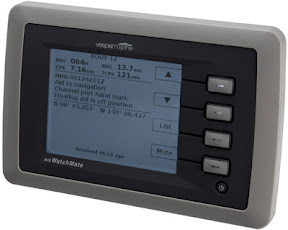
This week I received an email from Jeff Robbins, developer of the highly rated Vesper Marine Watchmate AIS display. The Watchmate is a very simple (low power) LCD screen that interprets data from any AIS unit and displays it essentially the way you need it. To quote Jeff "Watchmate prioritises targets ... the most important collision risks appear first. It also filters the data to eliminate false alarms when operating in harbour or crowded situations. And it has a user selectable "profile", that allows the user to select with a single button their sailing situation (eg. anchored, harbour,coastal,offshore)..."

Phew - Jeff has done his homework, and his display screen seems probably the best way to handle AIS information if you don't already have a compatible chart plotting system, and a very smart way to go even if you do. Of course it works with transponders or simple receivers.

Whilst we don't have Jeff's screen we're pleased with the extra safety and navigational information we receive from our AIS sytem, and even more pleased that the big boats out there know exactly where we are, day and night - rain, hail or shine. AIS transponders are a great advance in safety for both coastal and ocean sailors. Cruising author and boat designer Steve Dashew says of AIS "I would put an AIS B way ahead of most other “necessities” for a cruising yacht, especially when cruising in areas with lots of rain".

Wednesday, 15 October 2008

Refit Week 6 - The Bug Fixes Begin

You might ask who chose that delightful new colour scheme - hey everyone else is ! Truth is, we're six weeks into refit and starting to deal with the "unexpected". That is PVC floor covering taped over the topsides to protect them during the sand blasting. Woops....

Soon after hauling the boat from the water we noticed a reasonable number of small blisters under the waterline - we'd seen them before, as they started appearing about 5 years ago. The last few times I've spent a few days grinding them back and rebuilding the base epoxy coat on the steel. Whilst it only affected small areas, it was a real pain in the ***.

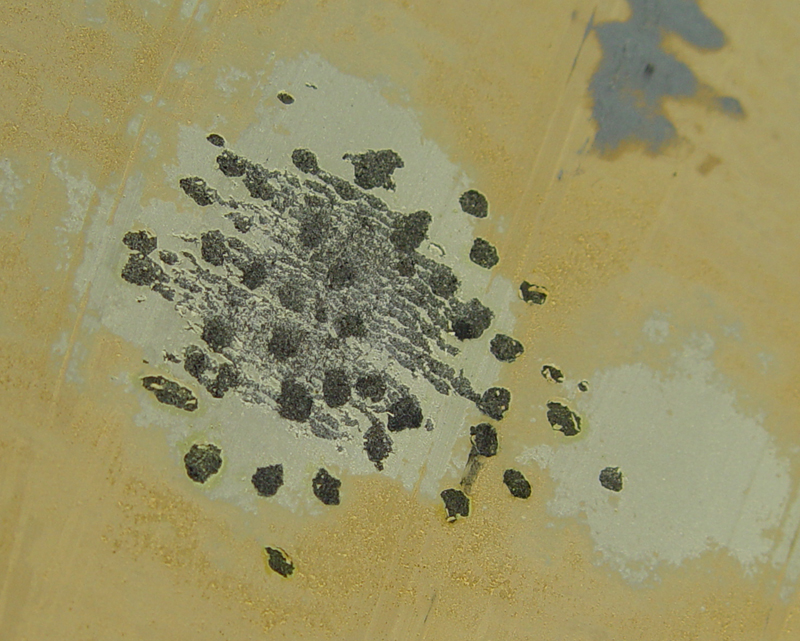
This time things were more serious - they've been breeding ! So we called in Jimmy Watt from Siam Surveyors, a local and knowledgeable marine surveyor. Jimmy scraped a couple back and offered a depressing explanation. It seems that the last time we sand blasted right back to bare metal below the waterline (at Harwood Slipway in NSW), there was possibly a malfunction somewhere - oil droplets were probably sprayed onto the hull, most likely from a leaky seal in the compressor. Where was the oil filter in the line I ask ? These small droplets of oil were effectively propelled onto the steel and then the epoxy coat was sprayed over the top. The result is that the epoxy is now releasing from the surface, where the oil interfered with the adhesion. Its easy to see the splatter pattern of the oil droplets when you look at the partially sanded hull - the blisters clearly occur in obvious groupings.

Some areas of the hull have almost none, whilst in other areas the groupings are depressingly frequent. Coincidentally, we have good friends sailing a beautiful composite hulled yacht whose steel keel has been exhibiting similar blistering. Guess what - that keel was blasted by the same contractor around the same time. Oops.

In the end we decided to sand blast the hull again - something we thought we'd put behind us. Pro-Yachting offered a revised contract price to include the necessary work, and we found we could blast the hull clean here in Phuket for a very reasonable cost. We had no hesitation in accepting the proposal. To minimise the blasting time, the Pro-Yachting team started with paint stripper and scrapers - a team of five guys worked for 2 weeks, working there way through 14 one gallon cans of paint stripper. Back braking work.

For the past 10 days they've been blasting and priming, working their way along each side of the hull and keel. It is slow, dirty, noxious and tedious work, but we're impressed with their dedication and attention to detail. The blasting and priming are now finished - we have one coat of zinc rich epoxy (Jotun Barrier 77) and two coats of high build protective epoxy (Jotamastic 87).

Incidentally, we also asked the surveyor to test and inspect Crystal Blues hull, as she's almost 20 years old now. So Jimmy used his ultrasound testing equipment to survey the plate thickness. He checked all the likely "weak spots" - bottom of the fuel tank, the chain locker, bottom of the rudder, shaft log area, as well as numerous random samples. Whilst he did find two tiny pinholes (welding faults) he also said it was one of the best survey results he'd seen for a steel yacht. Happiness is a sound hull ! Jimmy has also shown us that she's built of Cor-Ten steel, something we did suspect but could not confirm. Cor-Ten steel is a step up from standard mild steel - stiffer and more corrosion resistant - some good news to balance the bad stuff.

Monday, 6 October 2008

Internet Afloat - The Story Continues In Thailand

We've recently posted quite a few stories on the use of 3G, GPRS and Edge mobile data services here in Asia (here, here & here). These are all broadband data services that piggy back on the GSM and WCDMA global cellphone standards. Consequently, if you equip yourself to operate here, your equipment will also operate in almost every other country (you just have to subscribe to a local service provider - buy a SIM card).

Whilst we operated in Malaysia using the excellent DiGi service (it was GPRS) here in Thailand we've purchased a "1-2-Call" SIM card. The service is almost as good - and it costs about the same. For about Aussie $1.00 a day we're getting unlimited internet access - its online all the time. Plus we get a generous SMS allowance as well.

Local testing here in Phuket has proved that the 1-2-Call (Edge) cellular data service is actually faster than the local ADSL fixed-wire broadband service. Yep, for a buck a day we're getting faster and more reliable internet than those who pay for fixed line ADSL broadband. Amazing.

But be careful here - if you subscribe to a service that is over-sold and under provisioned (like Celcom in some parts of Malaysia, and recently I believe Optus in some parts of Australia), your data rate will suffer, and connections will not be reliable. Consequently we look for services that are not over-sold, like DiGi in Malaysia and 1-2-Call here in Thailand. I'm sure its the same in many other parts of the world - large or dominant service providers deliver sub-standard service almost as a default. Oops, did I really say that ?

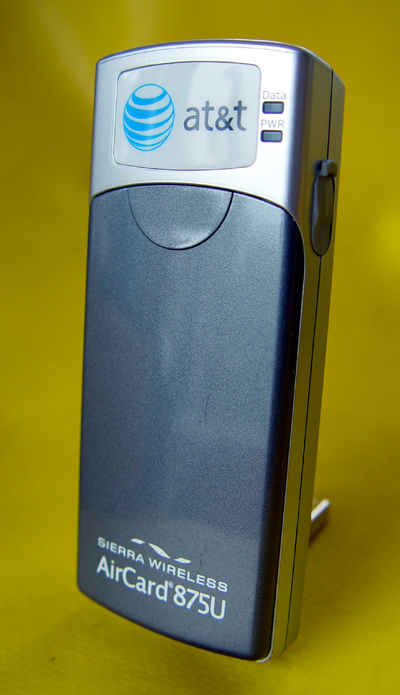
Fact is, even at GPRS or Edge speeds, the service is clearly faster, more reliable and much less expensive than the wi-fi internet services offered by marinas in this region. It really works well here. Since our original post on this topic many have followed our example, and the results have been generally good. Ian & Mona Robertson in Kuching (Sarawak) are now using DiGi (Edge Service) for their second business office, whilst Jon & Pam on SV Tweed are also delighted with Celcom's service in Langkawi. SV Taipan (David & Kris) have also written to say how happy they are. SV Aku Anka (Arja & Glen) in Langkawi read our stories and also made the jump. All these folk are using Sierra Wireless AirCard modems. We're expecting this service to keep working wherever we travel, though with variations in service cost. Right now its the best value internet access around, and it works surprisingly well for a considerable distance offshore.

July 2009 Update / Current model USB Modem is Sierra Wireless Compass 885 or 888.

Saturday, 27 September 2008

Refit Week 4 - Steelwork Completed

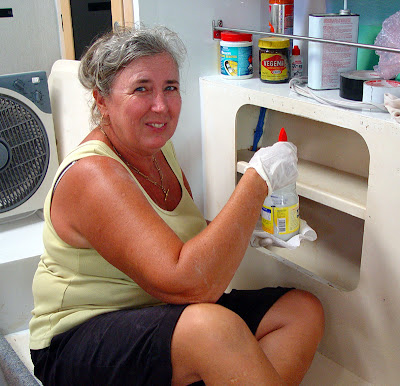
Its just on a month since we sailed into Phuket Boat Lagoon, and three weeks since we hauled out of the water. On deck we've been concentrating on steelwork - changes and additions to improve the boat and reduce maintenance in the future. Inside the boat we've started painting - with the lockers empty its a pefect time. Two coats of Jotun Penguard high build primer and two coats of Jotun Hardtop polyurethane and our old cupboards start to look like new again. As you can see in the photo at right, Ley just loves painting....

The guys from Mr.Nop's stainless steel fabrication business have been working very hard. They've fabricated beautiful new pulpit and pushpit railings and completely rebuilt the stern fuel locker in 316 stainless steel. This area was previously fabricated from timber, which was bolted and glued to the steel hull, and it was always a source of rust and maintenance work. Now its fixed and there forever, and our aft railings run forward past the cockpit for additional security.

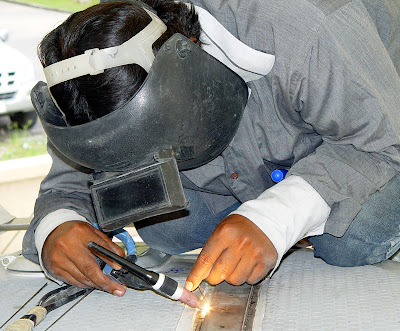
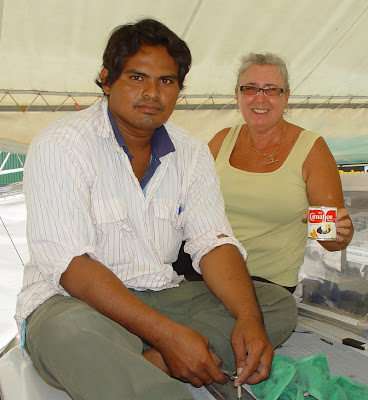
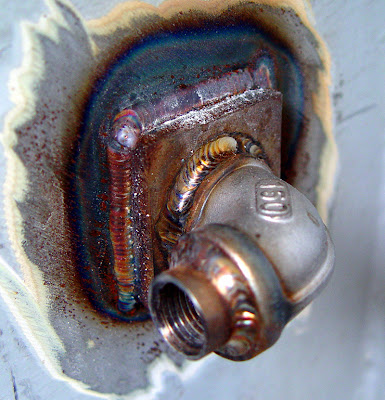
We've also improved a number of the hard point areas on deck, the ones we didn't tackle in our last refit 8 years ago. This basically involves welding thick 316 stainless plates into the deck, drilled and tapped to take our fittings. Because the holes don't go right through its impossible to get any leaks. The plates are faired into the deck and painted over. Last refit we welded shut 210 (!) holes in the deck, and fitted these welded blocks as hard points instead. For this refit the count is only 53, but it still feels good. The tough one was the mainsheet traveller - 24 precisely drilled and tapped holes in a 10x50mm 316 stainless bar, curved to match the roof of our steel dodger. The guys were having trouble tapping into the hard stainless bar, until Ley's father Ray suggested using Carnation Condensed Milk as a lubricant and cutting compound. I'm sure they thought we were crazy when we brought the can out to them, but after the first hole they'd changed their mind - it really works. All the big 316 bar and plate stock has to be ordered from Bangkok, but things happen pretty quickly here and the job is virtually done.

Our PowerDive hookah gear gets a lot of use cleaning the boat, but its often needed quickly if we pick up a net or line on our propeller at sea. Getting the gear setup on deck in the middle of the night at sea proved kind of frustrating, so we're installing it inside the boat permanently. A fixed airline will run to a new stainless stell compressed air socket at the stern - now we can just throw a switch and plug in a hose to get underwater quickly. We've also put in a new stainless penetration for our aft deck shower hose, and added a welded hardpoint for a pasarelle at the transom. The cost of all this is not insignificant of course, but even with Mr Nop's best "creative" margins in play it is great value, and the local workmanship is outstanding.

Tuesday, 23 September 2008

AIS Part 2 - The Installation Experience

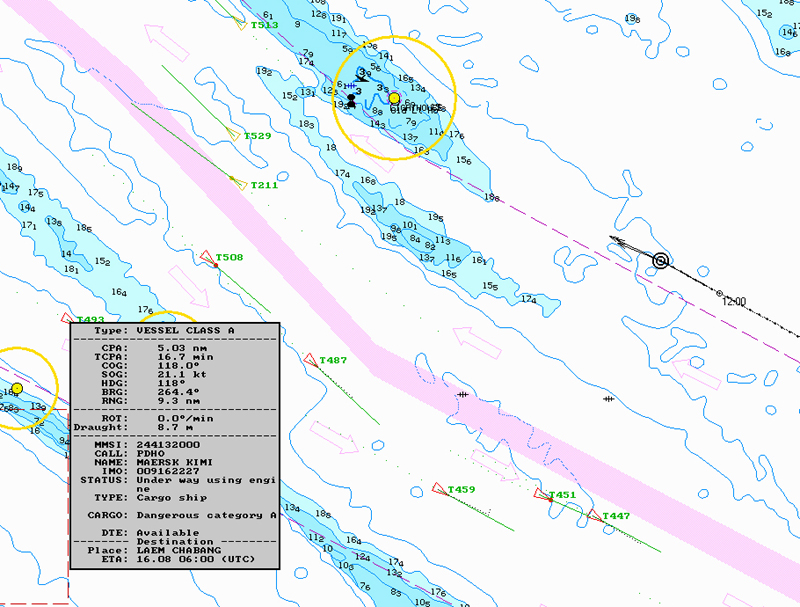
AIS stands for Automatic Identification System, an active primary safety system for vessels at sea. The black arrow in the photo at right, captured from our PC screen, is Crystal Blues. The red arrows (targets) are ships we want to avoid. Clicking on a target reveals the data box seen at bottom left - lots of information on the ship in question (click the image at right to enlarge).

I met a cruising sailor last night who said that my first AIS story (here) was very technical - oops, I guess it is a technical subject. Not sure that I can eliminate the technicalities, but I will try to explain them. First though, an essential technology primer .... I strongly recommend you spend time roaming the excellent PANBO website, specially the AIS pages. Also, here are links for two very informative and useful documents, covering co-axial connectors and co-axial cabling. OK, on with the story ....

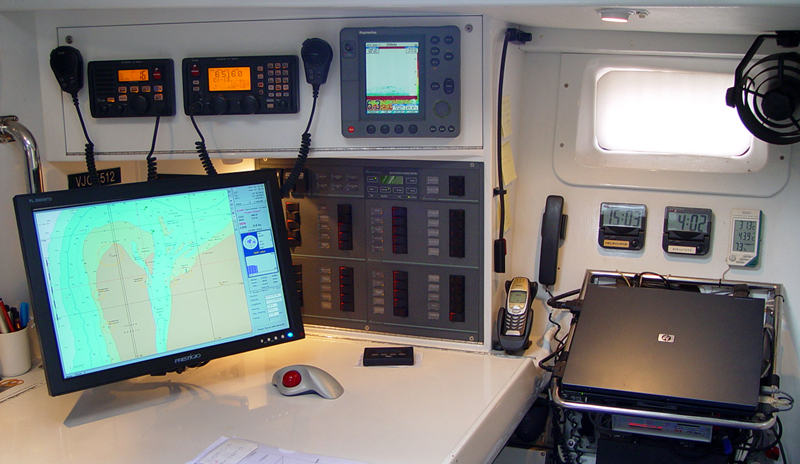
We purchased our Class B AIS transponder from Oceantalk in Singapore - in fact we bought four of them, as several other boats wanted to install the system. The unit is a Comar CSB.200, manufactured in the United Kingdom. It was supplied by Oceantalk with a Shakespeare VHF whip antenna and a Sanav GPS antenna.
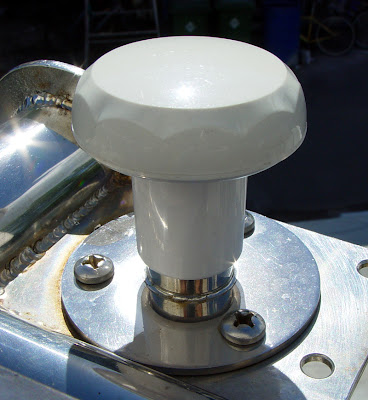
All Class B AIS transponders require a dedicated GPS receiver and a dedicated VHF antenna. No arguments please - if you want this powerful safety system, you have to install the extra antennae. No, you cannot share signals from existing systems, however the AIS derived GPS position information is available to you as a separate NMEA signal, for chart plotting purposes. You'd better plan carefully for antenna locations, bracket positions and cable runs.

The GPS antenna is a simple patch antenna with a low noise amplifier that sends the received signals (as RF) direct to the AIS system for timing analysis - in other words, the external receiver is just an amplified antenna, and all the complex decoding and mathematical computations to derive your vessel position occur inside the AIS transponder. This is a specific requirement of the IMO AIS regulatory framework - it basically ensures that no one can feed fake vessel positions into the system. That is good to know ...
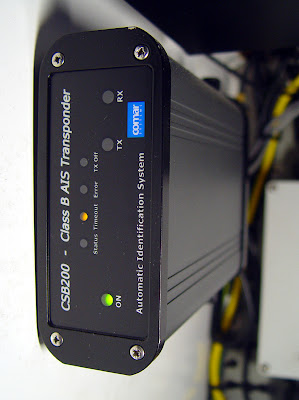
On the VHF side, AIS Class B uses just 2 watts of radiated power to send its reports outwards (the big ships get 12 watts). It is easy to receive signals from big-ship class A systems, however you better pay attention when installing your VHF cables, connectors and antenna. You want to ensure that all of your 2 watts is actually radiated into the ether. Robin Kidd from Oceantalk stressed this point - make sure your VHF cabling and connection work is good. Installation requires the following :

- Physically mount the AIS box. A U-bracket is supplied, but we used industrial strength adhesive Velcro to mount it on a vertical bulkhead (see photo).
- Run the cables for VHF and GPS antennae
- Install and connect both antennae
- Run cable for DC power with a fuse in line
- Run the data cable to the chart plotter/display system
- Terminate everything and then commission the system
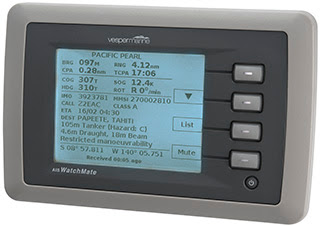
Of course your chart plotter must be compatible with AIS messages in NMEA format to display the targets and information. If it isn't, you can use this very neat AIS display from Vesper Marine, the AIS Watchmate, or a more serious display (with charts) made by Comar, the CSD.200.

Back to the installation. If you power the box from a shared DC circuit breaker (ours is on our navigation instruments circuit) you should include a 5amp fuse in the power feed. Be careful with the VHF antenna cabling - OK, its just RG.58, but you've only got 2 watts to radiate, so make sure you use high quality connectors and fittings.

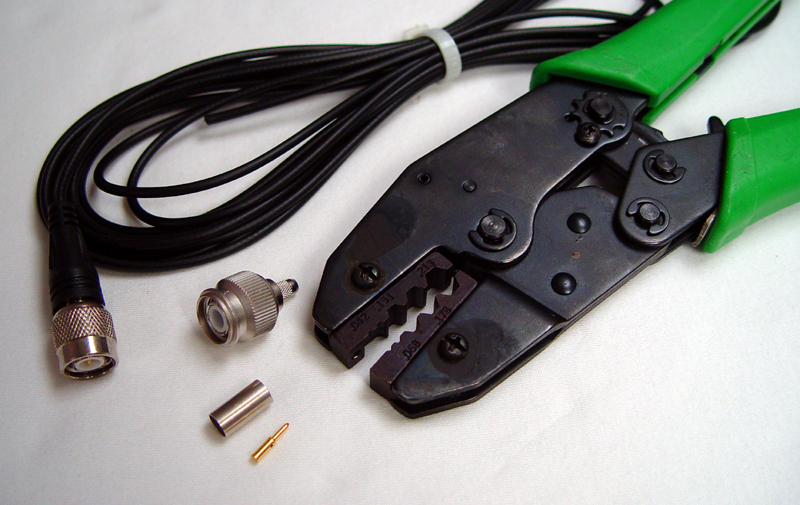
The GPS receiver supplied by Oceantalk is the RV-76, made by San Hose Technology in Taiwan. It includes a nice 10 metre pre-terminated cable. Its very thin, and easy to run through the boat, but it turns out to be RG.174, which has very high losses (attenuation) at these frequencies (1.5ghz). If you use the supplied cable as-is, with its existing terminations, it will work just fine. However if you need to cut, join, extend or splice (as we did), then you'll have to use a more suitable cable (RG.223). After attempting to extend the supplied cable, and getting no satellite signal, we changed to a Bedea RG.223 with Telegartner crimp connectors - voila, tons of signal. We purchased the cable and connectors from Coastal Electronics in Singapore, though similar cable is made by Belden and others. Make sure you use the correct crimping tool (see photo).
On the VHF side, the Comar AIS box will actually measure and report the SWR (reflected energy ratio) on your VHF transmission line during commissioning - you'll soon know if your VHF cabling and connectors are good or not. Click on the photo below at right to see typical values.
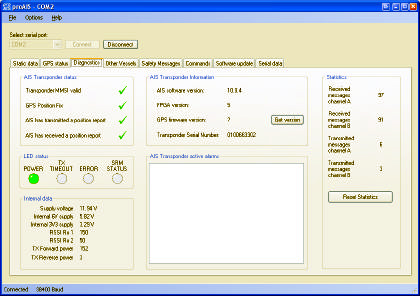
With all that hard work done the rest was easy - plug the box into our PC using the supplied cable and configure the COM port on the PC (baud rate etc) . Then load the Comar software (supplied) and configure the unit. At this point you'll be asked to input your vessel identifier, which is the unique "MMSI number" issued by your National Marine Authority. If you don't have an MMSI number you'd better apply for one now, because you cannot transmit using AIS without one. A Comar Class B transponder will stay in "receive only" mode until you give it your MMSI number. The real trick is that this number can only be entered ONCE by the user - mess it up and you have to send the box back to the dealer for resetting.

I've just learned that Class B systems are FINALLY approved for use in the USA (story here), but that they are not allowing users to configure the MMSI identifiers. I bet that will be fun to administer.... seems the installers or retailers will have to configure the box before handover. The Comar configuration software is simple to use, neat and logical.

So, use only good cables and connectors, get yourself an MMSI number and enjoy the results. Our next story on AIS will conclude the series with our user experiences.

Sunday, 14 September 2008

A Working Holiday In Phuket

Most people come to Phuket for a holiday, but we've come to work - Crystal Blues is here for a major refit. After arriving on August 18, we anchored in Chalong Bay and completed clearance with Immigration, Customs and the Port Captain. Now, four weeks later, that arrival seems like months ago - we've done so much in the past month it's scary. Ley says that it's beginning to feel like real work again - up at 5.30am, breakfast, drive to the boat yard. Of course the drive to work here is a little more interesting than at home in Australia - the local villages, caged monkeys, water buffalo and rubber plantations give this commute a different feel.

Two days after arrival we'd rented a car for six months and were on the road house hunting. Four days later we signed a lease for six months on a large three bedroom home (air conditioned & furnished throughout), in a quiet private estate. Then the fun began - how long would it take to empty the boat of everything ? The answer is forever - we're still not done, though I can say that 95% of the contents were removed in 25 car loads. Half those car loads were filled using the dinghy as transport to shore (it took 2 dinghy trips to fill the car). The rest happened after we moved into the Phuket Boat Lagoon 0n September 4th, where just 3 trolley loads could fill the car. It was messy, hot, sweaty work, but its done.
The ocean tides are big here, which is just as well, as the channel to the marina is dry on the lowest tides ... we motored in on a 3 metre tide but still saw less than 0.5 metres under the keel. They badly need a suction dredge.

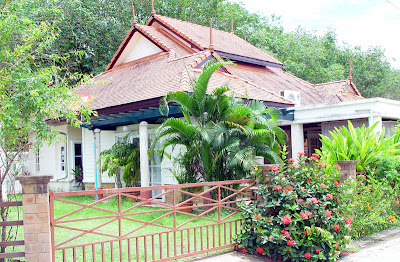
We've been lucky with the rental house (check the photo's here)- besides being comfortable, nicely furnished and "homely", its got a SHED ! It also has shelves, a work bench and even a Gerni (high pressure water wash). So the 25 car loads became 1 house load, which we're still trying to sort out. Seriously though, the house is lovely. Lots of light, space and a garden. The neighbour's dogs have adopted us (Lucky, Blacky, Red and Grumpy), and the locals are friendly as well. There are several good restaurants within a 5 minute drive, all very economical. The boat yard is a 10 minute drive.

We've now started a Picassa Web photo album, so family and friends can see the refit as it progresses - you can view it here.

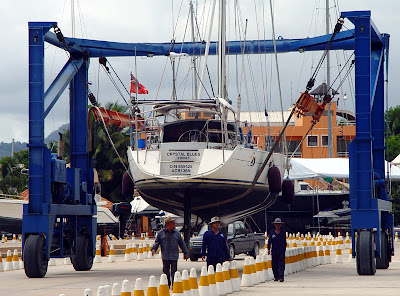
Crystal Blues was hauled from the water last Thursday, September 4. Prior to haulout we'd taken so much gear out of her she was riding over 100mm above her normal marks. The Boat Lagoon crew are really good at this work - Mr Sin runs a very tight ship. They held her in mid-air whilst we disconnected and dropped the rudder out, before expertly blocking her right in front of our contractors shed. Two days later, last Saturday morning, a huge crane truck arrived on schedule at 10.00am and lifted the mast out.

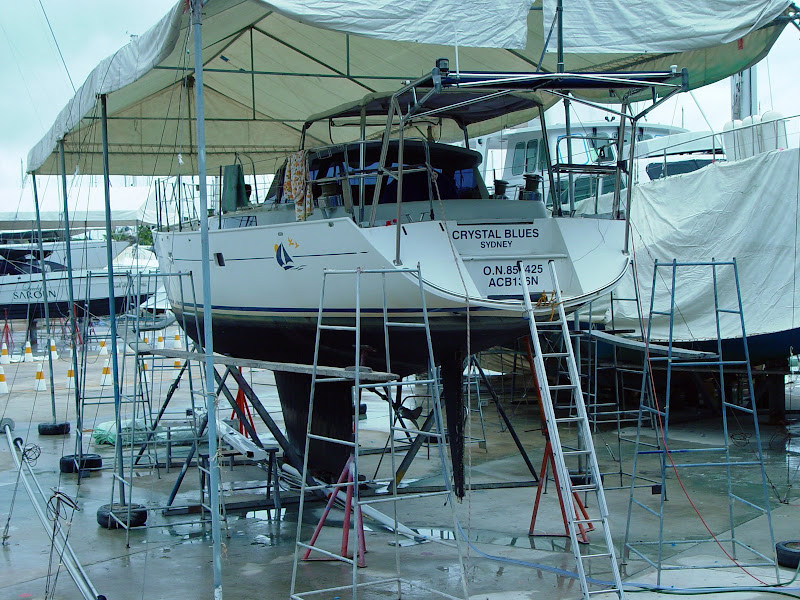
Within an hour the Pro Yachting team had moved a massive frame and tent into position and the boat was covered. Of course not everything went well - we were incredibly lucky that the monsoon rains held back whilst we emptied the boat contents, but the moment we were lifted the heavens opened, and they haven't closed yet. Its raining every day and night. Thank heavens we have that tent over the boat.

And just who ordered these political protests ? No sooner is the boat out of the water than suddenly there's talk of a people power revolution. Politics in Thailand is almost unfathomable - one side (the democratic party) is suggesting democracy be abandoned, whilst the other (the ruling coalition) is determined to re-nominate the prime minister who was sacked yesterday by the courts, basically for corruption. The coalition says he didn't do the country any harm - sure he did, he just stood up and lied in a court of law. Guess that doesn't count if you're a politician. The last prime minister, Mr Thaksin, is now exiled in London. When he was questioned about corruption (by the press) he basically said it was OK because it was everywhere. What a guy.

The political action in Bangkok has left Phuket quite untouched, except for a peaceful sit-in protest that shut down the airport. However last Friday a local friend called early and said he'd heard that the schools might close and that we may lose power if the government workers go on strike. In Phuket no power means no water, as almost all the water is sourced locally from wells. He recommended stocking up on drinking water, washing water and petrol for our portable
generator. So we rushed out and bought two 100 litre plastic containers for washing water, re-filled the water tanks on Crystal Blues, and moved our 200 litre Turtlepac water bladder to the back porch of the house. We now have 1400 litres of fresh water on hand plus 120 litres of petrol in jerry jugs in the shed. We're ready, though I doubt we'll need any of it. The Thai people are too smart to mess with the tourism cash-cow - I'm sure Phuket will remain peaceful.

Over the past 5 days we've stripped the deck of all fittings and have also stripped the winches, tracks and fittings from the mast, boom and spinnaker pole. Mr Sung, the stainless steel expert from Nop Stainless, has demolished our wooden transom fuel locker and re-built it in 316 stainless steel. Next he'll move onto the deck, where we're adding more stainless attachment points and some electrical and air penetrations. The staff at Pro Yachting have been very helpful, every request has been rapidly supported. Right now we're ahead of our program, and very happy with the service here. If only it would stop raining !