Showing posts with label Technology. Show all posts

Monday, 18 June 2018

Dangerous AIS Targets? New Challenges To Safe Navigation

A Busy Waterway, However The AIS Fish Beacons Give Me Great Fears


Heading north around Cape Hatteras a few weeks back, we found ourselves facing a number of targets along our intended course - only some were more dangerous than others. That green target at top right of the image (36870200) was an American aircraft carrier performing incredibly tight turns and circles - but that wasn't the danger. Neither was the fast moving target to the left of our track (the track in black), which was the Captain Caden, a 21 meter fishing vessel out of Barnegat Bay.

FV Handful & Four Local AIS Beacons
The real danger was that tiny cluster of targets on our starboard side - the US flagged fishing vessel Handful, seen here with a cluster of AIS beacons around it (note : this image, and those that follow, is produced by replaying our voyage on our electronic nav system. The target shapes are different when in actual navigation mode). If we zoom in (at right), the picture becomes more clear - one primary AIS target, being the fishing vessel Handful itself, plus a cluster of four AIS fish net beacons floating around her. Fish net beacons, using AIS. Hmm. OK, read my lips. Say after me. This is not good....

The AIS system was devised and built as a safety system for vessels under management. It was not built as an identification system for unmanned, unpowered fish net and long line floats that do not ask questions and cannot correct their course. If the technology is used for net tracking, the targets should display with a clearly different icon or graphic on screen. But they do not. They look just like ships on screen.

The IMO (International Maritime Organisation) has published guidelines for the display of navigation related symbols on screen (read them here) and no fishing target beacons are included. The United Nations Food & Agriculture Organisation has published a draft paper (read it here) on marking of fishing gear, which acknowledges the illegal nature of AIS fishing beacons, but doesn't come down against them.

Thanks to Ben Ellison, author of the excellent PANBO marine electronics blog, I obtained the following information from a US Coast Guard website :

"18. Can I use AIS to mark nets, pots, traps, moorings, or as a race mark, etc.? There are no outright prohibitions to use AIS (i.e. AIS AtoN) as a marker (see Types of AIS and IALA Recommendation 1016 – Mobile Marine Aids to Navigation). However, it is not permissible to do so with equipment intended for use on vessels, (i.e. AIS Class A or B devices), for lifesaving (i.e. AIS SART, MOB AIS, EPIRB AIS), or with devices that are not FCC certified and licensed. See 47 CFR §§ 2.803, 2.805, 2.301, and 80.13 regarding licensing, station identity, and the prohibition to sell, market, or use radio devices that are not FCC authorized (search, Equipment Class: AIS)." It appears then that so long as these devices are FCC approved, they can be used at sea. But are they FCC approved?

So, what has gone wrong? Firstly, Chinese manufacturers have seized on an opportunity to use AIS electronic packages as fish net beacons, though without any approvals from relevant international AIS scheme managers. Secondly, US fisherman keen to track their nets (at  very low cost) have seized on these tools and deployed them, even though they are illegal under US law (my opinion). In fact you can't buy these readily in the USA - you have to order them online through Ali-Baba or one of the foreign web supply chains.


Above is the Ova fishing buoy beacon, sold out of China on the internet for not much over US$100.00, waterproof to 10 meters, and it comes pre-programmed with it's own MMSI number. Wait a minute - how did that happen? An MMSI number is supposed to be a Maritime Mobile Service Identifier - a number that identifies a vessel and an owner and tracks back to the national registration of the identified vessel.

Who ever heard of MMSI numbers being issued by the factory that built the product.... geez. They are supposed to be issued by the country of registration!

Then there are other brands and models - in fact there are so many models that there is an entire market place on the web where you can buy these (illegal) devices. Check out the page at this address. Many are shipped with software on disk plus a cable that allows the user to program the MMSI number - this is completely illegal under US FCC regulations.

Many fisherman, reading this story, will be wondering what the heck I'm complaining about - OK so it's illegal, but where is the harm? In fact it can be said that the fisherman are doing us a favor by identifying nets and floats that otherwise would be invisible to us at night. However until these beacons can be identified easily on screen as floating beacons (and not ships), then I believe that some dangerous situations are being created. Read on for the story on that ....

Saturday, 2 June 2018

Rockets R Us


OK, so the 10.0 knot speed at the top of the screen possibly caught the eye of the boating folk, but that's what happens in the Gulf Stream heading north. However anyone familiar with my dim dark past will smile at the small print on the navigation screen, just ahead of us in this image .... rocket impact area? Yes, we are south east of Cape Canaveral, where Ley and I watched the Space-X launch late last year, and where I watched the last moon shot (Apollo 17) take off back in 1972. Memories can surface on the midnight watch.

Friday, 26 January 2018

Great Guana Key, Bahamas

Community Fish Cleaning Action At Great Guana Cay
Sunshine, clear waters, fresh fish, friendly people - it doesn't get much better. Unless of course you also like messing around in boats, in which case all your dreams can come true here at Great Guana Cay in the Bahamas. I guess it must be a little frantic at peak tourist season, but right now its extra laid back and friendly. We arrived here yesterday after a quick 3 hour passage from Green Turtle Cay, and have settled into the anchorage to sit out the front that is expected later today.  We're in 3 meters of water with 27 meters of chain out, so we're not planning on going anywhere soon.

This morning we took the (fast) ferry 16nm to Marsh Harbor, where the Admiral found a hair dresser and we both searched the hardware and marine stores for parts we needed. That search turned up nothing of value, so we headed back to Great Guana in the early afternoon. This afternoon, before the weather deteriorated, we spent a few minutes testing our new aerial camera system, with great results. Click the play button below to view.


Sunday, 17 December 2017

Cruising The Space Coast

Falcon 9, 1st Stage Burn
Titusville Florida, and nearby Cocoa Beach, are known for their proximity to Kennedy Space Center (KSC). We anchored there with a specific mission - to see a SpaceX Falcon 9 rocket launch at this famous site. There are several designated anchorages that provide great viewing of the launches, however we opted to leave the boat and visit the nearby KSC Visitor Center with friends.

Space Cadet Neil
I was there in 2003, however even that wasn't my first visit. Back in 1972, only 45 years ago, I was there as a student representative for Australia - hosted by NASA, as a guest of the US Government. Back then I was truly fortunate to see the final spectacular Saturn V moon launch, for the Apollo 17 mission. That was an incredibly significant experience, and had all sorts of impacts on my life from that day forward. Yes I built a lot of rockets, had been doing so for many years, we even launched one from Crystal Blues on our wedding day!

So this really was a pilgrimage for me ... and I wasn't disappointed. With the boat safely anchored we arrived at KSC early, and joined the line of excited visitors. NASA provided buses to take us across Merritt Island to the Apollo Center, where viewing stands were available for the launch.

With Admiral Ley I watched the SpaceX launch and the (amazing) powered descent and soft landing of the 1st stage booster section around 8 minutes later. Also amazing is that both the booster and the Dragon spacecraft on top had been flown before (re-usable space craft are here). This launch was a re-supply mission to the International Space Station, flown by SpaceX for NASA.

If you're cruising the Florida coast, don't miss Kennedy Space Center.  It's a fantastic place and NASA do a great job entertaining and educating visitors of any age. If you really want to see a launch, check the launch schedule on the KSC web site. Thanks to Andrew & Carolyn Bellamy for sharing a fantastic day, full of great memories for this slightly older space cadet!

SpaceX Falcon 9 & Dragon Lift Off


UPDATE January 8, 2018 / Watch the SpaceX launch video for Mission CRS13 !


Yes, We had A Fun Day!


Thursday, 16 November 2017

The Next Crystal Blues ?

Crystal Blue, Image Courtesy Rolls Royce


OK, so it's not very likely, but in their wisdom the guru's at Rolls Royce have named their new 62 meter concept super yacht Crystal Blue. The cheek of them. You can read the full story of this amazing design here, note that it's hybrid powered by LNG and batteries, and does't (normally) anchor anywhere - instead, the thrusters linked to a dynamic positioning system simply keep it in place. It's planned to be accompanied by a 42 meter "tender" that will carry the water toys and act as a refueling barge for the LNG. The best part is that it doesn't have a conventional bridge - instead the crew helm the boat from below decks, using a range of sensors and vision systems. Oh joy.

Monday, 30 October 2017

Navionics Is Sold To Garmin, Autonomous Ships Are Here Next Year

In sailing industry news, my most interesting events of the month are these ...

Autonomous Ships

The worlds first autonomous electric powered ship, Yara Berkland, will be in service on the Norwegian coast next year. Read all about it here. She will apparently replace 40,000 diesel truck journeys on southern Norway roads. And quite a few commercial seamen will not be required of course.

Garmin Acquires Navionics

The full release is here, but two days ago Garmin announced they had purchased Navionics. Now we may see the dangerous Sonar Chart issues finally fixed.

It will be interesting to see how Raymarine enjoy having to buy Navionics charts from their biggest hardware competitor.  Ouch, that must hurt.

Sunday, 1 October 2017

Avoiding Hurricane Maria, Working On Electrics


Back in Reedville, Virginia, we secured ourselves to the dock just two days before Hurricane Maria was scheduled to touch the coast south of here. Fortunately she lost some of her "oomph" and stayed well to the south, so we only saw winds of 20 knots or so and little rain.

While Maria blew herself out we decided it was time for a little electrical therapy. Mastervolt had replaced a three year old inverter for us, under warranty, when it started to show signs of not starting our AC refrigeration system. Excellent support from them, as usual. The new unit was delivered to us back in Rockland, Maine, and this was our first chance to swap the old unit out for the new. While working in that (difficult to access) part of the boat I also wanted to replace some of our battery interconnect cables - we had a good supply of size 4/0 (107sq.mm.) tinned wire and all the necessary lugs, so we spent an afternoon making up interconnect cables to measured lengths.

It took us two days to swap the inverters over, upgrade the battery interconnects and also to replace a bilge pump sensor switch. That was just long enough for hurricane Maria to bounce off the coast and head away from us.

Right now we're preparing for the boat to stay here while we head off on our road trip, so we're checking all the bilge systems, shutting down and preserving the watermaker, servicing essential equipment etc. In case another hurricane sneaks in we've doubled up on all the dock lines and removed both the furling headsails and stowed them below.

We've been warmly welcomed back into the local community, the weather has also remained warm (at least in the daytime) and the social life has been great. Importantly, we're getting a good share of "dog time", walking the neighbours dog and even graced with a visit from our favorite sailing dog, the lovely Flaco, who as you'll see below is very interested in all things "boat". 

Three Boys Looking - Image By Chris Burry

Sunday, 3 September 2017

Navionics Sonar Charts & The Missing Reef

Part Of The Keel Damage
Early on August 9 we departed Potts Harbour, heading for Booth Bay, Maine. Leaving the anchorage we collided with a submerged reef, bringing the mighty Crystal Blues to an instant stop from around 5 knots. Ouch. Our first computer assisted grounding!

Fact is, we were lucky.  The mast and rig stayed up, the hull was not breached and the damage could be repaired fairly simply. However a boat built less heavily would have been in severe trouble. The story that follows is intended to serve as a warning for others, to help prevent further accidents. So how did it happen ?

First off, I made the mistake of trusting Navionics Sonar Charts, which I'm unlikely to do again. Secondly, I failed to check any secondary navigation aids or references. So with more care I could have avoided the reef. Dodging lobster pots, early in the morning, I was busy at the helm and trusted the charts that had brought us into harbor the afternoon before. Never again...

It's ironic that I was actually looking at the charts (on the iPad) as we connected with the reef - when Ley stumbled up the companionway and I picked myself up off the wheel, we both looked at the chart on the iPad - it showed over 13 meters of water depth. Wrong. In fact very wrong.

Crystal Blues was at that point bobbing on the gentle swell, afloat, but occasionally colliding with the reef on the bottom of the swells and occasionally hitting something as she rocked from side to side. Not wanting to start the engine in unknown waters, we lowered the dinghy and towed her away to deep water using the outboard motor. We lifted the floor boards and inspected the bilges for damage or leaks, and then (more than a little shaken) proceeded to Booth Bay, where I dived on the boat and captured the image above.

Pulling Away From The Reef

So now, over three weeks later, we're hauled out of the water at Journey's End Marina in Rockland, Maine, working towards repairing and refinishing the keel. In the time since the accident both we and others have had time to look at the Navionics charts for the area in some detail, and the results are not good.

The Missing Reef

First of all, this problem has nothing to do with zoom levels on the screen. No matter how close in you zoom, that reef was not shown. So here is what we were viewing on screen right when the collision occurred :


With the wisdom of hindsight, it does look weird. The yellow line is our track, and it shows just over 13 meters where we came to a sudden stop. When we checked the standard Navionics chart (not the Sonar Chart version), a serious chart error became apparent :


You can see that this version shows a depth of 5.4 meters nearby, and the dark blue zone adds to the message that we shouldn't be there. However it gets worse, much worse.


The official government chart, above, shows a minimum depth on that reef of less than 1 meter. Yoiks ! So, not only the Navionics Sonar Charts were wrong, but also the "standard" Navionics charts.  How can this be ? How widespread is this problem ?

Wednesday, 2 August 2017

Boating On Steroids - An Electric Foiling Speed Boat

Seen here during testing on Bristol Harbour, this appears to be a prototype high speed foiling power cat. We did see her rip across the harbour, silently, late one afternoon in the fading light. When I approached the crew later they were unable to talk about the vessel at all, except to say it was an "electric speed boat".

The presence on the dock of a technical support vehicle from Goetz Composites shows that these are serious structures - Goetz have built 10 Americas Cup challengers and defenders, and have been involved in 5 Volvo Ocean Race (Whitbread) campaigns. Ironic that the testing of this high tech vessel was taking place right in front of the Herreshoff Museum, where the boats of the Americas Cup legend were originally created.

Reliance & Shamrock III, USA Library Of Congress Image

Sunday, 30 July 2017

220 Volt Boat Systems, In A 110 Volt World

Charge Master Multi Voltage / Multi Frequency
Sailing the Eastern Coast of the USA for the past couple of months, we've learned to be careful with our AC power management.  Crystal Blues is of course a 220volt /50cycle boat, basically incompatible with the 110volt/60cycle power supply typically available in the USA.

We have friends who plugged in to local shore power this year, thinking all would be well, only to find they destroyed a set of house batteries in just a few days - the battery charger was not actually charging. Other friends blew up a perfectly good air conditioner. Both boats thought the dual phase 220 volt service that many US marinas offer would be OK - an expensive mistake. It's actually two phases of a 110 volt service, without a neutral conductor (which is kind of dangerous) and it runs at 60 hertz - be real careful with that.  Even a transformer won't save the day - sure it can convert the voltage, but does nothing to correct the frequency problem.

So the number one item for sailboats cruising in the USA, Caribbean and South America, is a battery charger that will deal with all voltages and frequencies. We upgraded ours specifically for this task, when we arrived in the Caribbean. This allows us to keep the batteries charged from shore power whilst at the same time running the systems on the boat from the inverter. More detail on that topic in a recent post here.

But what happens when something fails - when a frequently used electrical device stops working?  Traveling north through the Caribbean I worried about our microwave oven, which was starting to make nasty noises. So we replaced it in St. Martin, almost the last place (heading north) with 220volt 50 cycle appliances for sale. I definitely did not want to have it fail here in the USA, where I could not replace it.

A Quiet Beer To Celebrate The Installation!
Then, as we cruised through US waters, we were dismayed to hear warning signs - bad noises again - coming from our washing machine. Now we were in trouble!

However our friend Steven Shaw was absolutely sure we'd find 220 volt / 50 hertz products for sale in the USA - check the internet he said. Sure enough, we came across a supplier who specialises in 220 volt / 50 hertz products, based in Illinois. 220 Electronics had four different washing machines in stock, one of which was a perfect fit in the space we had available.

It was ordered last week, arrived on  Monday and is now installed and working - I'm pleased to say the Admiral is a happy lady again. The folks at 220 - Electronics have everything from power tools to refrigerators, kitchen appliances and gensets, all running 220 volt 50 hertz, and they ship anywhere.

Saturday, 6 May 2017

LED Lighting Goes Beserk

Super Yacht Savannah Lights Up The Harbour, Nicely


This year in the Caribbean I've often been delighted, though more often offended, by the incredible displays of light pumped out of sailing and power vessels at night time. It seems that the energy efficiency of LED lamps has launched boat owners on a new quest to throw light into the water and the sky.

While Savannah did it in a classy way - a silky curtain of white light below the waterline, in a perfect 360 degree arc around the vessel - others were less tactful.

This catamaran owner obviously spent a lot of money installing a large number of LED lights, however the color scheme was kind of  off-putting, or as cruising friends said, "Oh Puke"! It would be cheaper and more honest to simply paint the side of the boat with "Look At Me!".

While the big boats lead the pack in this new trend, even smaller cruising vessels are starting to compete. In Trinidad we berthed next to an older Beneteau 37, a lady of a "certain age", that had applied new make-up. She had (wait for it) blue underwater LED's in an arc around the stern, plus recessed LED strip lighting along both sides of the salon, which changed color every minute or so. Yep, one minute the interior was green, next minute it was red, then blue and so on - all it needed was a shiny pole and some dancers to complete the picture. Please, spare me.

OK, enough griping - we're off to Cuba today, 570 nautical miles West North West and downwind all the way, we hope. Our next post should come from Puerto De Vita on the north coast of Cuba, if we can find some internet there.


Tuesday, 25 April 2017

Carriacou to Martinique - Assisting French Customs Along The Way


French Customs Patrol Boat


Two weeks ago we sailed out of Tyrell Bay in Carriacou, heading for Martinique, looking for our first taste of France in the Caribbean. It was a 24 hour passage, covering some 130 nautical miles, and involved a mixture of spirited sailing, and flat calms requiring the engine to keep us moving forward.  We sailed right past the Tobago Cays, Mustique, Bequia, St Vincent and St Lucia - many wonderful anchorages - however life just isn't long enough to stop at every island and we're still on a mission to reach the USA before the end of May. Equally, we're careful about personal security and were committed to bypassing St.Vincent, among others (St. Vincent is responsible for more than half of all security incidents involving cruisers in the Caribbean area).

The Vessel Of Interest- Click The Image To Enlarge
Approaching Martinique we were over-flown by a patrol aircraft, then an hour or so later a very beautifully presented patrol boat (so very French) approached us at speed and asked our intentions. They sat on our stern quarter while we worked our way through the basic identification tasks for the vessel and crew, established our intentions as tourists in Martinique and as bona-fide cruisers for the past 12 years before approving our approach to the island and wishing us a good day.

Their final question was to ask if we has seen any unusual boat activity in the past few hours - which we had. I explained that we had observed a small trimaran on a reciprocal course (it was heading south) that seemed to be badly handled, with sails not trimmed properly and steering a little wildly.  They were immediately interested and asked for all of our observations, timing, position etc. - it was clear this was a vessel they were looking for. I explained that the vessel was transmitting its position via AIS, and that as our navigation system logged all targets and data I could replay our course and establish its last known position received by AIS.

Now they were really interested and offered to stand by while we shut down the Transas navigation software and re-booted it in playback mode, scanning for that vessel and event. It took 10 minutes but we were eventually able to give them an accurate last known position, course and speed for the offending vessel, after which they thanked us profusely and steamed on their way. We're not sure what was going on, but were sure happy to help.

Arriving in Fort De France a few hours later we anchored in 4 meters of water, close to the old fort on good mud holding ground and found ourselves right in the heart of town - what a joy! The French had provided a nice dinghy dock on the bay promenade, and it was literally only 50 meters to the first coffee shop and restaurant. Oh joy, welcome to France.

Tuesday, 18 October 2016

Shore Power Conversion & Electrical Ramblings

Lifted out of the water and propped up on the hard stand here in Trinidad, we find ourselves for the first time having to deal with 110 volt / 60 hertz AC power. Yes, we're in a USA influenced part of the world, but Crystal Blues is a 220 volt / 50 hertz vessel. It's been kind of amusing getting things sorted out, without blowing anything (or anybody) up. Most amusing is the fact that right now we have three (yes three, count 'em) separate shore power cords connected to support our quasi-camping life style here on the hard stand.

Three Different Sockets, All 60 Hz, Some 2-Phase 220v.
First, The Shore Power Supply

Our regular shore power lead is now plugged into a 30 amp 110 volt 60 hertz supply. On-board the boat, this is passes through a Mastervolt Ivet-C isolation transformer to raise the voltage to 220 volts, though it is still at 60 hertz frequency. The transformer provides voltage matching and isolates us from the marina electrical ground system.

Most of the time we can operate from this shore power supply, as (surprisingly) much of the equipment on-board is quite happy with a 60 hertz supply.  We can use our battery charger, power tools and vacuum cleaner, home appliances, hot water heater, media and computer equipment, all without problems.

Only the galley microwave, the refrigeration and the boat's central air conditioning will not run on 60 hertz. This is not a big problem right now - when we need to use the microwave we switch over to the inverter and run it off the batteries. The refrigeration and central aircon are both sea water cooled, so they cannot be run while we are out of the water anyway...

Second, Real Time Conversion

Our second connection is direct to the battery charger only.  In the long term, once we are back in the water, most of our needs in this part of the world will be met by the real time conversion process.  Shore power will go only to the Mastervolt Chargemaster 100 amp battery charger. That charger works from almost any shore supply frequency to feed the batteries up to 100 amps of (nominal) 12 volt DC power - this equals happy batteries.

At the same time, the Mastervolt Mass Sine inverter uses this DC supply to create a clean 220 volts / 50 hertz sine wave power supply (at up to 2000 watts) that will run most of the boat's systems. Once we're out of the boat yard, living afloat again, that process allows us to run even our big water cooled refrigeration compressor - the inverter starts and runs that compressor easily. In fact it will also run the central aircon, but I do feel guilty even contemplating that type of decadence at sea. Also a little embarrassed to admit that I've even tested it (which I have) ... but then again, a Tesla car runs air conditioning from a battery supply - why shouldn't we do the same ? Maybe when our batteries are bigger.

At this point we should really give thanks to Bob Wisniewski who initially opened my eyes to real time conversion and who clearly simplified our life in the 60 hertz world . Back in the year 2000, when we were refitting Crystal Blues for the first time, Bob owned and managed Power Protection Solutions in Queensland, Australia. We wanted to buy a new (single combi unit) Mastervolt Inverter/Charger from him, but Bob asked me some pertinent questions and then recommended against it.

He said that if we were staying in the Australian / Pacific / Asian region then a single unit "Combi" Inverter/Charger would be just fine. However, if we planned to cruise further afield, entering the area of 60 hertz power supply, then installing a stand alone inverter and a separate charger would serve us better - and he's right. Real Time Conversion keeps our systems running at all times, and we don't need to worry about the voltage or frequency of the shore supply. So a big thanks from us to Bob Wisniewski, whose vision is keeping our beer cold in this 60 hertz world! Note : Bob is now working with BLA in Queensland, the current Mastervolt distributor in Australia.

Third, The Air Conditioning

It is damn hot here. Power cord number three is for a rented A/C unit, provided by the boat yard, that operates on that quaint 220 volt dual phase 60 hertz system that pollutes US society.  It has no neutral conductor, so is considered kind of dangerous by us purists. It should be protected by dual pole circuit breakers at all times, but you can guess correctly that it rarely is in practice. In fact the power supply poles here do not have any circuit protection at all - no breakers, no earth leakage devices at all - yoiks. So the boat yard provides the AC unit to sit on the deck, a fiberglass housing to direct the cool air down below and the necessary 220v / 60hz cabling. That's cord number three, keeping us cool while out of the water, but definitely not plugged into the boat thank you very much.

Sunday, 25 September 2016

Compass Installation Made Easy

Recently I came across a cruising sailboat with a beautiful new compass installation - problem was, it just didn't work. The compass had been installed in a location where the local magnetic interference was very strong, consequently the compass readings were sadly inaccurate.

A boat's compass uses the earth's magnetic flux to drive the floating card - any local magnetic forces can distort or even dominate at the compass, ruining the compass accuracy. Loudspeakers, engine blocks, electric motors, electric cables and the like can all distort the reading and in the case of steel boats the hull also has an effect.

We faced similar challenges when positioning our Raymarine EV-1 Sensor Core. This unit contains a fluxgate electronic compass, a multi axis solid state gyro and a GPS receiver.

The Sensor Core is the real intelligence that drives our autopilot system - it was important that we found a satisfactory location for the unit - the same goes for any magnetic compass. Raymarine's installation guides said it should work fine where our previous electronic compass was mounted, but we wanted to check alternate sites. In the end we measured the lowest magnetic flux field right where the old compass was mounted - out on the stainless davits mounted on the stern. Unfortunately this meant running the STng network cables another 10 meters through the boat and out onto the davits, but that's another story...

Multi Measures App

To test possible compass installation locations we used two software tools that run on the iPhone / iPad operating system. Multi Measures, by Skypaw, is an app that includes a basic Tesla meter - it graphs the field strength and gives x/y/z orientation for the magnetic flux field.

Incidentally, Tesla is the name for a measured unit of magnetic flux density, named after Nikola Tesla, a Serbian - American physicist and engineer.

What makes a good Sensor Core or electronic compass location ?  It should ideally close to the vessel center line, with access for the required network cabling and with a decent view of the sky so the internal GPS can operate. However the real driver here is lack of magnetic interference - that's the fundamental requirement.

Using the Multi Measures app we were able to wander around the boat, watching the display in real time and testing all the possible installation locations. When testing each location its a good idea to operate all the boats electrical systems, to make sure that no interference is generated when say the genset is started or when the water heater is switched on. The Multi Measures app also includes a tilt measuring function, truly useful for mounting things horizontally or vertically on boats that often have no useful reference lines.

Gemeco Marine Installers App

We also used the very capable Tesla meter included in the iNstall marine installers app by Gemeco. The Gemeco company distributes a wide range of marine electronics and NMEA network products in the USA, so this app is clearly aimed at marine electronics technicians.

iNstall includes a generous number of tools, references and calculators to make marine electronics installation a little easier - transducer details, cable sizing tools, tilt measurement and a "mix'n'match" guide for sorting out product compatibility.

The Tesla meter within the app allows you to zero the meter scale once a background level is established, then see the differences as electrical systems or machinery are activated.

Sadly for us, these handy Tesla meters proved that our inspired "alternate location" choices were not so good after all, and the Sensor Core ended up installed back out on the davits, where it works just fine.

Friday, 20 May 2016

Things That Work For Us #8 - Ultrasonic Antifouling

Ultrasonic Antifouling - Two Years On, The Results Are Excellent

In May of 2014, we installed a new Ultrasonic Antifouling system, hoping to reduce or eliminate the problems we had been having with barnacle growth on the hull and inside our water inlets.

At the time we reported on the system installation, and covered some of the basics of barnacle breeding, with the help of marine biologist Glen Burns - read that story here.  We also covered a high tech barnacle removal tool - the story is here.

I should explain that we like to sail for at least two years between each haul out, where possible. This saves us quite a lot in boat yard and paint costs. So Crystal Blues was last hauled and painted with anti-fouling paint back in October 2014.

We applied four coats of our favourite antifouling paint, Jotun Sea Force 90, rolling it on over three days. We added a fifth coat to the leading edges of the keel, rudder and skeg, and around the waterline. That paint system is now 19 months old, and we've covered over 9,000 nautical miles since it was rolled on - quite some distance for us.

At this point the biocides in the paint system are just starting to let us down - the slime on the hull needs to be wiped every month, and green seagrass is now starting to grow where sunlight penetrates the water depth.

HOWEVER THERE ARE NO BARNACLES.  NONE.

Back in Cape Town I paid the local divers to clean the hull - the water there was way too cold for my 3mm wetsuit - and they reported that it was in very good condition, finding only three (3!) barnacles.

Here in St. Helena, where the water is a balmy 23 degrees, I dived to clear some fouling on our folding propeller, and found that the hull needed a wipe, but no barnacle scraping at all.

This is a major improvement for us, as previously we fought a constant rear guard action against barnacle growth on the hull and in our sea water intakes. The raw water intake for the refrigeration, aircon and genset systems had been specially problematic, frequently clogging with extensive barnacle growth. Since installing the ultrasonic system we haven't had a single incident of barnacle clogging.

I'm sold - the package is compact, doesn't draw much power (half an amp at 12 volts) and requires absolutely no maintenance. The only thing I have to remember is to turn it off at the DC switchboard before I go diving under the hull - it does generate some audible harmonics underwater that are quite painful when you get close to the transducer location.

Follow this link for details about the system we have installed, which is sold by Ultrasonic Antifouling Ltd in the United Kingdom.

Sunday, 1 May 2016

Another One Bites The Dust

Day 7 of our passage north west and we find ourselves prompted by yet another song title - yes, another one bites the dust. This time it's our HF/SSB radio that is refusing to function.

So with Ley's help I've removed the control head, stripped and checked that (we had previous issues with a sub-standard repair), then removed the transceiver and double checked all the connections.

No obvious issues found so far. Tomorrow, when the swell abates a little, I'll move into the back of the boat and check the antenna tuner and it's connections.

Crystal Blues is more than half way to St. Helena now, with (just) 825 nautical miles to run. Sea conditions have grown big again, with an objectionable 2.5 meter quartering swell hitting us on a 7 second period. This makes movement, day to day activity and even sleeping a little strenuous and tiresome. Ley is continuing to produce gourmet food, so we're eating very well. However we are definitely looking forward to some tropical sunshine and warm weather - four days of grey sky's and rainy conditions have taken the shine of the south Atlantic !

The shine has also been missing from our solar panels - on this north westerly course, with the winter sun already well to the north of the equator, our sails are blocking the sunshine even when the clouds are not. So we're getting very little energy from the solar system, and the Northern Lights generator is doing extra duty.

Friday, 22 April 2016

Lubrication 101 - Use Something That Doesn't Damage Things ....

More than 12 years back we were shown just how incredibly slippery McLube Sailkote dry lubricant spray really is. However the spray can doesn't detail the contents, and we didn't want to use anything with silicon on a painted deck, so we chased down the manufacturer for details.

Eventually, in a late night call from Australia, I spoke to an engineer in the USA, who explained that the contents were actually chemically milled, microscopic teflon ball bearings, floating in a propellant that evaporates completely.  When you spray on McLube Sailkote, the micro ball bearings stick to the surface using static charge only - sure they eventually get washed away, but they last long enough to be amazingly beneficial.  The great thing is that they don't gum up the works - ever.  There is no build up of wax or chemical gunk to attract salt, moisture and dirt.

Looks Pretty, But It Doesn't Roll Anymore
On Crystal Blues this means we spray-lube the mainsail track once or twice a year, and Ley can hand haul the mainsail almost to the top without even using a winch. It is amazing stuff.

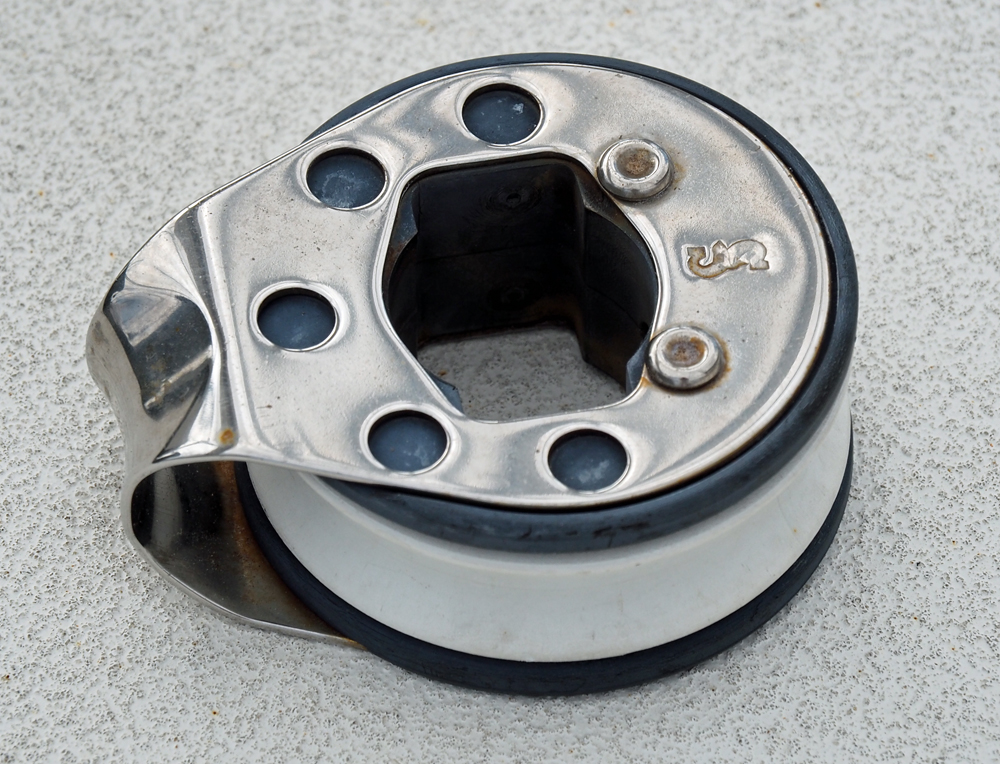
We also used it on our Schaefer "Clear-Step" sheaves, that manage the furling lines on deck.

Around five or six years later the Schaefer sheaves started to jam up, and no amount of cleaning or lubrication would get them to work under load.  I could spin them easily, though they sounded a little noisy - it was a mystery that even Schaefer themselves could not solve. This lead to us replacing them with an alternate product here in Cape Town, at reasonable expense to our boat budget (and that's another story).

Here in Cape Town we spotted a new McLube product called One Drop on the shelves of the distributor.  The technical representative there explained that the new One Drop liquid product was for "things that turned, including any product that used ball bearing races". The older spray product, he said, was specifically for things that slide.

He went on to explain that the original SailKote spray is just so extremely slippery that it can cause problems in ball bearing systems - the ball bearings actually skid along the surface, instead of rotating as they should (!).  This can lead to flat spots and failure of the ball bearing system.

Suddenly, we know what had happened to all our older Schaefer sheaves - all that fresh water washing and lubing with SailKote had actually created flat spots on the ball bearings.  We can see why the new McLube One Drop liquid product was developed - they needed a product that worked with ball bearing races.

We'll continue to use SailKote spray on our mainsail track, as the Antal track uses carbon faced fiber slides, rather than ball bearings.  But our turning blocks will all receive the One Drop treatment from now on.  Sailkote is ONLY for things that slide...

Ship Causes Traffic Jam In Cape Town

AQUASHIELD II Being Delivered For Launching
They do build a lot of boats here in Cape Town - over 200 catamarans are exported every year by local builder Robertson & Caine alone.

This high speed patrol and supply vessel is one of four built by Nautic Africa for the oil industry in Lagos. 36 meters in length, she runs fast at 35 knots, driven by three MTU diesels. Yesterday she traveled much more slowly, stopping traffic at a leisurely walking pace for her 2 kilometer ride to the water.

This was her first voyage, from factory to launch, on the ship lift in Cape Town harbour.  The self propelled carrier is hydraulically driven and remote controlled, with the "driver" walking alongside.  No less than 64 big wheels spread the load on the road.

Our friends here at Associated Rigging, who recently re-rigged Crystal Blues, also benefit from these commercial projects - they supplied the swaged life lines and gates for these vessels, in 316 1x19 wire.

Tuesday, 19 April 2016

Family Memories - A Unique Anemometer

Ley's father, Ray, was a toolmaker, machinist and engineer - there really wasn't much he couldn't build or repair. My own father says that Ray had a tool for every task, no matter how unusual.

During our recent visit home we were given some tools and measuring instruments from Ray's workshop, among them this lovely anemometer.

Opening the wooden case I really wasn't sure what to expect, so the brass and alloy instrument was certainly a surprise. I think every sailor is habitually fascinated by wind speed - it is the one thing we dwell on for many countless hours of our lives.

Nowadays, the very latest wind instruments use ultrasonic measurements to track wind speed, however I don't think that even the modern instruments could match this one at the low end of the speed range.

I really only have to blow on it very gently to generate readings on those dials, which all seem to be working. An amazing instrument, though not one likely to survive at sea.  We'll keep it safe and dry on land.