Showing posts with label Military. Show all posts

Saturday, 2 June 2018

Back In The USA , Its Springtime Cruising


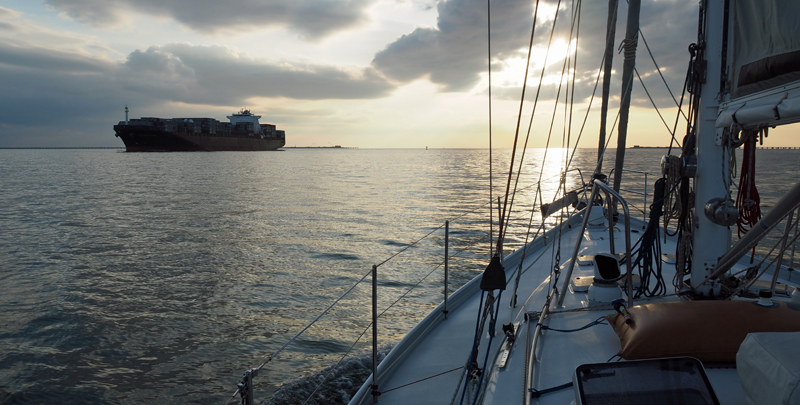
Arrival At Sunset, Chesapeake Bay


778 nautical miles later, we arrive in Norfolk, Virginia, after a very quick (3.5 days) transit from Great Sail Cay in the Bahamas. For the sailors reading this, that is an average of 9.26 knots. Of course we had 3 to 4 knots of lift from the Gulf Stream current for some of the passage, but we were pleased with our sailing speeds never the less. Cleaning the hull underwater, before we departed, also helped quite a lot.  The passage was completed with about 80% of the distance under sail, so not too much motoring.

Approaching The Sea Buoy Off The Chesapeake Bay Entrance
The warm weather had followed us north, so we sailed into harbor in shorts and not much else. After anchoring overnight we moved into a commercial marina berth the next morning, to allow for the necessary inspection by Customs & Border Protection

The clearance process here was simple and friendly, unlike the fairly shabby treatment we had received in Charleston the previous year. Next day we visited the Customs offices to obtain our 12 month Cruising Permit, and with that last piece of paper in place we could relax - we'd officially arrived.

In our approach, our first time here, we passed the enormous US Navy ship yard complex that stretches out along both sides of the river - a spectacular statement about US military expenditure - there were more ships here in just one river than in the entire Royal Australian Navy.


Thursday, 19 May 2016

The Emperor Napoleon & Fine Wine In St Helena

St Helena's most famous resident was Napoleon Bonaparte, exiled here by the British after his final defeat at the battle of Waterloo. He was sent to a converted farmhouse known as Longwood, a damp residence in the wettest part of the island, which he constantly complained about. With his small entourage he lived there until his death in 1821.

Longwood House is now owned by the French Government, along with several other key locations associated with Napoleon's time here. We took a guided tour of the restored house, accompanied by a knowledgeable local guide. It is kind of spooky to be in the room where he died, then where he lay in state, then where his autopsy was conducted.

I was more interested in the wine cellar, now a simple gallery of paintings and drawings from the period.

There is some controversy surrounding his death, with some claiming he was poisoned, while the autopsy concluded that he died of stomach cancer - as did his sister and father.

Whatever the cause, he certainly enjoyed fine wine - he had a standing monthly order for 18 liters of Vin De Constance, an intensly beautiful desert wine made in the hills above Cape Town.

Our good friends on the catamaran Ceilydh gifted us a 500ml bottle of the wine, which is still in production and is still winning awards. We shared the bottle with the Ceilydh crew after dinner in the anchorage, accompanied by sauteed and flambeed local bananas, saluting the Emperor and acknowledging his very fine taste in wine.

When he passed, Napoleon was interred in a beautiful valley that is also now a significant monument owned and administered by the French Government, despite the fact that his body was removed and re-interred in Paris some 20 years after his death.

The entire saga of his defeat, imprisonment, eventual death and associated controversy has made the Emperor Napoleon one of the islands biggest tourist attractions. For many it is an emotional pilgrimage - we visited Londwood House, and the grave, with French cruising sailors who were very moved and grateful to see something so significant in their national history.

The Emperor Napoleon's Tomb In St. Helena

Friday, 22 April 2016

Ship Causes Traffic Jam In Cape Town

AQUASHIELD II Being Delivered For Launching
They do build a lot of boats here in Cape Town - over 200 catamarans are exported every year by local builder Robertson & Caine alone.

This high speed patrol and supply vessel is one of four built by Nautic Africa for the oil industry in Lagos. 36 meters in length, she runs fast at 35 knots, driven by three MTU diesels. Yesterday she traveled much more slowly, stopping traffic at a leisurely walking pace for her 2 kilometer ride to the water.

This was her first voyage, from factory to launch, on the ship lift in Cape Town harbour.  The self propelled carrier is hydraulically driven and remote controlled, with the "driver" walking alongside.  No less than 64 big wheels spread the load on the road.

Our friends here at Associated Rigging, who recently re-rigged Crystal Blues, also benefit from these commercial projects - they supplied the swaged life lines and gates for these vessels, in 316 1x19 wire.

Friday, 1 January 2016

Low Flying - Durban To Cape Town In A Hurry

Like this low flying gull, we literally walked on water as we traveled south and west to Cape Town.  Setting out from Durban on December 26 we sailed south east to find the strongest section of the Agulhas Current. 

Then the low flying began in earnest, with up to 5 knots of current assisting us and 30 knots of wind from the north, we covered  512 nautical miles in the first two days.

18 international boats departed Durban over two days, all wanting to reach The Cape. This was a great weather window, which allowed us to continue non-stop to Cape Town in just under 4 days. 
 
The total distance covered was 802 nautical miles, giving us an average of over 200 nautical miles per day for the 4 days.  Top speed was over 15 knots, which we saw quite frequently.

Thrilling sailing indeed, though tough on the boat and on the crew, specially the 50 knot easterly blast that hit us as we entered False Bay at 2:00am, just a few hours from our destination.  The damage bill for the voyage was minimal - a couple of broken battens in the mainsail and a shredded end on a genoa sheet where it ran through the spinnaker pole.

Not all the boats fared so well, with several retiring into harbours and ports along the way, the most common issues being autopilot problems - the big winds and cross seas really made those systems work hard.

We saw seals, whales, sharks and literally millions of sea birds, who were feasting on the ocean bounty where the warm Aghulas Current meets the cold water from the Atlantic.

We had good forecast data on the Aghulas Current location and strength (click on the image at right for details), however local sailors advised us to watch for the long band of cloud that runs down the coast, some way off shore - this cloud band hovers over the warm current.

As you can see in the image here, it was blindingly obvious once we understood what to look for.


Here in Simon's Town Marina, the sea life and bird life is prolific - the cry of gulls is a constant background music, punctuated by bosun's whistle calls as officers are piped aboard the South African Navy ships adjacent to us.  From a peak of 26.7 degrees off Durban, the water temperature has plummeted to just 19.7 degrees here in False Bay.  Sailing here feels awfully like sailing at home - the frequent weather changes, low water temperature, plus the sea and bird life give me just a small touch of home sickness.

We celebrated the New Year with cruising friends here at the very beautiful False Bay Yacht Club, in Simon's Town, a short commute from the city of Cape Town.  We'll stay here until late January, hoping to explore South Africa a little more.  For now, we'll launch into the necessary maintenance and repairs ......  Happy New Year to all !
Sunrise At The Cape - Ley Took This Photo On Watch.  Look Carefully For The Lights Of SV Totem At Right

Monday, 18 May 2015

Chagos Time & History

Time has slowed down - after two weeks here we are truly settled in.

Cruising sail boats have been calling here for several decades. One of the main attractions was that you could live a "Robinson Crusoe" lifestyle without bureaucracy infringing on your freedom. With an idyllic climate, plentiful rainfall, sweet water wells, a sea full of fish and and a never ending supply of coconuts, the Chagos Atolls were paradise. Many cruisers stayed for a year or more, living off the land and the sea, just as the earlier Chagossians did.

Chagos has had a chequered history, being "owned" by the Portugese, French and now the English via the British Indian Ocean Territory (BIOT) Authority. It has been managed from Mauritius, Seychelles and now from London.

It had a well developed copra industry and an established population with schools, churches, shops and appropriate infrastructure.

Between 1967 and 1973 the main islands of Diego Garcia and Ille Boddam were "depopulated".  England had leased Diego Garcia to the USA for 50 years, plus a 20 year option. Diego Garcia is now the largest USA military base on it outside the USA.

Cruising sailors then became the only people "allowed" to visit Chagos, with Diego Garcia strictly off limits. The Chagosians have continued their fight to return home in the courts and although they have won this right, the whole area was recently declared by the UK as the world's largest Marine Park in 2010. This allowed for no permanent habitation of the atolls. This declaration also had a huge impact on anyone sailing to Chagos. Cruising boats can now stay for only four weeks, and then only after satisfying BIOT's requirements including wreck removal insurance and medical evacuation insurance.

The old church, the school, bakery and many other buildings are in various stages of decay. There is a cemetery at the north western end of the island and many stone dwellings through out the island, all struggling against the jungle of creepers and the invasive plantation coconut palms. We feel privileged to be here, though also saddened that the Chagossians are not yet allowed to return to their islands.

For further understanding of the plundering of Chagos see :
www.wikipedia.org/wiki/Chagos_Archipelago

Also view the eward winning Granada ITV / John Pilger documentary "Stealing A Nation".


Monday, 27 April 2015

Adoo Atoll, Maldives - Sailing South Of The Equator Again

After a very twitchy and uncomfortable overnight voyage south, Crystal Blues is anchored in 40 meters of clear water at Gan, in the Addu Atoll.  Turtles and dolphins swim around us and the environment seems pristine.

We did manage to sail for the entire passage, a rarity in this part of the world.  During the voyage we crossed the equator, sometime around the change of watch at 2:00am, but neither of us had the heart to celebrate - we were too busy just holding on.

We entered the atoll via the northern pass around 9:00am and were safely anchored within the hour, just before the first of many squalls bore down on us.

We have a 100 meters of anchor chain out here, but I'm always very watchful the first day or so after anchoring, specially when it repeatedly blows at 30 to 40 knots with little warning.

This is the most southern point of the Maldivian island chain, and will be our stepping off point for Chagos and then Mauritius.

Adoo Atoll is small, but heavily populated.  The British military ran an air base here until the 1970's (see the airport in the bottom of the photo above).  The old officers mess has been converted into the low key Equator Village resort, so we can go ashore for a beer if the need arises.  Right now the original runway is being extended, and the airport has recently qualified for "International Airport" status, though the only international flights so far are private jets delivering the rich and (sometimes) famous.

Monday, 13 October 2014

On Board USS Carl Vinson

We sail with just 2 crew most times, so it was amazing to visit a vessel with a ship's crew of 3000, plus another 3000 "passengers" being the various air wing teams deployed aboard.  That's 6000 people on a ship that is 1000' long, and displaces 192,900 tons. 

Crystal Blues neighbour at Keppel Bay Marina was a very smart Riviera power cruiser that is owned by the US embassy in Singapore. Commander Paul Harris Wilt runs the boat, whilst his real job is Assistant Naval Attache at the embassy. Paul invited us to a reception on board the carrier when the battle group berthed in Singapore. The USS Carl Vinson (CVN-70) is the third United States Navy Nimitz class supercarrier and is named after Carl Vinson, a Congressman from Georgia, in recognition of his contributions to the US Navy.

Onboard, we moved through an honor guard into a massive aircraft hanger, dressed with flags, where the reception was held.  Military music, food and drinks of course, on an otherwise "dry" US Navy vessel. 

The real fun began after the speeches and formalities - we were invited to ride the aircraft lift up to the flight deck and inspect the various aircraft up there.  An amazing site, dozens of aircraft of many types, positively eerie on the darkened flight deck.