Showing posts with label Maintenance. Show all posts

Saturday, 29 September 2018

We're Marking Time In New York City

This Is My Kind Of Transport - The Club Launch At NYAC Pelham Brings Us Ashore In Fine Style


With unexpected repairs and maintenance to complete, we're kinda stuck in New York City.

Do You have this In A Size Large ?
However it's not a bad place to spend some time - we're berthed against a floating pontoon in the river at the New York Athletic Club Yacht Club, in Pelham. Our friends Paul & Eileen Osmolskis have arranged visitor access to the NYAC for us, and we've been able to participate in the social life here at the club, including crewing for Paul in a club race last weekend.

Manhattan is only 30 minutes away by train, where we emerge into the stunning hall at Grand Central Station, check our credit cards and head off into retail wonder land.

We're expecting our nephew and friend Brendan Pollard to arrive on Tuesday, staying with us for six days, so we'll no doubt see a lot more of the big apple.

September is the busiest month for tropical storms on the east coast, and so far we've been lucky on this part of the coast, though the storm season still has two months to run. However summer is waning, trees are starting to change colour and we can feel autumn in the air.  In fact we've broken out what little warm clothing we have, stored away the shorts and T-shirts, and have even taken to wearing socks. Quite a shock to the system.

From The Mast, Moored Boats In The River At NYAC Pelham

Thursday, 19 July 2018

Updating Your Anchor Chain


Looks fairly grungy doesn't it? This was the state of our anchor chain when we replaced it last month. Yes, we did consider having it re-galvanised, however it appears that many galvanising businesses nowadays don't want to handle chain, and don't have the correct equipment to spin it as it leaves the galvanising bath - the result is usually links welded together by excess zinc. During my search for galvanizing businesses on the US east coast, I discovered a really useful text, written by someone who worked in the galvanising industry and who was also a sailor - download it here.

A Hard Working Life

Anchor chain works hard, we consider it our most important first line of insurance. Our old chain was purchased new in 2002, 400 feet (yep) of 3/8 inch ISO size chain, heat treated to high tensile standards. Here in the USA they call it G40 ISO chain - the G40 referring to the high tensile nature and the ISO defining the link shape and size. It's actually stronger than standard 1/2 inch chain, but of course it's much lighter and takes up less space in the chain locker than 1/2 inch chain would. Download the USA specifications and chain manufacturing standards here.

Zinc Dimples On Many Links
Grinding Off The Zinc Dimples, One At A Time
By 2007 it had done a lot of work, and was regalvanised in Sarawak (Northern Borneo), where the hot chain came out of the bath and was thrown around by well intentioned workers to keep the links from sticking together. Then they hang it to cool, and the excess zinc ran down the chain to form large dimples on the end of each link - dimples just big enough to jam in the hawse pipe that lead to our chain locker. Damn.

So we spent several days grinding off the excess dimples to ensure the chain would run freely through the hawse pipe.

Then, in Thailand in 2014, we shipped it off to Bangkok to be galvanised again. That time it came back looking great, however the last four years have been tough, with reefy anchorages through Asia and across the Indian Ocean, not to mention fairly tough anchoring in Ascension Island plus all those reefy places in the Caribbean. Then a year on the US coast, the Bahama, Cuba - really, this chain had traveled well and worked hard.  Given the lack of galvanising services we decided to invest in new chain.

In Australia we would buy only chain manufactured by PWB Anchor, while here in the USA we wanted Acco / Peerless chain, manufactured in the USA. Imported Chinese chain is cheaper, but we simply don't trust it. An hour or so on the web revealed a huge variation in price - West Marine wanted $6.39 per foot for the Acco chain, while Defender offered the same product at $3.80 per foot. In the end we purchased from the West Marine outlet in Deltaville, who price matched the offer from Defender - a huge discount. The new 400 foot length was delivered to the store within 48 hours in a drum, strapped on a fork lift pallet.

New G40 ISO Chain, Ready To Install


Out With The Old, In With The New

We borrowed a friend's truck to pick up the loaded pallet, which weighed in at around 660 pounds. Back in Reedville we were able to back the truck down to the dock, then slowly unload the chain from the drum by hand and drag it down the dock to the boat.

Eventually we moved one end over the bow roller and fed it down through the windlass system into the chain locker and tied off the bitter end. From there the windlass did half the work, while Ley fed the new chain over the edge of the dock at the bow of the boat.

Hot and heavy work, compounded by the need to drag the old chain back along the dock and lift it into another truck the dame day - we'd donated it to the local Smith Point Sea Rescue group, who promptly and happily sent a truck to collect it.

Monday, 11 June 2018

Return To Reedville

Crystal Blues Shares The Dock, With The Beautiful Grand Banks Trawler Slow Dancing, Plus Dingies From The Visiting OCC Fleet


On Virginia's "northern neck", Reedville is a small village with a proud commercial fishing history. Right now it has aged gracefully to become a popular retirement and vacation area, set among rural farmlands, surrounded by a myriad creeks and bays.

Reedville Peninsular
Its a beautiful environment, still with a large population of working watermen, engaged in oystering, crabbing and net fishing. A fleet of large trawlers still work the Menhaden schools at the bottom of Chesapeake Bay and in the nearby Atlantic ocean. The Menhaden fish has been called "the most important fish in the sea". By tonnage, Reedville is still the second largest fishing port in the USA.

The Menhaden fishery once gave Reedville a fabulous wealth - it had the highest per capita income in the United States. Millionaires row in Main Street Reedville is evidence of this - scores of magnificent homes line the single street that forms the spine of this tiny peninsular.

Our friends Walter Keith and Mary Frazer have welcomed us back to their home and dock. There is a busy social calendar this time of the year, and in between music and social events we're trying to work on maintenance and repairs, but that is proving difficult.

On June 9th the Ocean Cruising Club started a Potomac River History Cruise from here, so we suddenly found the anchorage filled with 25 visiting OCC boats. Then cruising friends Bill & Jean Crew arrived on Pelican Express, with four legged crew mate Bella. Local friends are also calling to welcome us, several arriving by boat.

Ted & Lynne Hower Bring Pepper To Visit.  The Boat Is A Chesapeake Deadrise Skiff, Built By George Butler In Reedville.

 Yesterday was a big day for the OCC rally group - they came for cocktails here at Walter & Mary's home, then we all crossed the street for the first musical concert of the year at the Reedville Fisherman's Museum. Bluegrass and country rock kept our feet tapping until predicted thunderstorms shut down the evening.

Between the rain storms the social schedule has been frantic and the maintenance schedule continues to take a beating. Tomorrow we're off to cruise the lower Potomac River for three days with the OCC.


OCC Cruising Sailors Celebrate On The Porch At Walter & Mary's
Our Reedville Welcoming Committee
On The Dock In Reedville


Thursday, 19 April 2018

The Cuban Capacitor Bomb

Some weeks back I noticed that our reverse osmosis water maker pump was having some difficulty in starting up. As we're dependent on that machine for all our fresh water supply, this wasn't welcome news - a failure would limit our cruising on the Cuban coast.

After some testing and discussion with the manufacturer, we identified the starting capacitor as the likely culprit, though we weren't optimistic about finding one in Santiago De Cuba. It's an uncommonly large value capacitor - 600 micro farad, and physically quite small.

Then, after many fruitless hours searching stores and even second hand goods markets, our friend and driver Noel Sardina took us to another friend, which is of course the Cubano way of solving most problems. Everyone has many friends...

This friend repairs air conditioners and refrigeration equipment.  From him we purchased this typically Cuban problem solver - our Cuban Capacitor Bomb. A trio of well used but functional starting capacitors, all of lower values, but wired together in parallel to create the desired effect - and this assembly is now starting our pump perfectly. It ain't pretty, but it works. The Cuban way!

Wednesday, 18 April 2018

Cuban Cruising - Marea Del Portillo


Fisherman Row Home After A Night On The Water - Marea Del Portillo


From Santiago De Cuba we headed west along the southern coast, with the dramatic Sierra Madre mountains running down to the coast right along the shore line. It was 80 nautical miles to our next safe harbour, and we managed to motor and sail the distance in a single daylight run, arriving in beautiful Marea Del Portillo just on sunset.

The bay here is wide and deep, well protected from the ocean with mangroves and reefy cays on the ocean side. Local fisherman work the reefs and mangrove channels in small row boats, setting nets and traps.

The local Guarda Frontera officer, resplendent in green uniform, was rowed out in a tiny fishing boat to welcome us and take possession of our cruising permit - in each port they hold the permit until we depart. With heavy conditions forecast for the coming days, we decided to sit tight in this beautiful bay and catch up on some boat work.


The staysail furler needed some fine tuning, so we dropped the sail to the deck and worked on the furling mechanism for a day, including removing the drum mechanism and detaching the stay from the deck. During all this we (of course) found and rectified the mistakes made by the last riggers that worked on the system, but that's just the cruising life .... sure it is.

After sorting that one, we moved the sewing machine onto the fore deck and Ley re-stitched the sacrificial UV cloth on the staysail. A monster job, now done and dusted. So we re-rigged the staysail, furled it and turned our eyes to the shore, where the local village was waiting for us.

At the local fisherman's jetty we landed our dinghy on a black sand beach. Immediately it was clear that this was a fairly poor rural village, with little infrastructure and most of that in poor condition.


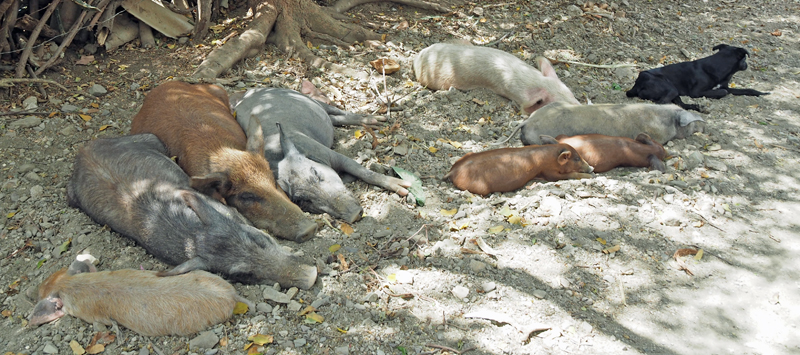
However that didn't stop the locals wanting to help us ... they made us quite welcome.  These were farmers and fisherman, the only industry being a modern bakery that produced bread for nearby beach resorts. It was a sleepy kind of place, with pigs, goats, horses and chickens roaming free in the streets.

A Sleepy Kind Of Village - Dog & Pig Siesta


Local Housing
The housing was very basic, though as we've seen elsewhere in Cuba the people were well fed and healthy, with a medical clinic in the village.

One local lady offered to provide us with bananas, and we visited her house while her husband went out to the gardens to cut the bananas for us - for these we traded clothing, a welcome delight to these folks who are miles from any stores. She proudly showed us the new metal roof on her home, replaced after the last hurricane stole the original roof. We also saw cherished photos of her children and grand children, departing having once again found friends in the Cuban countryside.

Monday, 12 March 2018

A Soft Shackle Starter


Soft Shackle Main Sheet Block Attachment
Soft shackles can and do replace conventional stainless D shackles in many places aboard sailboats today. We like using them because they can articulate readily, they don't rattle, won't scratch other fittings and don't bleed rust (as all the stainless shackles will do in the long run).

On Crystal Blues we've been using them for some years, originally purchasing shackles made by our friend David at Precision Shipwright Services in Phuket, Thailand.

Eventually I was shamed into learning how to make my own, settling on a process that is clearly described here at L-36.com, a great source of boating and rigging info. We do like the "better" soft shackle described there.

Now I'm a hunter in all the chandleries we visit, looking for short lengths of Dyneema high strength line that I can buy cheap - off cuts, roll ends etc. On occasion I've been given short lengths for free, which are quickly converted into valuable shackles. Most of our shackles are made on passage, whiling away the hours on watch at sea, so it's not an onerous task. The calculator on the L-36 web page will guide you as to the critical dimensions and line lengths required.

Out Latest Production Batch - We've Been Busy


Wednesday, 7 March 2018

Beautiful Bahamas Cruising


The locals call these Nurse Sharks, but to us they look a little like the Australian Wobbegongs, or maybe Lemon Sharks.... either way, they are an unusual welcoming committee. Coming ashore in the Exumas Islands these guys are a common sight, along with giant rays, turtles and numerous reef fishes. The further south we travel, the more interesting this area becomes...


Warderick Wells Mooring Field


Of course it's also beautiful, when the weather is cooperating. We're still working with weather systems that are occasionally dominated by the lows and cold fronts that come down off the US east coast, but at least the average temperatures are now above 25degC. in the daytime. Warderick Wells, inside the Exumas Land & Sea Park, is a popular cruising hangout, and the walks ashore reveal a distinct (if limited) range of wildlife. Lizards and birds dominate, though if you stay on the beach after dark you'll be sure to see the native rodent, the Bahamian Hutia, once considered extinct but now resurgent in the park.This is the first place we've been where native palms dominate - sure enough, we found the park service had worked very hard to eliminate the invasive Australian Casuarina, or the She Oak as we call it back home in Australia. The locals here really don't like these Aussie invaders.

VonYachtSki Moored At Warderick Wells


Our friends Harry & Liz aboard the Canadian yacht VonYachtSki enjoyed the park with us, and we eventually sailed further south to Staniel Cay in company. Next we're heading for the big smoke - Georgetown on Great Exuma Island. We should be there before the end of the week. For our favourite images of Warderick Wells and the Bahamian wildlife click the link below.


Monday, 5 February 2018

Low Flying In Skinny Water

Crystal Blues At Tilloo Cay Anchorage - Unusually Deep At 3.5 Meters
Welcome to the beauty of the Bahamas, where we are (finally) enjoying some warm weather and quiet days.  For blue water sailors, relaxing here requires some serious attitude adjustment - everywhere is just so damn shallow!

Skimming across the flats in 3 to 4 meters of water is exciting, feeling just like low flying. However it is stressful to someone who for years has had the shallow depth alarm set at 5 meters - heck the alarm would be sounding continuously here! Many harbors we simply cannot approach, our 2.1 meter depth being way over the available water depth.

At Grand Cay, where we cleared customs and immigration, we eased our way through the entrance channel with 10cm under the keel, to find an anchorage that was just over 3 meters deep. So we often anchor outside the harbors and the dinghy gets a real workout - we traveled 5 miles each way in the dink to visit beautiful Hope Town on Elbow Cay, which is surrounded by 1.0 to 1.5 meter sand banks.

Hope Town Harbor, Elbow Cay, Bahamas


Hope Town Light House

In Hope Town we toured the magnificent lighthouse, the last in the world still operating with an oil burning lamp and a clockwork rotational mechanism. With strong community support it is maintained in working condition, and is open to tourists six days a week.

One great positive - turtles are making a come back here, now protected by government legislation. We see them every day, and two days back saw nine in one small lagoon.

Over the past two weeks we've used the periods of nice weather (very few) to catch up on maintenance - cleaning the hull being the big job. Whilst the images may look sunny, it really isn't warm here in winter, most days between 20 and 25 degrees C. And the sea is cold - wet suits are essential.

Cold fronts regularly move off the US east coast, wind directions clock 360 degrees in as little as 36 hours. Frequent moves are called for to stay sheltered as the winds change direction.

Hope Town was our last "town" visit in the Abaco Islands - tomorrow we're heading south 50 nautical miles to the northern end of Eleuthera Island. A growing group of boats is swinging at anchor here at Lydyard Cay, ready to make the ocean jump to Eleuthera tomorrow.

Hull Cleaning At Tilloo Cay


Thursday, 25 January 2018

So, Which Ball Valves Are You Using ?

Philmac Ball Valves On Our Seawater Manifold
My story on ball valve replacement at sea (read it here) lead predictably to the question of ball valve construction. Are you a traditional bronze kind of sailor? Or maybe you like stainless steel? Or just maybe you've converted to the newer industrial plastics, made with glass reinforced PVC or Nylon?

On Crystal Blues we love the industrial plastic valves, and have used Philmac ball valves for almost 20 years. These are built for the industrial process and agriculture industries, are tough as nails and (the best part) are cheaper than all those products that have the word marine included in the product description.... still, I understand the Philmac valves are approved for use on commercial vessels in commercial survey in Australia and New Zealand.

Engineered plastic valves are light, strong, do not corrode and won't conduct electricity, all properties that I love. Nowadays there is a new and I believe even higher quality product available - made from glass reinforced PVC. New Zealand company TruDesign make a superb range of tough, precision plastic skin fittings, valves and plumbing components specifically for the marine market. These are sold all over the world, and have certifications from Bureaux Veritas, ABYC, CE and ISO. These are the valves and fittings that will be used on Crystal Blues in the future.

Or Are You Using "Marelon" ?

Glass reinforced plastic valves and fittings are also made using Marelon, principally marketed in the USA by Forespar. Unfortunately these valves have experienced well publicized failures over many years. Marelon is a version of Dupont Zytel, a glass reinforced form of Nylon, a fine structural material, but perhaps not best suited to making marine ball valves, as the base material is weakened by immersion over long periods.  Read The Discussions Here and buyer beware.
TruDesign Diverter Valve

We won't use the Forespar Marelon valves. I should also say that the Forespar Marelon toilet waste diverter valves we purchased never worked properly - the closed outlet always leaked slightly, meaning the holding tank had to be emptied periodically even when not being used.

They were not fit for purpose in my experience. That was an expensive mistake, rectified by refitting with TruDesign diverter valves.

Monday, 8 January 2018

Changing A Thru Hull / Ball Valve At Sea

New Valve Going On, No Water Enters the Boat

We've done this a couple of times now, and it's a really simple and fast maintenance job. Finding a dripping leak in a ball valve on the engine sea water inlet, we investigated and found it was seeping through the seal to the handle. It had given us 15 years of service, so I was happy to replace it. We located the spares we carry and selected the right size - 1.25" in this case.

Next we needed a diver, and in chilly St. Augustine that was not going to be the Admiral. No way said she! A call to the local cruiser's net identified a willing local, so we scheduled the job for the next day at slack tide. Note that Crystal Blues has skin fittings (thru hulls) with stand pipes that are threaded, to allow the ball valves to be screwed on and off, without actually effecting the skin fitting.

Diver Ryan arrived right on time, and as he prepared his gear and suited up I started on my own work sequence :

- Close the faulty valve and loosen the hose clamps on the hose connected to it

Trusty Toilet Plunger
- With the hose clamps out of the way the hose tail (hose barb) is unscrewed from the valve. It rotates easily inside the hose, meaning you don't ever have to fight to actually get the hose off the hose tail. This is made easier if you always apply a little silicone sealant to the hose tail during assembly, before sliding the hose over it.

- Once the hose tail is disconnected the action begins - Ryan the diver enters the water with our trusty toilet plunger and holds it over the water entry point. He taps three times on the hull to signal he's ready, and I open the ball valve - voila, just a tiny amount of water enters the boat, before the pressure differential forces the plunger tightly against the hull and seals the entry.

- Unscrew the old ball valve, clean up the threads on the stand pipe, apply new PTFE tape and then screw on the new valve. Close the valve, tap three times on the hull and the diver removes the plunger. Simple!

- Some time later I re-attached the hose tail and re-fastened the hose clamps. Job done.

While many older boats still have skin fittings that incorporate the valve, many newer vessels are built with separate components which allows this process to work just fine. From my perspective, $80 for a diver for 30 minutes is a lot better than $800 for a haul out, just to change a ball valve.

Diver Ryan Was Faster & Cheaper Than A Haul Out


Saturday, 6 January 2018

A New Year Begins, New Destinations Await

You know you're getting older when your favorite local radio station is called The Real Oldies. Whatever happened to K-Rock, Planet Rock, or KIISS and the like?  They all drifted into pop sameness, or repetitive rapping, is what happened..... and I stopped listening.

Here in Florida we had a great Christmas, listening to The Real Oldies on the rental car radio, pulling together the supplies and parts we needed and then celebrating with friends at Hobe Sound, north of Palm Beach.

George & Nancy Marvin, OCC Port Officers for the region, kindly invited us to share Christmas Eve and Christmas Day Luncheon with them - a fine group of cruisers were there, so spirits were high and endless dreams and lies circulated the table.

George & Nancy also kindly acted as a delivery point for our many parcels in the weeks before and after Christmas. Once those goodies were in hand we settled down to a sequence of repairs and service jobs onboard Crystal Blues.

The toughest project was replacing the heater hoses that snake their way through the boat from the engine to the hot water service. The old hose had been installed 12 years ago and was starting to crack - we'd found and repaired two leaks in the past 6 months.

So out it came, which took a day, and then the new silicone rubber hose went in, which took a couple of days - there is about 70 feet of hose in the circuit.  For good measure we flushed and cleaned the cooling circuit in the engine, and replaced the coolant in the system.

Both the Northern Lights genset and the Cummins main engine were due for injector servicing, so we gave both engines a treat and installed new (actually re-built) injectors. Both machines are running silky smooth now, aided by the recent valve lash adjustment - you really can tell the difference.

The Cummins was also rewarded with a new Walker AirSep Filter system, the original item having passed it's use-by date - 12 years was a good run. All in all the boat did real well in the Christmas gift department.

As to those radio stations, we also spent a day installing a new FM radio antenna connection - then scrolled right past the local spanish and rock / pop channels to settle on Legends Radio, a local jazz oriented station. Bliss.

Hopefully we'll be well ahead on the service and maintenance items when we leave here, and can spend time relaxing in the Bahamas soon. The cold weather that is impacting us should pass in a couple of days, and we're hoping for a clear weather window early next week for passage to the Bahamas.

New Walker AirSep Filter System Installed


Saturday, 9 December 2017

South To St Augustine, Florida

Atlantic Sunrise, Off The Carolina Coast
Too Small & Too Bloody - Mackerel Tuna
With winter rapidly setting in, we escaped southward last week, sailing offshore down the Atlantic coast in warm weather bound for St. Augustine, Florida. Light winds from astern were not helpful, so the Cummins engine worked hard once again, as we pushed south and west, staying close to the coast to avoid the north-setting Gulf Stream current.

I wasn't surprised to find the Admiral on deck early one morning, with a fish hanging off a lure ... but really, did she have to start fishing before breakfast? Unfortunately the first three fish that came in were low-value Mackerel Tuna, and they were all released. With this state of affairs the Admiral gave up in disgust - she wanted Mahi Mahi or Wahoo, or Spanish Mackerel. Dream on.

So the fishing tackle was stowed once again and relaxed cruising resumed. We arrived at the St. Augustine bar right on time, in the middle of a rising tide with a following wind. The entrance was therefore drama free and Crystal Blues found herself safely moored on a City Marina mooring ball well before it was time for drinks. Perfect!

Christmas Lights In St. Augustine

This town, reported as the oldest city in America, was once a Spanish outpost. Now, with Christmas approaching, it kinda feels like a Disney outpost. Trolley / tram rides clog the streets, carrying droves of serious tourists from sight to sight, from Ghost Tour to Spanish Fort, restaurant to restaurant. This is not at all what we expected. But the decorative lights are really nice, and the spirit of the place does eventually get to you. Music is everywhere! St. Augustine has an incredibly vibrant live music scene - we've enjoyed great bars and restaurants with excellent live entertainment and usually no cover charge.

Checking The Injection Elbow
However it hasn't been all glittering lights and music. Our beloved Cummins 4BT engine was due for a major 4,000 hour service, so this past week we've tackled everything that can be checked and refreshed on the unit. The standard lube oil and filters, fuel filters etc were ticked off early, before we moved on to the gearbox lube oil and filter, then flushing and cleaning the gear oil cooler and the engine heat exchanger. Then we inspected and checked the turbo, serviced the Walker AirSep filter system, serviced the syphon break, checked the exhaust injection elbow, replaced the drive belt and replaced the belt tensioner.

The Salt water pump was checked (all blades Ok after 500 hours) and the coolant was tested with a Fleetguard coolant test kit, then adjusted to the correct chemical mix using a measured concentrate. For good measure we finished off with valve lash adjustment today.

OK, I'm slow, but it has taken almost six days to work through the job, in between shopping trips and the essential cruising social activities. The weather here has now turned to winter again, with a series of small cold fronts moving in. Predicted 2 degrees Centigrade overnight tomorrow evening. So we'll probably move aft and turn our attention to the Northern Lights generator - its now ready for service.

Valve Lash (Tappet) Adjustment On The Cummins 4BT

Saturday, 2 December 2017

Things That Work For Us # 09 - CUTCO Shears & Knives

I just love it when a company is so proud of its product they put a lifetime warranty on it.

After twenty years of hard use on board a cruising sail boat, it's even better when that same company stands by it's word. So hat's off to CUTCO, a manufacturer famous for their knives but who also make a really mean pair of shears.

Last month we sent our 20 year old CUTCO bread knife back for the free sharpening service they provide - that knife will slice hot bread straight from the oven and does a mean job with foam insulation. We also shipped our favorite CUTCO shears for service.

The bread knife came back beautifully sharpened, and the shears came back - well, brand new. They gave us a new pair (I guess we had worked them pretty hard), no charge. These shears will cut almost anything, including bones, light sheet metal and coins. Of course they work beautifully on heavy duty sail cloth and canvas, perhaps not so good on finer lightweight fabrics. They are so good that the admiral does get antsy when she can't find them ....


Sunday, 1 October 2017

Avoiding Hurricane Maria, Working On Electrics


Back in Reedville, Virginia, we secured ourselves to the dock just two days before Hurricane Maria was scheduled to touch the coast south of here. Fortunately she lost some of her "oomph" and stayed well to the south, so we only saw winds of 20 knots or so and little rain.

While Maria blew herself out we decided it was time for a little electrical therapy. Mastervolt had replaced a three year old inverter for us, under warranty, when it started to show signs of not starting our AC refrigeration system. Excellent support from them, as usual. The new unit was delivered to us back in Rockland, Maine, and this was our first chance to swap the old unit out for the new. While working in that (difficult to access) part of the boat I also wanted to replace some of our battery interconnect cables - we had a good supply of size 4/0 (107sq.mm.) tinned wire and all the necessary lugs, so we spent an afternoon making up interconnect cables to measured lengths.

It took us two days to swap the inverters over, upgrade the battery interconnects and also to replace a bilge pump sensor switch. That was just long enough for hurricane Maria to bounce off the coast and head away from us.

Right now we're preparing for the boat to stay here while we head off on our road trip, so we're checking all the bilge systems, shutting down and preserving the watermaker, servicing essential equipment etc. In case another hurricane sneaks in we've doubled up on all the dock lines and removed both the furling headsails and stowed them below.

We've been warmly welcomed back into the local community, the weather has also remained warm (at least in the daytime) and the social life has been great. Importantly, we're getting a good share of "dog time", walking the neighbours dog and even graced with a visit from our favorite sailing dog, the lovely Flaco, who as you'll see below is very interested in all things "boat". 

Three Boys Looking - Image By Chris Burry