Wednesday, 16 May 2018

Havana Cruising - The Mojito Coast

Line Ém Up - Mass Mojito Mixing Every Few Minutes


After the quiet dignity and charm of the Cuban south coast and cities, arriving in Havana is a shock to the system - specially the liver. This is a party town, where the bars mix Mojitos in bulk and rum is cheaper than mixers, so each glass carries a delicious kick.

We arrived in Havana at Hemingway Marina on April 27, and wisely resisted hitting the Old Town for a few days - rest and repairs took precedence initially. Of course getting to the city isn't simple - with the marina about 15 miles out of town, a fairly battered 1950s Chevy will cost 25 bucks each way. So after an initial day visit we decided to book a room in the Old Town and stay for a couple of days next time.


1950's Chevy Taxi, This One Still Had The Original Engine & Transmission


And so the fun began - Havana Old Town is a world class destination, with thousands of historic buildings, many now restored, and a lively culture that welcomes tourists. A non-profit foundation has managed the gradual restoration of the Old Town with great sensitivity. Its a huge area to manage, but the planning policies have given it a living breathing heart, ensuring that the local population are not displaced and that schools and community facilities are included in the development mix. So yes there are tourists (thousands of them) but there is also nearly half a million locals in the old city, so the visitor gets a "warts and all" education in pretty quick time.

Plaza Vieja - Restaurants, Bars, Boutiques, Hotels, Home Stays & A Primary School - Life Must Go On


Of course mixing the haves and have-nots occasionally creates predictable social challenges, however the Cuban people are not without pride and dignity, and they handle even the ugliest tourist behaviour with great patience. The financial differences between the citizens and the visitors are enormous - a school teacher in Cuba might earn US$40.00 per month, a doctor say US$80.00 per month. Many tourists spend that on drinks in a single day.  But the real imbalance occurs when restaurant waiters earn, in a single day (and just in tips), the equivalent of a teachers monthly salary. How does that work? Yes, social change is coming, and its driven by tourism, which in turn is driven by the culture, music and history of the place.

Opposite our guesthouse, just minutes from the beautiful Plaza Vieja shown above, was a small store selling tourist nick nacks, cold drinks and local crafts. We spoke with the two sales staff, who on that day was a pleasant husband and wife team with excellent English skills - they were both University Professors, and she had a Doctorate in Mathematics, yet in one day selling stuff to tourists they earned more than their monthly government stipend. Something has to give.

Local Transport In The Old Town


Despite the rampant inequalities between the base level Cuban worker and the growing middle class, people are happy. They all have a decent education, they all have access to above average health care. Basic food stuffs and consumables are price controlled by the government so that every one can eat - just not in the new restaurants.


Havana is not to be missed - staggeringly beautiful buildings and plazas, amazing culture, food and drink that was frankly much better than expected and a musical culture that is without par. And it is the Mojito capital of the world.

Want to see more? Click the link below for more images of Old Havana.

Tuesday, 15 May 2018

Cuban Cruising - Sunsets & Thunderstorms

Cayo Largo Marina Sunset


Thunderstorm Formation
From the marina at Cayo Largo these thunderheads do look lovely. We were two days out from Cienfuegos and spent a couple of days in the small marina at Cayo Largo, before moving on westward again.

Our plans to explore the reefs and cayos changed rapidly when strong winds were forecast, so we changed tactics and course, heading instead to Havana after rounding Cape San Antonio at the extreme western tip of Cuba.
Around the cape, now heading north east, next afternoon the weather became decidedly dodgy, with thunderstorms forming right in front of us. These are things we like to avoid, as the accelerated winds and lightning they contain can be quite dangerous.

One in particular gave us grief for many hours - first came the the incredible cloud formation, followed by heavy rain nearby. We altered course, further offshore, monitoring the storm's movement on our radar as we traveled.

Then a fantastic waterspout formed, snaking across the ocean surface and sucking water furiously up into the clouds.
Waterspout On Starboard - We Last Saw One Of These In The South China Sea


This was not something we wanted over the top of us, so the radar tracking took on extra importance. Below is the basic radar image of the storm - note that the green rings on screen are each set 2 nautical miles apart, so the storm on our starboard side is only a mile or so away - that water spout was close.


Often we want a more informed view on screen, specially at night, so the radar image can be over-layed onto the electronic chart display, giving us a more detailed view of the navigation environment. In the image below the radar information is displaying in pink, whilst the vessel, it's track, course and heading can be seen on screen. These display systems are now common on many cruising boats - we all benefit from the improved safety information and situation awareness. And it helps to keep those nasty waterspouts away.


Friday, 4 May 2018

Cuban Cruising - Charming Cienfuegos

Tourist Rides, When They're Running


Like every city in Cuba, Cienfuegos is full of beautiful old cars, though keeping them running seems a constant task. We anchored off the marina just south of the city and spent 10 days exploring and relaxing, with the usual range of boat jobs thrown in. This was also a great city to re-provision, for our next passage to the west.

Cafe Prado


The city is relaxed, safe and surprisingly sophisticated, with a great range of restaurants, cafes and bars. Yes, it is Cuba, so nothing is perfect, but the city has a sense of prosperity and optimism that was infectious. There is quite a lot of tourism, but its low key and chilled.

You could spend weeks just sampling food at the dozens of privately run restaurants and paladars.  The architecture in the central city is grand and well preserved, though you only need to move a block or so to find the classic Cubano crumbling edifices. Two hours drive to the east is the city of Trinidad, the oldest Spanish city in the new world, well restored and a UNESCO World Heritage site.

As usual we chased down all the music we could find, and on any night in the town square you could easily listen to four or five different acts.

There is never a cover charge, unless you visit one of the late night clubs.  The bands are paid a government stipend, which they creatively augment with CD sales and tips from the crowd.

On our first Saturday in town we came across a local community center cultural event, in a residential side street away from the city center.  Basically a classic Cuban band playing for the local residents, who really know how to dance. These folks have standards though - long pants and a collared shirt were required for entry - we fit the bill and were invited in for a wonderful night with the locals. After dancing all night we pulled up kinda tired the next day .... but we did return again the following Saturday.


For two days we explored the countryside around Cienfuegos on a rented scooter - traffic is light and generally slow, much of it horse drawn, so we felt safe riding. The farming town people made us welcome, ignoring our lack of Spanish and trying very hard to support us.

Crystal Blues departed Cienfuegos on April 22nd, bound for Cayo Largo.
For more images of beautiful Cienfuegos click below.

A Great Wine Cellar - Another Cuban Surprise

Palacio de Valle


Cuba's third largest city, Cienfuegos sits at the top of a protected bay. The marina is nothing fancy, a spread of concrete wharves in fairly poor condition, so we were happy to anchor off the shore, with the majority of visiting boats.

Just north of the anchorage was the Palacio de Valle, once a private home but now part of a large tourist hotel, Hotel Jagua.

After the very basic infrastructure we'd seen over recent weeks on the Cuban coast, this area was like arriving in Disneyland. The Palacio even boasted a serious wine cellar, where we were able to re-stock with reasonable wines.

Cellar Door
The cellars are absolutely original, built into the basement of the Palacio, behind heavy locked doors.  The basement also hosts a Tapas Bar - ask at the bar to look inside the cellars. You can purchase wines at very reasonable (wholesale) rates here, the range is OK and the storage is all air conditioned so we don't expect any losses.

El Jeffe, President Castro, had a holiday residence nearby and would come to these cellars for his wine, even eating in the cellar dining room. We figured that was good enough for us, and held a tapas dinner there with cruising friends, in the same tiny room, full of character and history.


Wednesday, 25 April 2018

Musical Cruising - Manzanillo To Cienfuegos

Making Music With Our Fisherman Friends
We departed Manzanillo in company with the English catamaran Miss Molly, heading for Cienfuegos via the Golfo De Guacanayabo and the Golfo De Ana Maria.

Miss Molly
The total straight line distance is around 250 nautical miles, however the thousands of cayos and reefs in this region mean that a straight line course is impossible. So we dodged and weaved our way to the north west, traveling in the daylight and anchoring up each night where ever protection could be found.

Philip and Monica Shorter aboard Miss Molly are members of the Ocean Cruising Club, as are we, so we had a lot of cruising gossip to share each evening. Phil is also a guitarist, so he and I were able to share music and belt out some favourite songs between beers and gossip.

In total we spent seventeen days among the reefs and cayos, and covered around 300 nautical miles. The weather was mostly benign, with little wind, so most of the traveling was diesel powered. On the upside, the water was clear, warm and blue, the fish plentiful and we convinced ourselves to start swimming again.

First Swim Of The Season For Admiral Ley
 The northern hemisphere summer is approaching rapidly, and we're starting to set sun shades on deck again, even running the aircon some evenings to cool the boat when there is no wind.

At Cayo Breton we purchased five crayfish from local fisherman. Next night at Cayo Guayo the same fishing boat happened to be nearby.  Captain Phil and Admiral Ley, the fishing experts, went to visit the local boat and were invited on board. Ley was given a number of coral trout, so we reciprocated with cold beers. Then, in the early evening, the fisherman presented us with a beautifully prepared platter of grilled fish, with tomato paste, onion, garlic and fried plantain chips - a gift from the chef on the fishing boat.

Before another hour had passed Phil and I started a music session, jamming away, and the fisherman joined us onboard Miss Molly. The evening ramped up into a regular floating party. The ladies danced with the fisherman and the rum bottles was eventually emptied. This is the cruising life...

Typical Waters In The Gulf Of Guacanayabo - Kinda Reefy


Sunday, 22 April 2018

In Manzanillo, Cruising For Cuban Music

We're cruising the world to meet good people, drink good wine and listen to good music.


In the 20 odd years since the Buena Vista Social Club (both the music album and the documentary) made Cuban music famous again, we've dreamed about the great live music we might experience here.

The fun started in Santiago De Cuba, where we found that a few venues and bands were playing to the tourists, while very many others (often just around the corner) were performing for the love and joy of entertaining friends and locals. That's the music we wanted to hear!

Of course there are many styles of Cuban music, with cultural roots that spread from Spain to Africa and the Caribbean. Across the country, these influences can be heard in every town. On a recent Sunday morning, the food, wine and music all came together for us in the form of a regular local performance.

Strolling through Manzanillo town, looking for a restaurant for lunch, the music simply came roaring down the laneway at us, around the corner and across the cobblestones. Lunch was quickly forgotten as we squeezed into a crowded old bar, with windows open to the street and a beautiful courtyard within - all very Spanish.

The patrons shuffled tables and chairs around and made space for us, some offered rum, placing glasses of the clear and delicious local alcohol on our table. Cruising friends soon arrived, also attracted by the sound, and ordered a bottle of rum to share with our neighbours - and so the party developed. The band was outstanding, crowds gathered on the street outside to listen, while we were hosted by locals and danced our feet off in the limited space available. This is Cuba. Nothing fancy, just a heartfelt joy and great community spirit.


Saturday, 21 April 2018

Cuban Cruising - The South Coast To Manzanillo

Fresh Dinner
We departed peaceful Marea Del Portillo on a fine forecast - in fact it was a little too fine and we motored the 30 nautical miles westward to Cabo Cruz. On arrival the anchorage there didn't look so attractive, so we continued on around the Cape, heading North West to Manzanillo, a small city to the north west.

Now we were in the Gulf of Guacanayabo, at the eastern end of a chain of Cayos and reefs that extends almost to the western tip of Cuba. Our immediate target was Ensenada Guano, a small bay that would provide shelter in the prevailing winds.

The approach to the bay looks straight forward, however sailors should be careful of some coral heads rising up from the depths as you close the shore - visual navigation is essential. After anchoring in the late afternoon we were reminded why the Cuban south coast is popular in sailboat cruising circles - the locals are very supportive! Just before sunset two fisherman came by in a tiny rowboat and offered very nice sized spiny lobster - we traded for two, a few pesos plus a couple of T-shirts to cement the deal. Our dinner plans changed for the better, and the locals rowed home happy with their bounty.


Manzanillo

Next morning we worked our way north through the narrow channels under engine power, before breaking out into the wider bay and enjoying a brisk windward beat for five hours toward Manzanillo. On arrival we took the dinghy to shore, landing among the fishing boats on the stony beach, eagerly assisted by fisherman and kids. They guided us to the Guarda Frontera office where we were heartily welcomed and cleared in by a very capable young officer with excellent English skills - a rare thing in these parts.

Local Fishing Boat
 A word about the local boats is in order - while there were many traditional planked wooden fishing boats with single cylinder diesel engines, there was also a fleet of smaller styrofoam vessels, some with sails, available for rent. Against all odds, the Cuban people are inventive and determined to enjoy themselves. 


Our guide book said that Manzanillo was a typical small rural Cuban city, with less vehicles and a relaxed atmosphere. This proved to be true, as the locals were incredibly friendly and proud to have us in their city.

The city itself was a beautiful collection of traditional wooden, brick and stone buildings, many crumbling, set on streets populated mainly by pedestrians, bicycles and horse carts.

The city center featured a grand square of parkland and pedestrian walks, the Parque Cespedes, with shade trees and seating areas. In the park was a stunning tiled gazebo, The Glorietta, with classical Moorish design features. As in every Cuban town, around the square were arrayed museums, restaurants, bars, banks, churches, ice cream shops and government offices.


The streets near the square hosted small traders and shops, some excellent small restaurants and many homes that also served as "Casa Particular", the classic Cuban home stay. For us, the shopping and provisioning was quite adequate - we bought vegetables from street traders and packaged goods in the stores. This was a fine city, and though the beach landing was through fairly dirty shallow water, that was soon forgotten once among the friendly locals in this city of fading grandeur.


Thursday, 19 April 2018

The Cuban Capacitor Bomb

Some weeks back I noticed that our reverse osmosis water maker pump was having some difficulty in starting up. As we're dependent on that machine for all our fresh water supply, this wasn't welcome news - a failure would limit our cruising on the Cuban coast.

After some testing and discussion with the manufacturer, we identified the starting capacitor as the likely culprit, though we weren't optimistic about finding one in Santiago De Cuba. It's an uncommonly large value capacitor - 600 micro farad, and physically quite small.

Then, after many fruitless hours searching stores and even second hand goods markets, our friend and driver Noel Sardina took us to another friend, which is of course the Cubano way of solving most problems. Everyone has many friends...

This friend repairs air conditioners and refrigeration equipment.  From him we purchased this typically Cuban problem solver - our Cuban Capacitor Bomb. A trio of well used but functional starting capacitors, all of lower values, but wired together in parallel to create the desired effect - and this assembly is now starting our pump perfectly. It ain't pretty, but it works. The Cuban way!

Wednesday, 18 April 2018

Cuban Cruising - Marea Del Portillo


Fisherman Row Home After A Night On The Water - Marea Del Portillo


From Santiago De Cuba we headed west along the southern coast, with the dramatic Sierra Madre mountains running down to the coast right along the shore line. It was 80 nautical miles to our next safe harbour, and we managed to motor and sail the distance in a single daylight run, arriving in beautiful Marea Del Portillo just on sunset.

The bay here is wide and deep, well protected from the ocean with mangroves and reefy cays on the ocean side. Local fisherman work the reefs and mangrove channels in small row boats, setting nets and traps.

The local Guarda Frontera officer, resplendent in green uniform, was rowed out in a tiny fishing boat to welcome us and take possession of our cruising permit - in each port they hold the permit until we depart. With heavy conditions forecast for the coming days, we decided to sit tight in this beautiful bay and catch up on some boat work.


The staysail furler needed some fine tuning, so we dropped the sail to the deck and worked on the furling mechanism for a day, including removing the drum mechanism and detaching the stay from the deck. During all this we (of course) found and rectified the mistakes made by the last riggers that worked on the system, but that's just the cruising life .... sure it is.

After sorting that one, we moved the sewing machine onto the fore deck and Ley re-stitched the sacrificial UV cloth on the staysail. A monster job, now done and dusted. So we re-rigged the staysail, furled it and turned our eyes to the shore, where the local village was waiting for us.

At the local fisherman's jetty we landed our dinghy on a black sand beach. Immediately it was clear that this was a fairly poor rural village, with little infrastructure and most of that in poor condition.


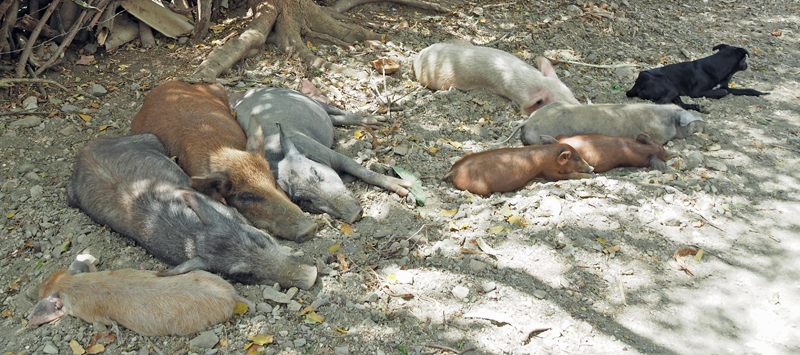
However that didn't stop the locals wanting to help us ... they made us quite welcome.  These were farmers and fisherman, the only industry being a modern bakery that produced bread for nearby beach resorts. It was a sleepy kind of place, with pigs, goats, horses and chickens roaming free in the streets.

A Sleepy Kind Of Village - Dog & Pig Siesta


Local Housing
The housing was very basic, though as we've seen elsewhere in Cuba the people were well fed and healthy, with a medical clinic in the village.

One local lady offered to provide us with bananas, and we visited her house while her husband went out to the gardens to cut the bananas for us - for these we traded clothing, a welcome delight to these folks who are miles from any stores. She proudly showed us the new metal roof on her home, replaced after the last hurricane stole the original roof. We also saw cherished photos of her children and grand children, departing having once again found friends in the Cuban countryside.

Friday, 23 March 2018

A Cuban Landfall - Santiago de Cuba

The Morro Fort Is On Starboard As We Approach The Entry


Crystal Blues arrived on the south coast of Cuba at Santiago de Cuba, last Friday afternoon. Sailing under the ramparts of the Morro Fort, dating back to the 15th century, was an incredible arrival experience. The government run marina is about 1/4 mile inside the harbor, where we received a friendly welcome. Many visiting boats were anchored out, however the marina offered us a berth and we accepted gladly - the first time we'd berthed the boat since last November.

Ley's Favourite Vegetable Stall
This is Cuba's third largest city, with around a million people, though it's position in the far east of the country gives it an individual identity and a strong sense of independence. From this region the first rebellion against Spanish rule commenced, and later it was Castro himself who started from here to evict the Batista regime.

Of course the Cuba of today is very different, with a population that are embracing change as Cuba relaxes the old rules. Economic prosperity is still some way off, however the people do have some of the highest literacy and health care standards in the world.

Starting last Saturday we've traveled a little in the city and out into the mountains to the north west. This included an overnight trip to Bayamo, one of the oldest Spanish cities in the world, where we stayed in a "Casa Particulare", basically a homestay with meals available if we wanted. This cost around $25.00 per night. Ley figures the Cuban people invented the AirBnB concept, without the internet....

Overflight On Our Arrival

Over the years the Cuban people have learned to live with less, and the place is famous for keeping old cars running well beyond there regular use-by date.

Noel & Neil At The Morro Fort
We've enlisted the services of a local taxi driver "Noel", who has enriched our visit with his quiet pride and strong sense of humor. Noel's taxi is a fairly battered but reliable Moskovich (Russian) car - I asked how old it was one day, and he quickly replied "It's New! Just 30 years!" Compared to some of the vehicles we've seen, it is indeed quite new.

Cuba has been in our cruising sights for many years, and whilst we had a little taste of the land  last year, we had high hopes for our visit this year, keen to experience more of the people, food and music. We haven't been disappointed!

The annual music festival in Santiago de Cuba was in full swing when we arrived, a festival that is produced for the locals, not just for tourists. The national history includes waves of immigration from Spain, Britain, France and Africa. These influences have been distilled into a national musical palet that includes strong African segments, more traditional Cuban works plus Spanish influenced classical styles. Here in Santiago the African tribal roots are celebrated with community performances in a local coffee shop twice a week, where we were able to dance to a beat from 8 drums and a variety of percussion instruments accompanied by many voices.

Santiago Concert Hall


 At the local concert hall, we were fortnate to view a performance by the orchestra from the local conservatory, with guest vocalists from around Cuba and a guitar trio from Mexico. That same evening we danced in the streets to more classic Cuban sounds when the festival stage went live for the evening.

Learning To Busk, Latin Style
In the town square local troubadors entertain each evening, earning coins for their performance. I was able to spend an hour accompanying one guitarist with my newly purchased percussian instrment, the local Guayo.

Music is everywhere in this country. In the towns we often see people carrying guitars, brass instruments and drums, all a common sight. Culture is different here - some how more inter-personal, rich and educated than we expected. In Bayamo we came across a fencing school right on the street, while in Santiago we've visited two different chess clubs that occupy beautiful historic buildings.

We plan to sail onwards across the south coast of Cuba for the next few weeks.

Tuesday, 13 March 2018

Departing George Town, Bound For Cuba

Exumas Racing Sloop
After almost a week in George Town Harbor we are ready to move on, with fuel and provisions loaded and our hearts looking forward to the next destination - the south coast of Cuba.

We arrived here in the middle of the George Town Cruising Regatta and learned to live with the constant VHF radio chatter generated by more than 250 cruising sailboats in the one harbor. The harbor could probably cater for many more - it's long, generally shallow and provides great holding and protection for anchored yachts.

The annual regatta here has a little something for everyone, from big boat racing to Bocce tournaments, beach volleyball, poker and even cruiser golf played on the local salt flats.  And yes, the local rum was a major attraction.

The local sailors also get involved, competing in traditional 16 foot sloops that feature heavy sliding boards to carry the windward crew and impossibly large main sails and booms.

To the north of us, the Atlantic Ocean is whipping up a major storm that is expected to send large swells down here later this week, so we're heading south before we're boxed in again. A series of cold fronts moving down off the US coast have complicated the local weather forecasting, and no one is relying on anything more than two or three days out. Subject to weather, we expect to arrive in Santiago De Cuba on Friday morning, March 16, truly ready for the local music, food and yet more rum.

Monday, 12 March 2018

A Soft Shackle Starter


Soft Shackle Main Sheet Block Attachment
Soft shackles can and do replace conventional stainless D shackles in many places aboard sailboats today. We like using them because they can articulate readily, they don't rattle, won't scratch other fittings and don't bleed rust (as all the stainless shackles will do in the long run).

On Crystal Blues we've been using them for some years, originally purchasing shackles made by our friend David at Precision Shipwright Services in Phuket, Thailand.

Eventually I was shamed into learning how to make my own, settling on a process that is clearly described here at L-36.com, a great source of boating and rigging info. We do like the "better" soft shackle described there.

Now I'm a hunter in all the chandleries we visit, looking for short lengths of Dyneema high strength line that I can buy cheap - off cuts, roll ends etc. On occasion I've been given short lengths for free, which are quickly converted into valuable shackles. Most of our shackles are made on passage, whiling away the hours on watch at sea, so it's not an onerous task. The calculator on the L-36 web page will guide you as to the critical dimensions and line lengths required.

Out Latest Production Batch - We've Been Busy


Thursday, 8 March 2018

George Town Arrival

Yesterday afternoon we arrived in George Town, Exuma Islands, after a seven hour passage from Black Point Harbour.  Atlantic ocean storms to the north of us, while delivering snow and heavy weather in the UK and USA, are sending large long period swells down to this part of the world.  Moving on or off the shallow Bahamas banks requires a little care and planning, selecting a reef pass that is preferably wide and deep. The Admiral snapped this swell as we moved through the Conch Cay Cut into Exuma Harbour yesterday.

Wednesday, 7 March 2018

Beautiful Bahamas Cruising


The locals call these Nurse Sharks, but to us they look a little like the Australian Wobbegongs, or maybe Lemon Sharks.... either way, they are an unusual welcoming committee. Coming ashore in the Exumas Islands these guys are a common sight, along with giant rays, turtles and numerous reef fishes. The further south we travel, the more interesting this area becomes...


Warderick Wells Mooring Field


Of course it's also beautiful, when the weather is cooperating. We're still working with weather systems that are occasionally dominated by the lows and cold fronts that come down off the US east coast, but at least the average temperatures are now above 25degC. in the daytime. Warderick Wells, inside the Exumas Land & Sea Park, is a popular cruising hangout, and the walks ashore reveal a distinct (if limited) range of wildlife. Lizards and birds dominate, though if you stay on the beach after dark you'll be sure to see the native rodent, the Bahamian Hutia, once considered extinct but now resurgent in the park.This is the first place we've been where native palms dominate - sure enough, we found the park service had worked very hard to eliminate the invasive Australian Casuarina, or the She Oak as we call it back home in Australia. The locals here really don't like these Aussie invaders.

VonYachtSki Moored At Warderick Wells


Our friends Harry & Liz aboard the Canadian yacht VonYachtSki enjoyed the park with us, and we eventually sailed further south to Staniel Cay in company. Next we're heading for the big smoke - Georgetown on Great Exuma Island. We should be there before the end of the week. For our favourite images of Warderick Wells and the Bahamian wildlife click the link below.