Tuesday, 7 June 2016

Pole Dancing In the South Atlantic

Last Saturday we departed Ascension Island, bound for Suriname in South America, though the departure wasn't without its challenges.

First the anchor windlass failed when the chain was half way in, leaving 40 meters to be hauled in by hand, accomplished with a chain hook attached to our primary windlass in the cockpit.

Then one of my shoes blew overboard on a nasty leeward lurch, flying off the dodger as if it was unhappy with the wash I'd just given it. After retrieving the floating footwear, which took almost half an hour in lumpy seas, we re-hoisted the mainsail and discovered a small tear close to one of a the car attachments. Damn it !

Down came the mainsail, and we've proceeded ever since on a poled out genoa plus the staysail, wing and wing. Like all sailors we're a little superstitious, when it suits us, and we firmly believe that bad things come in threes, so nothing else will now go wrong on this passage. We hope...

As to the pole dancing, the motion of the boat is close to that kind if sexy sashay you might expect to see on stage. The spinnaker pole is holding the genoa out for the wind, and we've even experimented with our big boat hook to pole out the staysail. Proving that things do come in threes, yesterday the Man Over Board pole got into the act, failing above the float, so we spent an hour repairing that.

The voyage to Suriname will cover over 2600 nautical miles, and with the expected light trade winds from dead astern it will probably take around 20 days. Lots of time for reading books and fixing things that break. Suriname, and then Trinidad, was originally our destination for this year, though we changed that to the Azores and Europe after our delayed departure from South Africa. Later, we had a "management meeting" at Ascension Island and decided to take the easier passage, spending the next few months in Surinane, French Guyana, Trinidad and Tobago before flying home later in the year. This voyage will take us from 10 degrees south of the equator to roughly 10 degrees north, and as I write this we have only 2,180 Nautical miles to go!

Sent via satellite phone using OCENS OneMail
www.ocens.com/onemail

Friday, 3 June 2016

Ascension Departure Tomorrow

Sorry, No Apples
We plan to depart Ascension Island tomorrow morning, with our next destination being Suriname in South America.

Its a passage of 2600 nautical miles, which we're expecting to take a little less than three weeks. We'll cross the equator again, and move through the inter-tropical convergence zone.

In Suriname we plan to stay up the river at Waterland Marina Resort. 

So we'll leave behind our friends and acquaintances on Ascension, the most memorable of which was this feral donkey who was convinced we had food in the car for him.


We're reasonably well provisioned for the passage, specially now we have those wild bananas from the local mountain.

Ley and friend Maia have been practicing banana recipes, with flambe banana the most popular so far, possibly because of the amount of rum involved.

Food Is Where You Find It…


Lamb chops anyone? This feral sheep on Ascension Island popped out of the banana trees on Green Mountain just as we approached on our banana hunt.  Finding food is not always easy, and while we did have space in the freezer, we decided to leave the sheep behind.

We spent an amazing 10 days on St Helena Island in the company of Canadian friends Diane, Evan and Maia, from the catamaran Ceilydh, much o fthe time chasing down food. It’s a spectacular and beautiful island, steeped in history, dotted with old forts, with rock walls and cannons aplenty.  However finding fresh food and provisions there was not easy.

We would prowl the supermarkets for fresh produce, sometimes meeting with local friends and retiring to the Blue Lounge at The Consulate Hotel.  There we would connect to the most expensive (and slowest) internet we have encountered, before prowling the shops once again. 

Jamestown - Site Of "Food Scrum Thursdays"
Sometimes It's Who You Know

Information on food sources comes from other cruisers and locals alike.  On our passage from Cape Town, Di emailed  us about Food Scrum Thursdays at one of the main supermarkets on the island.  Local produce would be delivered from the farms, shoppers would queue up at the side door and the food scrum would begin.  Except when we arrived only carrots and cucumbers were on offer each Thursday!

So each day we would scout out the four main supermarkets, sometimes hourly.  6 bags of potatoes were opened one day, luckily during one of our hourly visitations.  Bags of freshly picked green beans were on offer another time.  Another day we found local lettuce - again a very small supply, reinforcing our regular supermarket sorties. Our friend, film maker Dominic, told us about a man who drives into town every Thursday morning with a boot load of bananas, and he offered to buy some for us.

Evan Harvesting Bananas On Green Mountain
Not every excursion was rewarding, but slowly we manage to buy egg plants, avocados, basil, parsley, mushrooms, green tomatoes, onions and some produce that was bought in on the supply ship, RMS St. Helena, from Cape Town.   

Our best deal was several dozen farm fresh eggs, supplied by the farmer Peter, who was delivering beer to the Consulate Hotel. Really, provisioning in these small places is about who you know.

We are now ready to depart from Ascension Island, but with a seriously depleted fruit and veggie larder.  We saw only two small vegetable plots on our drive around this volcanic island and there is very little available in the two small stores open to us.   

However, we struck cruiser’s gold on Green Mountain – wild bananas available for picking.  With limited resources we managed to get 3 small bunches of green bananas to be shared.  Maia also collected a small container of delicious wild raspberries.

Spending our last few St Helena pounds in the supermarket we sadly noticed that there were no frozen peas.  I asked the staff if there were any available  - “No” was the sad answer, so we resorted to buying mixed frozen vegetables.  At the check out we heard a voice call “did you want frozen peas?”  They found some for us in their store room .  Out cruising in remote areas,  it’s important to talk to people and let them know what you need. They will often go the extra mile for you.

Our Fruit Basket In Better Times - Now It Holds Just Wild Bananas And A Few Remaining Oranges

Thursday, 2 June 2016

Rigging & Sail Maintenance - Anchored At Ascension Island

We've covered over 9000 nautical miles since leaving Asia last year, with much of the Indian Ocean passage sailed in heavy reaching and windward conditions. From Cape Town onwards, the sailing has been mainly down wind, generating different loads and different wear on the systems.

Anchored safely at Ascension Island, we turned to essential maintenance on sails and rigging. Our standing rigging, all 1x19 wire, had been replaced in Cape Town, so our work there was limited to checking terminals and rig tension.

However the down wind sailing has taken a toll on our main halyard - with the boom run out around 45 degrees, the head board of the sail flops out to 90 degrees. This lays the halyard diagonally across the edge of the sheave in the top of the mast, leading to excessive wear. We'd already sleeved the worn halyard with Dynema sheathing,  but even that was eventually cut through by the edge of the masthead sheave.

So, on our last night at sea the main halyard parted and the sail came sliding down into the boom bag, without us even noticing, until Ley checked the deck soon after coming on watch. We tidied up the sail and reefing lines, centered the boom and proceeded under poled out genoa, losing only 3/4 of a knot in boat speed.

After removing the remains of the halyard from inside the mast, we were able to run a new mouse line down the mast, using a bicycle chain to weight the line.  The chain is flexible enough to roll over obstacles and heavy enough to keep moving downwards - once at the base it can be fished out with a hook or with a magnet on a stick.  The mouse line was then used to re-install the (shortened) halyard, which we'll now declare as "suspect", due to UV damage over the years. Fortunately we do have another (spare) halyard in the mast, for the mainsail.


UV Sail Damage

Our genoa also needed quite a bit of work. The Sunbrella sacrificial cloth, replaced in Thailand around five years ago, has worked to protect the Hydranet sail cloth when the sail is furled, and the Sunbrella itself is still in reasonable condition. However the thread used at the time has failed, only where it is exposed when the sail is furled.

So we re-stitched every seam and panel join all the way up the leech of the sail, for a distance of a about 250mm into the body of the sail. We always use Tenara thread for sail and canvas work, as it outlasts the fabric. 

However in this case the sailmaker did not have access to Tenara, so we find ourselves re-sewing seams just five years on.

Wildlife On Ascension Island


At English Bay the tourists are gathering around a baby turtle, recently hatched, crawling across the sand towards the ocean. Ascension Island beaches are dominated by turtle nests, and this is the season when the hatchlings emerge.

Of course nature moves in mysterious ways, and within seconds of entering the ocean this baby was snapped up by a cruising Frigate Bird.  Very frustrating.


Other creatures on Ascension, also protected, are perhaps less attractive to the birds. As we cruised the island the road signs reminded us to keep to the speed limit (just 40kmph) and to watch out for the local land crabs, which were on the road in quantity in some places.


Wednesday, 1 June 2016

Ascension Island Landing - It's Character Building

While the open ocean anchorage sets the tone, going ashore here extends the challenge to visiting cruisers.  With no harbour or breakwater, the landing platform is an exposed concrete shelf on the end of the wharf, set just above the high tide level. As you can see above, the ocean surge can easily cover that with swirling water, on almost every wave cycle when the tide is high.

On our second day ashore the swell had really increased, so we tied the dinghy to an off-shore buoy and were ferried to the landing in a US Air Force safety boat that was monitoring barge loading at the same wharf.  Everything has to be timed "just so" - approach the wall on the high and as the swell drops the boat comes alongside the ledge and you step ashore quickly, to immediately run up the steps before the next swell engulfs you.  Meanwhile the boat driver is getting away from the wall before the next swell arrives.

We're getting good at it now, and our new Tohatsu 9.8hp engine has certainly worked hard getting the dinghy in and out rapidly between each wave cycle - one person or one bag ashore per wave is the best we can manage. When the swell is really big you simply cannot get off the boat - we have friends who were here last month and eventually departed without setting foot on shore.

Dry Feet This Time, Thanks To The USAF Safety Boat

Monday, 30 May 2016

Ascension Island Welcoming Committee

Crystal Blues arrived at Ascension Island last Wednesday, May 25, after a 750 nautical mile passage from St. Helena. For the last three hours we were escorted by a pod of large bottle nose dolphins, doing the usual surfing on our pressure wave.

They certainly lifted our spirits, which had flagged somewhat when the main halyard parted in the middle of the previous night - the mainsail lowered itself gracefully into the sail bag on the boom and the boat sailed on. In fact we were blissfully unaware until Ley did a check on deck soon after she came on watch. One more item on the maintenance list...

The biggest thrill of the passage came from Ley's fishing activities - trailing a lure astern, she watched as a big marlin (body more than 2 meters long) took the lure and leaped clean out of the water. This is potentially a very bad thing. There is no way we could land a fish that big on the stern. Fortunately his aerial activity pulled the hook from the lure, and we presume he is wearing Ley's hook as a piece if lip jewelry. Punk fish. It certainly didn't slow him down - as Ley hauled in the line he hunted back and forth behind the boat looking for the lure, and ended up right at the stern tracking us. Ley says it was the most frightening fish she's seen - so much aggression.

Ascension Island is a "young" volcanic island, barren and rocky for the most part. However the highest peak carries a carpet of trees and plants that take the edge off. We anchored off the capital of Georgetown, in Clarence Bay. This is an open road-stead anchorage, exposed to the north and west. The prevailing south easterly wind keeps our bow pointing towards the beaches and mountains ashore, which we'll explore in the coming days.
Barren Lava Fields - NASA Chose This Place To Test Drive The Apollo Mission Moon Buggy

Monday, 23 May 2016

Flying Fish Pie ?

No, we really aren't that hungry! We did have a recipe for Flying Fish Pizza once, but they smell so bad we tossed the recipe.

Every morning I walk the deck, looking for problems, wear points, chafe etc. and invariably I'll find two or more of these creatures on deck, though 14 in one night (!) is the record for this paasage. Beautiful looking, but stiff as a board. Trails of fish scales lead us to them, and often they'll bounce off the windscreen before flopping down onto the deck.

Crystal Blues departed St. Helena late on Friday - it was St. Helena Day, a public holiday and a day of great celebration on the island. Marching bands, speeches by the new Governor, special church services, community sporting challenges and a joyful parade through the capital of Jamestown kept us entertained.

Ley was part of an 8 person team competing for the fastest time to climb inside a mini minor (an original one). The wining team comprised mainly kids under 12 - not fair ! We sailed out of James Bay late in the afternoon, and after the sun set in front of us we watched the fireworks explode over Jamestown directly behind us.

St. Helena Day - The Car Jam.  That's Ley and Di In The Front.


We're now more than half way to Ascension Island, a 720 nautical mile passage north and west up the Atlantic. The weather is (thankfully) definitely tropical, hot cloudy days with cooler evenings and the water temperature has almost reached 25 degrees. We have a good weather forecast and should be anchored in Ascension by Wednesday evening.


Friday, 20 May 2016

Things That Work For Us #8 - Ultrasonic Antifouling

Ultrasonic Antifouling - Two Years On, The Results Are Excellent

In May of 2014, we installed a new Ultrasonic Antifouling system, hoping to reduce or eliminate the problems we had been having with barnacle growth on the hull and inside our water inlets.

At the time we reported on the system installation, and covered some of the basics of barnacle breeding, with the help of marine biologist Glen Burns - read that story here.  We also covered a high tech barnacle removal tool - the story is here.

I should explain that we like to sail for at least two years between each haul out, where possible. This saves us quite a lot in boat yard and paint costs. So Crystal Blues was last hauled and painted with anti-fouling paint back in October 2014.

We applied four coats of our favourite antifouling paint, Jotun Sea Force 90, rolling it on over three days. We added a fifth coat to the leading edges of the keel, rudder and skeg, and around the waterline. That paint system is now 19 months old, and we've covered over 9,000 nautical miles since it was rolled on - quite some distance for us.

At this point the biocides in the paint system are just starting to let us down - the slime on the hull needs to be wiped every month, and green seagrass is now starting to grow where sunlight penetrates the water depth.

HOWEVER THERE ARE NO BARNACLES.  NONE.

Back in Cape Town I paid the local divers to clean the hull - the water there was way too cold for my 3mm wetsuit - and they reported that it was in very good condition, finding only three (3!) barnacles.

Here in St. Helena, where the water is a balmy 23 degrees, I dived to clear some fouling on our folding propeller, and found that the hull needed a wipe, but no barnacle scraping at all.

This is a major improvement for us, as previously we fought a constant rear guard action against barnacle growth on the hull and in our sea water intakes. The raw water intake for the refrigeration, aircon and genset systems had been specially problematic, frequently clogging with extensive barnacle growth. Since installing the ultrasonic system we haven't had a single incident of barnacle clogging.

I'm sold - the package is compact, doesn't draw much power (half an amp at 12 volts) and requires absolutely no maintenance. The only thing I have to remember is to turn it off at the DC switchboard before I go diving under the hull - it does generate some audible harmonics underwater that are quite painful when you get close to the transducer location.

Follow this link for details about the system we have installed, which is sold by Ultrasonic Antifouling Ltd in the United Kingdom.

Things We Love To Hate - Jabsco Pressure Tanks

Not often are we frustrated enough to openly criticize a product, but here is one of those cases.

Crystal Blues was fitted with Jabsco water pressure tanks to smooth the delivery and extend the life of the pumps. and the tanks do both of those things well.

The problem is in the failure mode - basically the product self destructs in a little over 10 years, rusting out and dripping water from the entry point.

In fact the Jabsco pressure pumps, which we like and trust, are lasting longer than the tanks (which have no moving parts).

Any water leaks inside our boat are completely unacceptable, and so are products that leak consistently.

These tanks really should be made of plastic, marine grade aluminium or 316 grade stainless steel. Mild steel just isn't good enough.

We've been through four of these since we bought the boat, and will not buy another until I find one made of a more stable material.
.

Thursday, 19 May 2016

The Governor's Place - Plantation House, St Helena

Recently opened for tours, Plantation House is the Governor's official residence on St. Helena.

Originally built by the British East India Company, it is beautiful residence in the hinterland above Jamestown, with broad ocean views.

Nearby in a dense woodland are the graves of husband and wife plantation workers with some interesting graphics on the headstones...

Beside the beautiful rooms, the library, the Jaguar car in the garage and the obligatory tennis court, Plantation House is also famous as the home of the worlds oldest living creature -  Jonathan the tortoise.

One of several gifted to St Helena by the Governor of the Seychelles, Jonathan's age has been calculated using historical photographs and records, and he is thought to be 187 years old. He is a little slow on his feet these days, and slightly cantankerous as well, but is still a significant island attraction. Long may he reign.


The Emperor Napoleon & Fine Wine In St Helena

St Helena's most famous resident was Napoleon Bonaparte, exiled here by the British after his final defeat at the battle of Waterloo. He was sent to a converted farmhouse known as Longwood, a damp residence in the wettest part of the island, which he constantly complained about. With his small entourage he lived there until his death in 1821.

Longwood House is now owned by the French Government, along with several other key locations associated with Napoleon's time here. We took a guided tour of the restored house, accompanied by a knowledgeable local guide. It is kind of spooky to be in the room where he died, then where he lay in state, then where his autopsy was conducted.

I was more interested in the wine cellar, now a simple gallery of paintings and drawings from the period.

There is some controversy surrounding his death, with some claiming he was poisoned, while the autopsy concluded that he died of stomach cancer - as did his sister and father.

Whatever the cause, he certainly enjoyed fine wine - he had a standing monthly order for 18 liters of Vin De Constance, an intensly beautiful desert wine made in the hills above Cape Town.

Our good friends on the catamaran Ceilydh gifted us a 500ml bottle of the wine, which is still in production and is still winning awards. We shared the bottle with the Ceilydh crew after dinner in the anchorage, accompanied by sauteed and flambeed local bananas, saluting the Emperor and acknowledging his very fine taste in wine.

When he passed, Napoleon was interred in a beautiful valley that is also now a significant monument owned and administered by the French Government, despite the fact that his body was removed and re-interred in Paris some 20 years after his death.

The entire saga of his defeat, imprisonment, eventual death and associated controversy has made the Emperor Napoleon one of the islands biggest tourist attractions. For many it is an emotional pilgrimage - we visited Londwood House, and the grave, with French cruising sailors who were very moved and grateful to see something so significant in their national history.

The Emperor Napoleon's Tomb In St. Helena

Wednesday, 18 May 2016

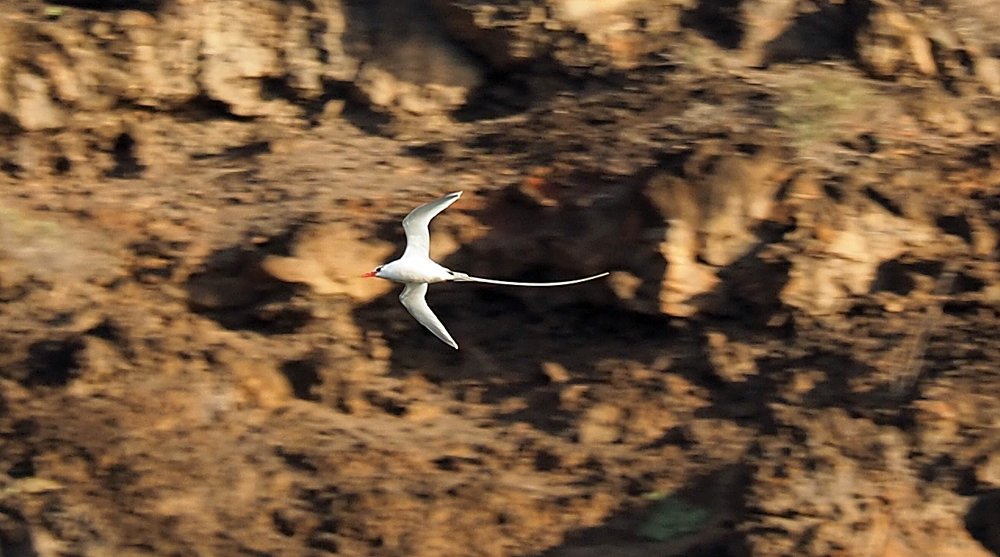
Tropic Birds Of St. Helena


We saw our first Tropic Bird on passage from New Caledonia to Australia, way back in 2003. I probably haven't seen more than a dozen since then.

That was until we arrived here in St Helena, where the island's cliffs provide homes for hundreds, probably thousands of these beautiful creatures.

Each afternoon as sundown approaches we sit on deck and watch the Tropic Birds zooming around the cliff face, some times in small groups, always at high speed, dragging those impossibly long tail feathers.  What flying speedsters they are.

Sail Repairs R Us

Our "big colored sail" is an asymetric or MPS - great for reaching and shy running off the wind.

It is, however, a bit of a monster - in fact it's a real handful for just two of us to handle when the wind gets up.

It exploded during the passage to St. Helena from Cape Town, in about 18 knots of breeze, telling us it is near the end of its useful life. We know that it's at least 20 years old, so it certainly doesn't owe us anything more.

However we really need it to get north to the equator and the ITCZ, as winds have been very light south of the line.

So Ley set about repairing the monster a few days back, giving the Sailrite Ultrafeed machine a workout after I hot-knifed the torn edges.  It has now been restored to its sail bag ready for a second life.

The nylon material down low on the sail, near the tack, is clearly more UV damaged and stretched than the main body of the sail. We'll keep our fingers crossed, and try to get the thing down on deck if the wind gets over 12 knots.

Tuesday, 17 May 2016

Donkey Love In St. Helena

Hopalong, Ley, Greedy and Neil, Out For A Stroll
Traveling the island we spotted several paddocks where donkeys grazed. These lovely creatures are descendants of the working animals that carried produce, crops and goods all over the island before powered vehicles became popular here.
Ley & Hopalong - Image By Dianne Selkirk

Flax was a major export product here until about 40 years ago, and the donkeys carried the flax from the fields to the mills over very steep terrain.

Many survived here as lonely "pets", semi abandoned on rural blocks, until a new community group decided to take action and rescue those that were most in need.

So the St. Helena Donkey Sanctuary was born, supported by locals and expat visitors alike. Land was donated, even the local government chipped in a little funding, and slowly animals were handed over to the group and their life improved.

Vetinary care was provided, hooves were healed and their health came back. The animals were gradually socialised and began to play a role in local life again.
Children from local schools visit the sanctuary, along with tourists, like Ley and I.

Every Saturday morning the sanctuary invites visitors to walk the donkeys, who are brought in from the fields, fitted with halters and leads in preparation.

With a group of friends Ley and I took part in this delightful walk, leading a four legged friend from the sanctuary yard along local roads for several kilometers. The main walk was along a spectacular ridge line to a rural church, with views across the island to the ocean both north and south of us.

Ley was paired with "Hopalong", so named because of a deformed front off-side foot that looked pretty sad but didn't stop him keeping up on the walk. It also didn't stop him leading Ley in the wrong direction whenever he spotted something of interest along the road. As she says, horses (and donkeys) just look at her and decide who the boss is - they are!

I was leading "Greedy", a gracious 30 year old lady who is the last remaining animal that carried flax as a working donkey. Greedy came to the sanctuary in a terrible state, almost completely bald, bleeding from fly blown sores and tick bites. The sanctuary team have brough her health back, and she is in fine condition now - specially given her age.  What stories she could tell...

Donkey Love - They're Not Stupid, Just Stubborn!
OK, so she doesn't like to walk real fast, happy to doddle along at the back of the pack, but she and Hopalong made a happy pair, completing their regular Saturday excursion at their own leisurely pace. Ley and I were also both pretty happy with that.

Following the walk the animals are brushed down, their hooves are cleaned and treated, and lotions and creams applied to stop flies and parasites. The stronger animals are being trained to carry saddles and young riders. They seem proud of their role, stepping out quite happily with (very) nice leather saddles that were shipped in from South Africa with funding from local government here. The original saddles were crude wooden affairs that also carried loads of flax - not good for the back at all.

After our donkey walk we had a picnic in the sunshine, high on the ridge line, contemplating the very happy outcome for these lovely creatures. Tourism in St. Helena is nothing if not quirky!