Monday, 6 October 2008

Internet Afloat - The Story Continues In Thailand

We've recently posted quite a few stories on the use of 3G, GPRS and Edge mobile data services here in Asia (here, here & here). These are all broadband data services that piggy back on the GSM and WCDMA global cellphone standards. Consequently, if you equip yourself to operate here, your equipment will also operate in almost every other country (you just have to subscribe to a local service provider - buy a SIM card).

Whilst we operated in Malaysia using the excellent DiGi service (it was GPRS) here in Thailand we've purchased a "1-2-Call" SIM card. The service is almost as good - and it costs about the same. For about Aussie $1.00 a day we're getting unlimited internet access - its online all the time. Plus we get a generous SMS allowance as well.

Local testing here in Phuket has proved that the 1-2-Call (Edge) cellular data service is actually faster than the local ADSL fixed-wire broadband service. Yep, for a buck a day we're getting faster and more reliable internet than those who pay for fixed line ADSL broadband. Amazing.

But be careful here - if you subscribe to a service that is over-sold and under provisioned (like Celcom in some parts of Malaysia, and recently I believe Optus in some parts of Australia), your data rate will suffer, and connections will not be reliable. Consequently we look for services that are not over-sold, like DiGi in Malaysia and 1-2-Call here in Thailand. I'm sure its the same in many other parts of the world - large or dominant service providers deliver sub-standard service almost as a default. Oops, did I really say that ?

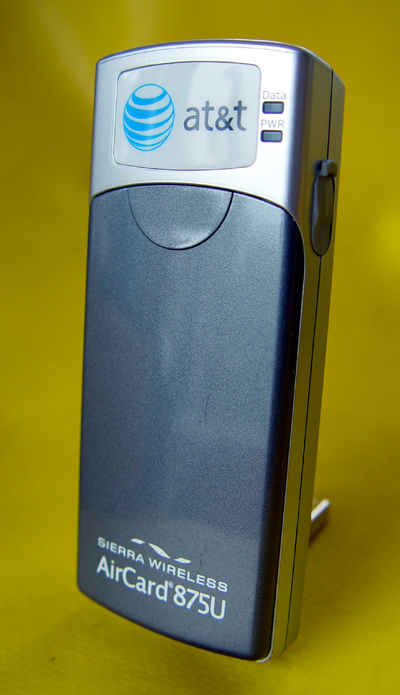
Fact is, even at GPRS or Edge speeds, the service is clearly faster, more reliable and much less expensive than the wi-fi internet services offered by marinas in this region. It really works well here. Since our original post on this topic many have followed our example, and the results have been generally good. Ian & Mona Robertson in Kuching (Sarawak) are now using DiGi (Edge Service) for their second business office, whilst Jon & Pam on SV Tweed are also delighted with Celcom's service in Langkawi. SV Taipan (David & Kris) have also written to say how happy they are. SV Aku Anka (Arja & Glen) in Langkawi read our stories and also made the jump. All these folk are using Sierra Wireless AirCard modems. We're expecting this service to keep working wherever we travel, though with variations in service cost. Right now its the best value internet access around, and it works surprisingly well for a considerable distance offshore.

July 2009 Update / Current model USB Modem is Sierra Wireless Compass 885 or 888.

Saturday, 27 September 2008

Refit Week 4 - Steelwork Completed

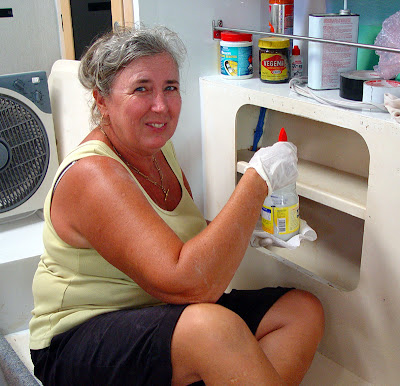
Its just on a month since we sailed into Phuket Boat Lagoon, and three weeks since we hauled out of the water. On deck we've been concentrating on steelwork - changes and additions to improve the boat and reduce maintenance in the future. Inside the boat we've started painting - with the lockers empty its a pefect time. Two coats of Jotun Penguard high build primer and two coats of Jotun Hardtop polyurethane and our old cupboards start to look like new again. As you can see in the photo at right, Ley just loves painting....

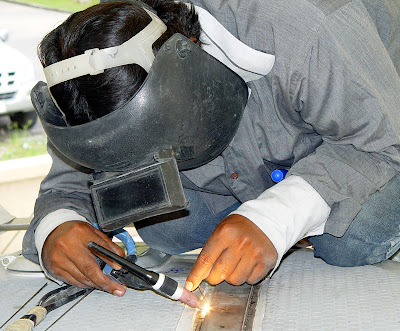
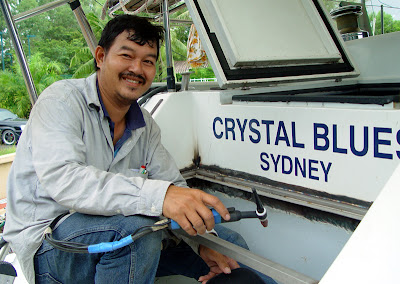
The guys from Mr.Nop's stainless steel fabrication business have been working very hard. They've fabricated beautiful new pulpit and pushpit railings and completely rebuilt the stern fuel locker in 316 stainless steel. This area was previously fabricated from timber, which was bolted and glued to the steel hull, and it was always a source of rust and maintenance work. Now its fixed and there forever, and our aft railings run forward past the cockpit for additional security.

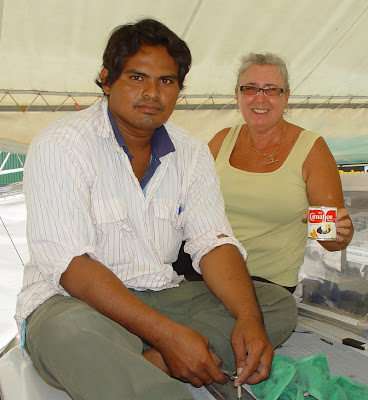
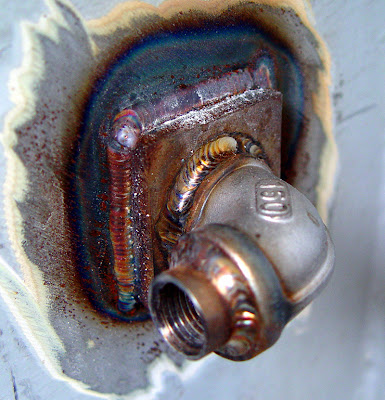
We've also improved a number of the hard point areas on deck, the ones we didn't tackle in our last refit 8 years ago. This basically involves welding thick 316 stainless plates into the deck, drilled and tapped to take our fittings. Because the holes don't go right through its impossible to get any leaks. The plates are faired into the deck and painted over. Last refit we welded shut 210 (!) holes in the deck, and fitted these welded blocks as hard points instead. For this refit the count is only 53, but it still feels good. The tough one was the mainsheet traveller - 24 precisely drilled and tapped holes in a 10x50mm 316 stainless bar, curved to match the roof of our steel dodger. The guys were having trouble tapping into the hard stainless bar, until Ley's father Ray suggested using Carnation Condensed Milk as a lubricant and cutting compound. I'm sure they thought we were crazy when we brought the can out to them, but after the first hole they'd changed their mind - it really works. All the big 316 bar and plate stock has to be ordered from Bangkok, but things happen pretty quickly here and the job is virtually done.

Our PowerDive hookah gear gets a lot of use cleaning the boat, but its often needed quickly if we pick up a net or line on our propeller at sea. Getting the gear setup on deck in the middle of the night at sea proved kind of frustrating, so we're installing it inside the boat permanently. A fixed airline will run to a new stainless stell compressed air socket at the stern - now we can just throw a switch and plug in a hose to get underwater quickly. We've also put in a new stainless penetration for our aft deck shower hose, and added a welded hardpoint for a pasarelle at the transom. The cost of all this is not insignificant of course, but even with Mr Nop's best "creative" margins in play it is great value, and the local workmanship is outstanding.

Tuesday, 23 September 2008

AIS Part 2 - The Installation Experience

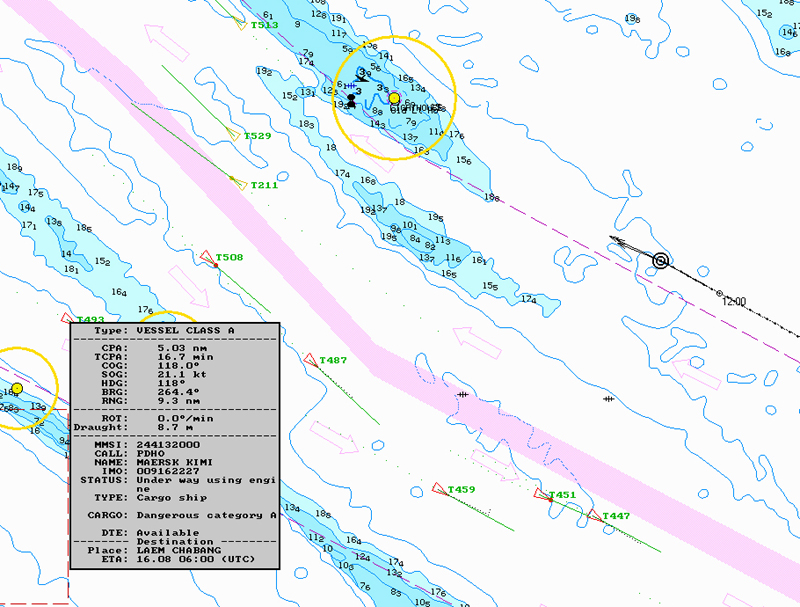
AIS stands for Automatic Identification System, an active primary safety system for vessels at sea. The black arrow in the photo at right, captured from our PC screen, is Crystal Blues. The red arrows (targets) are ships we want to avoid. Clicking on a target reveals the data box seen at bottom left - lots of information on the ship in question (click the image at right to enlarge).

I met a cruising sailor last night who said that my first AIS story (here) was very technical - oops, I guess it is a technical subject. Not sure that I can eliminate the technicalities, but I will try to explain them. First though, an essential technology primer .... I strongly recommend you spend time roaming the excellent PANBO website, specially the AIS pages. Also, here are links for two very informative and useful documents, covering co-axial connectors and co-axial cabling. OK, on with the story ....

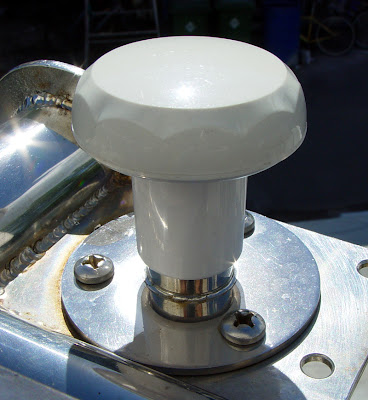
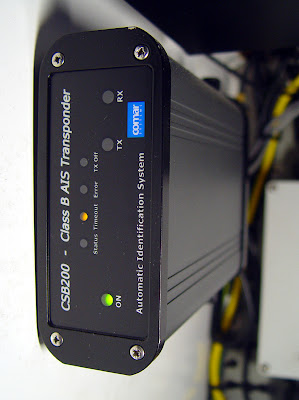
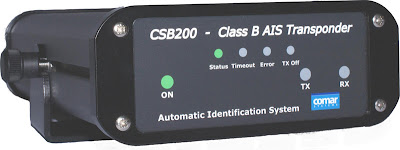
We purchased our Class B AIS transponder from Oceantalk in Singapore - in fact we bought four of them, as several other boats wanted to install the system. The unit is a Comar CSB.200, manufactured in the United Kingdom. It was supplied by Oceantalk with a Shakespeare VHF whip antenna and a Sanav GPS antenna.

All Class B AIS transponders require a dedicated GPS receiver and a dedicated VHF antenna. No arguments please - if you want this powerful safety system, you have to install the extra antennae. No, you cannot share signals from existing systems, however the AIS derived GPS position information is available to you as a separate NMEA signal, for chart plotting purposes. You'd better plan carefully for antenna locations, bracket positions and cable runs.

The GPS antenna is a simple patch antenna with a low noise amplifier that sends the received signals (as RF) direct to the AIS system for timing analysis - in other words, the external receiver is just an amplified antenna, and all the complex decoding and mathematical computations to derive your vessel position occur inside the AIS transponder. This is a specific requirement of the IMO AIS regulatory framework - it basically ensures that no one can feed fake vessel positions into the system. That is good to know ...

On the VHF side, AIS Class B uses just 2 watts of radiated power to send its reports outwards (the big ships get 12 watts). It is easy to receive signals from big-ship class A systems, however you better pay attention when installing your VHF cables, connectors and antenna. You want to ensure that all of your 2 watts is actually radiated into the ether. Robin Kidd from Oceantalk stressed this point - make sure your VHF cabling and connection work is good. Installation requires the following :

- Physically mount the AIS box. A U-bracket is supplied, but we used industrial strength adhesive Velcro to mount it on a vertical bulkhead (see photo).
- Run the cables for VHF and GPS antennae
- Install and connect both antennae
- Run cable for DC power with a fuse in line
- Run the data cable to the chart plotter/display system
- Terminate everything and then commission the system

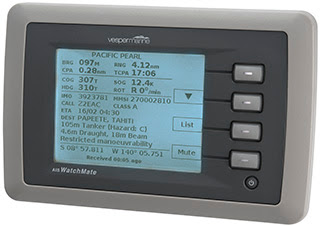
Of course your chart plotter must be compatible with AIS messages in NMEA format to display the targets and information. If it isn't, you can use this very neat AIS display from Vesper Marine, the AIS Watchmate, or a more serious display (with charts) made by Comar, the CSD.200.

Back to the installation. If you power the box from a shared DC circuit breaker (ours is on our navigation instruments circuit) you should include a 5amp fuse in the power feed. Be careful with the VHF antenna cabling - OK, its just RG.58, but you've only got 2 watts to radiate, so make sure you use high quality connectors and fittings.

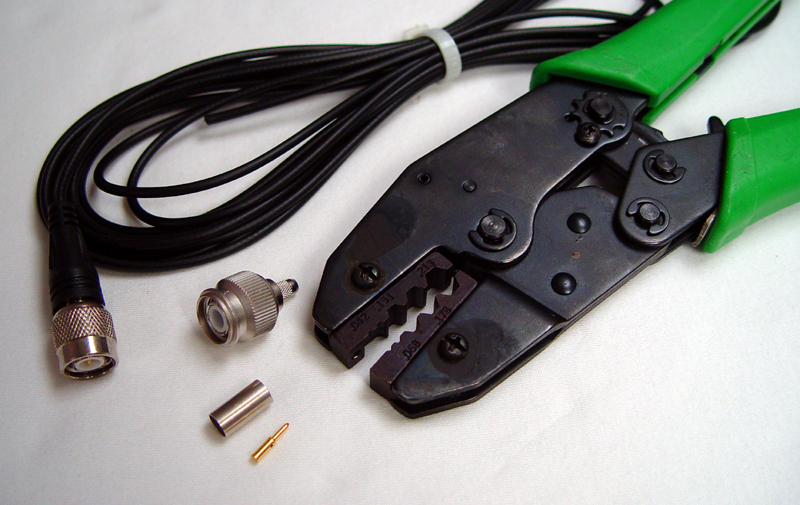
The GPS receiver supplied by Oceantalk is the RV-76, made by San Hose Technology in Taiwan. It includes a nice 10 metre pre-terminated cable. Its very thin, and easy to run through the boat, but it turns out to be RG.174, which has very high losses (attenuation) at these frequencies (1.5ghz). If you use the supplied cable as-is, with its existing terminations, it will work just fine. However if you need to cut, join, extend or splice (as we did), then you'll have to use a more suitable cable (RG.223). After attempting to extend the supplied cable, and getting no satellite signal, we changed to a Bedea RG.223 with Telegartner crimp connectors - voila, tons of signal. We purchased the cable and connectors from Coastal Electronics in Singapore, though similar cable is made by Belden and others. Make sure you use the correct crimping tool (see photo).

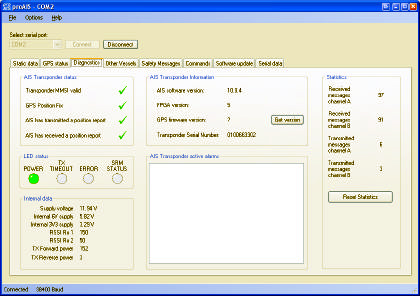
On the VHF side, the Comar AIS box will actually measure and report the SWR (reflected energy ratio) on your VHF transmission line during commissioning - you'll soon know if your VHF cabling and connectors are good or not. Click on the photo below at right to see typical values.

With all that hard work done the rest was easy - plug the box into our PC using the supplied cable and configure the COM port on the PC (baud rate etc) . Then load the Comar software (supplied) and configure the unit. At this point you'll be asked to input your vessel identifier, which is the unique "MMSI number" issued by your National Marine Authority. If you don't have an MMSI number you'd better apply for one now, because you cannot transmit using AIS without one. A Comar Class B transponder will stay in "receive only" mode until you give it your MMSI number. The real trick is that this number can only be entered ONCE by the user - mess it up and you have to send the box back to the dealer for resetting.

I've just learned that Class B systems are FINALLY approved for use in the USA (story here), but that they are not allowing users to configure the MMSI identifiers. I bet that will be fun to administer.... seems the installers or retailers will have to configure the box before handover. The Comar configuration software is simple to use, neat and logical.

So, use only good cables and connectors, get yourself an MMSI number and enjoy the results. Our next story on AIS will conclude the series with our user experiences.

Sunday, 14 September 2008

A Working Holiday In Phuket

Most people come to Phuket for a holiday, but we've come to work - Crystal Blues is here for a major refit. After arriving on August 18, we anchored in Chalong Bay and completed clearance with Immigration, Customs and the Port Captain. Now, four weeks later, that arrival seems like months ago - we've done so much in the past month it's scary. Ley says that it's beginning to feel like real work again - up at 5.30am, breakfast, drive to the boat yard. Of course the drive to work here is a little more interesting than at home in Australia - the local villages, caged monkeys, water buffalo and rubber plantations give this commute a different feel.

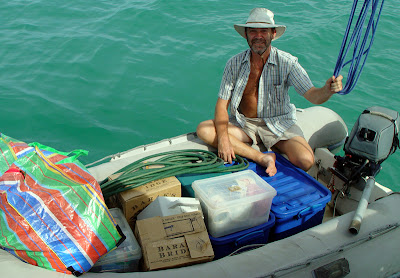
Two days after arrival we'd rented a car for six months and were on the road house hunting. Four days later we signed a lease for six months on a large three bedroom home (air conditioned & furnished throughout), in a quiet private estate. Then the fun began - how long would it take to empty the boat of everything ? The answer is forever - we're still not done, though I can say that 95% of the contents were removed in 25 car loads. Half those car loads were filled using the dinghy as transport to shore (it took 2 dinghy trips to fill the car). The rest happened after we moved into the Phuket Boat Lagoon 0n September 4th, where just 3 trolley loads could fill the car. It was messy, hot, sweaty work, but its done.

The ocean tides are big here, which is just as well, as the channel to the marina is dry on the lowest tides ... we motored in on a 3 metre tide but still saw less than 0.5 metres under the keel. They badly need a suction dredge.

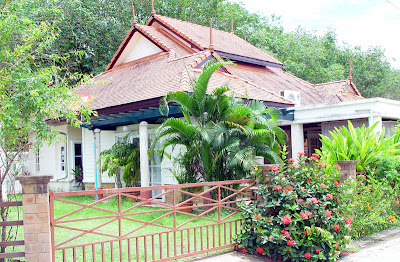
We've been lucky with the rental house (check the photo's here)- besides being comfortable, nicely furnished and "homely", its got a SHED ! It also has shelves, a work bench and even a Gerni (high pressure water wash). So the 25 car loads became 1 house load, which we're still trying to sort out. Seriously though, the house is lovely. Lots of light, space and a garden. The neighbour's dogs have adopted us (Lucky, Blacky, Red and Grumpy), and the locals are friendly as well. There are several good restaurants within a 5 minute drive, all very economical. The boat yard is a 10 minute drive.

We've now started a Picassa Web photo album, so family and friends can see the refit as it progresses - you can view it here.

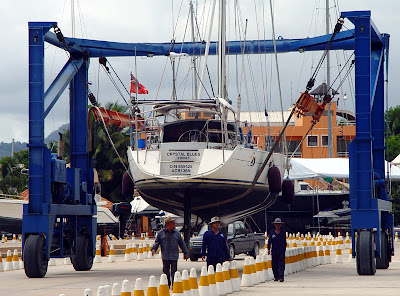
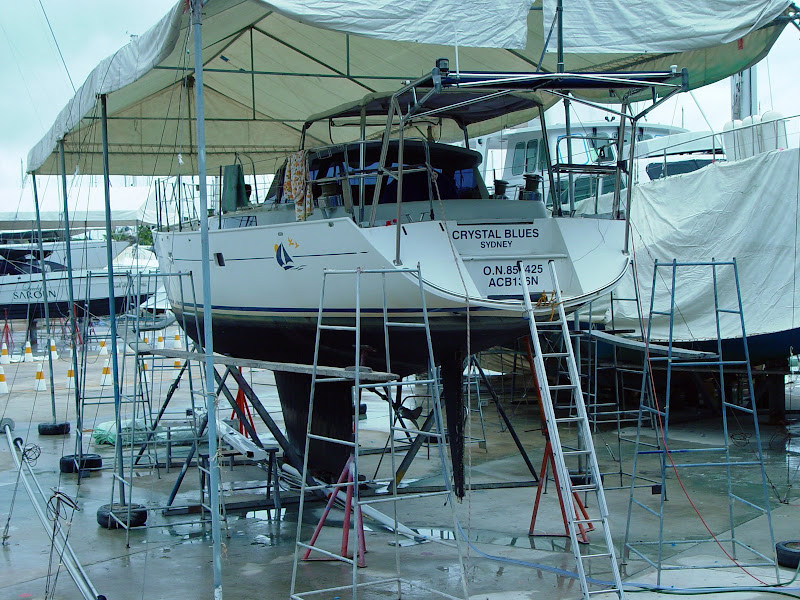
Crystal Blues was hauled from the water last Thursday, September 4. Prior to haulout we'd taken so much gear out of her she was riding over 100mm above her normal marks. The Boat Lagoon crew are really good at this work - Mr Sin runs a very tight ship. They held her in mid-air whilst we disconnected and dropped the rudder out, before expertly blocking her right in front of our contractors shed. Two days later, last Saturday morning, a huge crane truck arrived on schedule at 10.00am and lifted the mast out.

Within an hour the Pro Yachting team had moved a massive frame and tent into position and the boat was covered. Of course not everything went well - we were incredibly lucky that the monsoon rains held back whilst we emptied the boat contents, but the moment we were lifted the heavens opened, and they haven't closed yet. Its raining every day and night. Thank heavens we have that tent over the boat.

And just who ordered these political protests ? No sooner is the boat out of the water than suddenly there's talk of a people power revolution. Politics in Thailand is almost unfathomable - one side (the democratic party) is suggesting democracy be abandoned, whilst the other (the ruling coalition) is determined to re-nominate the prime minister who was sacked yesterday by the courts, basically for corruption. The coalition says he didn't do the country any harm - sure he did, he just stood up and lied in a court of law. Guess that doesn't count if you're a politician. The last prime minister, Mr Thaksin, is now exiled in London. When he was questioned about corruption (by the press) he basically said it was OK because it was everywhere. What a guy.

The political action in Bangkok has left Phuket quite untouched, except for a peaceful sit-in protest that shut down the airport. However last Friday a local friend called early and said he'd heard that the schools might close and that we may lose power if the government workers go on strike. In Phuket no power means no water, as almost all the water is sourced locally from wells. He recommended stocking up on drinking water, washing water and petrol for our portable
generator. So we rushed out and bought two 100 litre plastic containers for washing water, re-filled the water tanks on Crystal Blues, and moved our 200 litre Turtlepac water bladder to the back porch of the house. We now have 1400 litres of fresh water on hand plus 120 litres of petrol in jerry jugs in the shed. We're ready, though I doubt we'll need any of it. The Thai people are too smart to mess with the tourism cash-cow - I'm sure Phuket will remain peaceful.

Over the past 5 days we've stripped the deck of all fittings and have also stripped the winches, tracks and fittings from the mast, boom and spinnaker pole. Mr Sung, the stainless steel expert from Nop Stainless, has demolished our wooden transom fuel locker and re-built it in 316 stainless steel. Next he'll move onto the deck, where we're adding more stainless attachment points and some electrical and air penetrations. The staff at Pro Yachting have been very helpful, every request has been rapidly supported. Right now we're ahead of our program, and very happy with the service here. If only it would stop raining !

Saturday, 23 August 2008

AIS Part 1 - A System Primer

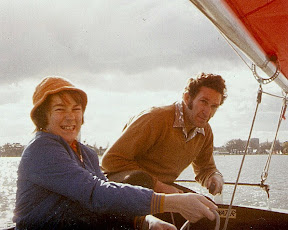
My father taught me to sail when I was about 8 years old - he's the worried one in the old photo at right (probably because my brother Peter is on mainsheet). With great and delightful understatement, he always said that "a collision at sea can ruin your whole day". He's absolutely right of course, though nowadays we can use AIS technology to help avoid those "ruined days". This is the first of three posts regarding the system, and basically describes the technology. Future posts will cover our installation experiences and the system in operation.

Some years ago the International Maritime Organisation (IMO) ratified a standard requiring all ships over 300 tons to carry an Automatic Identification System (AIS) transponder. This was a major step forward in collision avoidance for ships at sea. The system really works - AIS equipped ships constantly transmit information including name, MMSI number, position, speed, course, rate of turn, cargo carried etc etc. Commercial vessels within range receive that data, which is then displayed on dedicated screens or (in most cases) overlaid onto radar or chart plotting screens. The result is that AIS equipped vessels are readily identified, tracked and avoided.

This is a significant primary safety system, and many in the yachting community have taken advantage by purchasing low cost AIS receivers - these display ship locations on navigation chart plotters, or on suitably equiped navigation computers. Whilst an AIS receiver system is a good thing to have, I always believed that the best safety system required the big ships to see me as well - I wanted a transponder that would transmit and receive.

Nowadays we can all see and be seen, with low cost AIS transponders available to the cruising and pleasure craft community. The "big ship" Class A systems are expensive, so the IMO has also ratified a simpler version called AIS Class B, for pleasure vessels.

There are important differences between the two, however they are designed to work together. Class A systems use dedicated GPS receivers for position information and system timing. They then transmit a wide range of vessel data, and do so quite frequently, using coded data bursts on VHF channels 87 & 88. The system uses a protocol called SOTDMA to keep everything organised, with GPS derived time managing the broadcast slots. With 2250 time slots on each channel every second, the dual channel system provides up to 4500 time slots. Class A systems transmit at up to 12.5 watts. A ship travelling at more than 14 knots will transmit dynamic data every 6 seconds. A course change increases the burst rate to every 2 seconds.

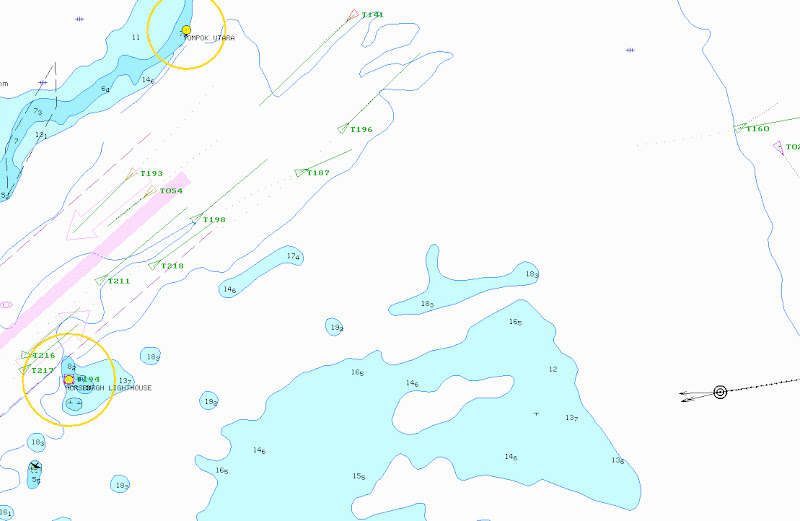
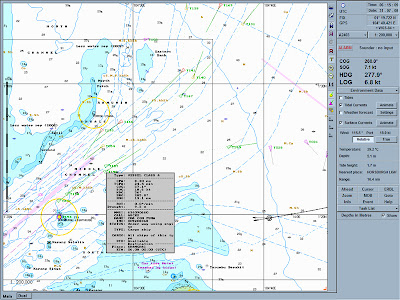
Thats us in the chart plotter image at right, the black circle and arrows on the lower right, moving west. At left of the image are AIS equipped ships entering and exiting Singapore Straits, into the Sth. China Sea. Click the image to enlarge.

Class B systems also use a dedicated GPS receiver, but transmit a more restricted data set (no rate of turn, destination, ETA or cargo information) and do so less frequently, using less power (maximum 2 watts). The control protocol is CSTDMA (Carrier Sense Time Division Multiple Access). Basically the Class B systems listen for a gap in the Class A traffic, then transmit. There is no guarantee that any individual data burst will be successfull, however the system transmits a burst every 30 seconds when underway. Even in Singapore, with literally hundreds of ships transmitting close by, I've watched very solid returns from Class B equipped vessels in the Singapore Straits. The system can certainly process lots of traffic - our transponder identified over 1000 targets (!) in 48 hours on our recent passage from Singapore to Langkawi.

Most of the approved Class B systems use a common internal circuit board, made by Software Radio Technology (SRT) in the UK. SRT was part of the IMO advisory panel that set the standard, so its no surprise they have complying product on the market. Our Comar CSB200 AIS transponder (user manual here) uses the SRT circuit board.

AIS is already compulsory on pleasure craft in some parts of the world (eg South Korea), and I believe it will become mandatory in many countries. In Singapore, pleasure craft must carry either an AIS-B transponder or one of the local HARTS transponders that use cellphone technology as the data link to shore based monitoring stations (more info on HARTS is here - thanks to Terry Sargent on SV Valhalla for the document).

For more background information on the politics, technology and products behind AIS, I suggest you spend awhile reading the AIS links on the excellent PANBO blogsite here. A very good background story, published by Yachting World, is also available here. Our own installation experiences will be posted next.

Thursday, 21 August 2008

Coastal Internet Update - Google At Sea

We continue to receive questions about internet access afloat, so an update seems appropriate. To my delight, our Sierra Wireless 3G/GPRS modem continues to provide amazing service. With a DiGi sim card installed we had perfectly reliable internet access for more than 70% of the voyage from Singapore to Langkawi. Service dropped out at One Fathom Bank, north of Port Klang, but came back in again as we approached Pangkor Island and held the coast to Penang. It dropped again for a few hours between Penang and Langkawi, but we have seen the service running quite well more than 16km offshore. In Malaysian waters we certainly don't bother with wi-fi anymore. Whilst true 3G and/or Edge service is hard to find, the DiGi GPRS is fast, stable and incredibly widespread. At about 2 ringit (70c) per day, we love it. The Sierra Wireless modem will work anywhere in the world, though costs will vary in different countries. For more detailed information, click here & here.

Monday, 18 August 2008

1000 Miles To Phuket

Latitude 06 degrees 32.31 North, Longitude 099 degrees 25.16 East. The Southern Andaman Sea

Its 1000 nautical miles (just under 2000km) from our long-house anchorage in Borneo to Phuket in Thailand. Right now we're just 90nm from Phuket and should arrive there tomorrow morning. Then we start work in earnest, as Crystal Blues will come out of the water onto the hard stand for a six month intensive refit and paint job.

We departed Sarawak, Borneo, on July 23rd, and paused in Singapore for a 4 day break that (typically) turned into a 2 week layover. Why does this always happen to us ? Catching up with friends is part of it, and being thoroughly entertained by the Stonham family (we call it being "Stonhamed") also took its toll. However we did spend a lot of time checking out equipment for an upcoming video shoot, completed our AIS transponder installation, re-installed our wifi antenna system to the davits aft and purchased a lot of the materials needed for the refit.

Our good friend Robert Goh, who lives in Singapore, is a newly initiated cruising sailor. He's also a 1st rate alpinist and mountain climber. Unfortunately he was caught up in the sad disaster that engulfed the climbing teams on K2 in Pakistan this season - Robert wasn't hurt, he was below the ice fall and he returned to base camp safely. Check his website here. His summit attempt has now been cancelled and he's naturally very disappointed. Robert's partner Elaine spent time with us as the disaster progressed, and is naturally quite relieved that he's on his way home.

We escaped from Singapore on Wednesday August 13, heading north up the Malacca Straits and arrived in Langkawi (Malaysia) exactly 2 days and 11 hours later. Every hour of that passage was on the engine - the "new" Cummins engine has now clocked over 2000 hours. There was no useful wind for the entire trip. The even newer Comar Automatic Identification System also proved its worth - more on that in a future story. 36 hours anchored at Kuah town in Langkawi let us abuse our credit cards whilst stocking up on essential duty free "beverages" and adding further to the collection of refit materials now clogging the boat.

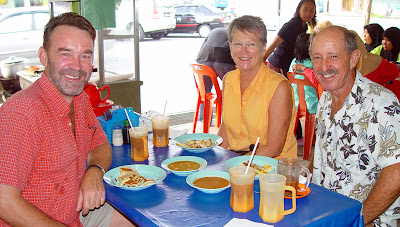
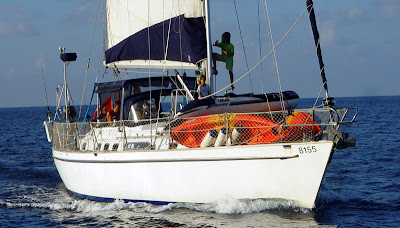
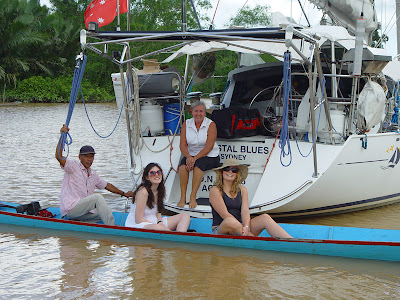
Stashed below are 2 sheets of Dow RTM Styrofoam insulation for our new freezer box (each 2.6m long), plus a roll of vinyl marine hooding for Ley to make new covers. On deck we have a new aluminium extension ladder for access to the boat on the hard. A deck mount air-con unit loaned by SV Tweed fills the salon, thanks Jon & Pam (thats the Tweed crew in the image at left, breakfasting on Roti in Langkawi). Our aft cabin is full of grog, hardware, stainless steel angle, paint and spare parts. Its now a big floating hardware store, and it all has to come off the boat and go into storage when we arrive, along with everything else on the vessel - food, clothing, utensils, parts, tools, mast, rigging etc. This will take a while, though we hope to complete the transfer before we haul out on September 4th.

We departed Langkawi this morning and have a fine weather forecast for the next 24 hours - a little wind this time, so we're now motor sailing with 7 knots of breeze just aft the beam. Flat seas and sunny weather, little rain, its unusually mild for the South West monsoon. Ley and I expect to be in Thailand for 6 months, and will be renting a house for the duration, somewhere close to Phuket Boat Lagoon. Friends and family are always welcome, so please email or call us if you'd like to visit.

Wednesday, 6 August 2008

A Cruising Life For Sale ...

We met Jon & Sandra Stonham in Borneo two years ago. They've became fine friends, and we've travelled extensively together (see our Andaman travels here). They also have a terrific website - see it here. However they've decided its time to stop roving and put the girls (Nicola and Alex) into "real" schools. So they're settling here in Singapore, where Jon is starting a new business and Sandra has accepted a position in the finance industry. All of which means that their beloved Tui Tai, a centre cockpit Tayana 47 designed by Robert Perry, is for sale.

The family moved off the boat three days ago, into a lovely big apartment, and the girls are learning to sleep in a "real" house again. Jon and Sandra haven't been getting much sleep at all, as their beds arrived from Hong Kong without mattresses. Oops.

Tui Tai was launched in 1993, is registered in Hong Kong and now waits patiently for a new owner at One Degree 15 Marina here in Singapore. She has a fabulous inventory, and has never wanted for maintenance. Download the inventory document here. She sails very well, is quicker than Crystal Blues in light airs, and sleeps six in three cabins. Tui Tai has air conditioning, a 6kva generator, an R.O. water maker, substantial systems and lots of comfort. Many of the electronic systems have been upgraded in the past two years. A solid cruising boat with impecable credentials. Interested ? An email to jon"at"thestonhams.com would kick things off nicely.

Thursday, 31 July 2008

Kuching to Singapore, With AIS Onboard

After two months with our friends on the Tulai River, Crystal Blues departed Santubong (Kuching) at 11.00am on Tuesday, bound for Phuket (Thailand) via Singapore, Penang and Langkawi. As I write we are just 125 miles from One Degree 15 Marina in Singapore - it has been a magic run across the South China Sea. We covered 180 nautical miles in the past 24 hours.

Good winds have kept the boat speed well over 7 knots for hours at a time, and the forecast is for these conditions to hold. Right now we have 11.5 knots of true windjust aft the beam, boat speed is 7.5 knots and a favourable current is giving us 7.8 knots over the ground. Magical sailing, although its pitch black outside and the new moon won't rise for another hour - just before dawn.

On this voyage we're testing and commissioning our new Comar AIS (Automatic Identification System) installation. The system uses small vessel mounted VFH transceivers to transmit and receive vessel data - position, speed, course, name etc. This data is automatically received by other AIS equipped vessels, and the data is displayed on dedicated screens or overlayed onto electronic chart displays.

In our case the AIS targets and data are available on our Transas Navigation software chart display - so we can see our own vessel, plus all AIS equipped vessels as real time targets on the electronic chart. Check the image at right - or click here to download a larger hi-resolution screen image. Radar targets can also be overlayed and compared, making this an ideal active safety system. Right now we're receiving data and safety messages from vessls over 100 nautical miles away, so I'm very impressed. Its a real step forward in collision avoidance, a major concern for all cruising vessels. More on this in a future story on the web, once its fully commissioned.

AIS is already compulsory on larger vessels, and is moving into the recreational boating area. It's now compulsory on all private vessels in Singapore, and we think it will become compulsory in many other countries quite soon.

We should arrive in Singapore late tonight, with a planned stopover of four or five days. Our telephone number in Singapore is +65-9122-8094 (see the right hand pane).

Tuesday, 29 July 2008

Cruising Internet Access Improved

fiogkaomjonDiGi have simplified registration requirements for "foreigners" who wish to take advantage of their excellent 3G / GPRS data services here in Malaysia. You can now buy a post-paid SIM card for only MR$100.00 up front, from which the first months service charge will be deducted.

You'll need your passport and a Malaysian billing address to sign up, but you don't actually need the monthly invoice .... just remember to go to any DiGi office each month, quote your service number and pay the bill. Sixty six ringit for unlimited and reliable data access is great value. We departed Santubong earlier today, bound for Singapore. The DiGi service has worked continuously since we weighed anchor, and we're now more than half way to Tanjong Datu - its rock solid. Click here for info on the system and the equipment we use. We've noted some folk using 3G cell phones are having trouble with access - 3G service is limited to the big cities, so you must configure the phone to down-shift to GPRS if you want wide area coverage. If your phone can't do that then you should consider a stand alone modem that will.

Monday, 28 July 2008

Births, Deaths & Marriages

This is our third year visiting our friends on the Tulai River, and we thought we'd seen it all....regular readers will already know about the marriage, however life here has a way of grabbing you by the throat and forcing you to face reality.

A few days after our Aussie visitors headed back to Australia we were relaxing in the cockpit when a local longboat approached ... "Uncle, can you help us ?" they asked. "Of course, what is the problem ?" we said. "My wife is having a baby" he said ... "When ?" I asked ..."Maybe now" he said !!!

Wow .. They needed a fast trip to the clinic, and our Caribe dinghy is the fastest boat on the river. Quickly I threw some clothes on, Ley checked the fuel tank and the wife and husband climbed aboard. The grandparents were left in the longboat to travel down stream at a slower, traditional pace. So off we went, with me busily thanking God that we'd serviced the Tohatsu outboard and there was good air pressure in the tubes.

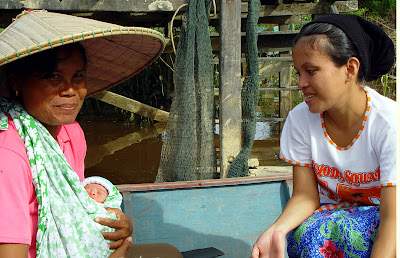
Always the wise one, Ley had spotted the storm clouds in the distance and thrown in our largest umbrella. As the rain started I slowed the boat and set the umbrella up as a kind of dodger ... mother-to-be and father sheltered behind that and off we went again, flat out to Bintangor town. Dodging logs and flotsam at 20 knots in a rain storm proved kind of challenging, but we got there OK. The clinic put them in an ambulance to Sarikei Hospital, and a healthy baby girl was born about two hours later. Thank heavens ! That's Grandmother at left, in the photo above, with a nervous mother at right.

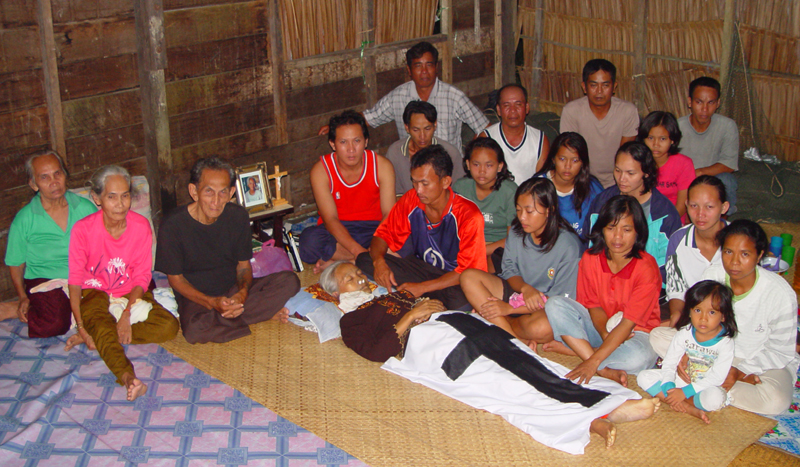
The following Sunday Ley set off to church early, and was immediately aware of a loud keening and wailing coming from the longhouse. On arrival she learned that our friend Lucy had passed away in the early morning ... suddenly everything had changed in the longhouse. Lucy was 60 years old, had eight children, the youngest being only 13. She was regal and proud, a beautiful woman. Unfortunately she had high blood pressure, as many Iban do, and suffered a stroke in the early hours. With no transport available, the family sat with her until she passed away around 6.00am.

Lucy was laid out in the public area of the longhouse for two days while visitors and family arrived from all over Sarawak and Malaysia. We sat with the family, next to Lucy, while friends and relatives arrived and completed there lifetime relationship with her. Each person was able to sit with her, to talk, to sing their memories and to hold her hand. The family never left her side, sang to her, burned candles constantly and still managed to look after the dozens of visitors.

Frankly I've never been so moved by a social process - the ability of these folk to deal with death and face it positively, actively combining Christian and traditional practices, was awe inspiring. After 48 hours so many people had gathered it felt like a party ... the locals erected a special kitchen just to cook for the visitors, who all slept in the public space of the longhouse.

For three days no one in the longhouse worked - no fishing, no agriculture, no hunting. Then Lucy was buried by the community and her family, who asked specially that we take the final photograph of her, as seen above. As a practicing Catholic her final resting was organised differently to traditional Iban practice, which would have seen her laid out on a platform above ground. For another two weeks, the children in the longhouse must now be careful - no running, no music, no television, no entertainment. Life will be quiet.

We departed the Tulai River last Wednesday, on the outgoing tide. Given our close relationship this was a very sad departure - many tears were shed for days before, yet on the day our friends were all there on the river bank, wishing us safe travel. We really do love this river, but we love the people even more - they're family now, and it is very hard to leave them.

Crystal Blues is now anchored on the Santubong River, near Kuching, and will depart for Singapore tomorrow morning. The passage should take three days. Our next six months will be spent in Phuket, Thailand, refitting and painting Crystal Blues. Our refit booking starts in September, so we need to get a move on ... we have to cover 1000 nautical miles (about 2000km) in the next 2 weeks.

Sunday, 27 July 2008

Did We Tell You About The Crocodiles ?

Late in May, Crystal Blues returned to the Tulai river, and found the children surprisingly reluctant to swim in the river. Then we discovered they had spotted some juvenuile crocodiles living down stream. It looked as though swimming was off the activity list, which was quite annoying given our hassles with crocs in Santubong.

Next day, the afternoon heat and the lure of the cool river overcame the crocodile fear. We all swam then, two or three times a day and our friends from the longhouse came down to the river each afternoon to bathe, swim and socialise. The crocodile threat appeared to be forgotton.

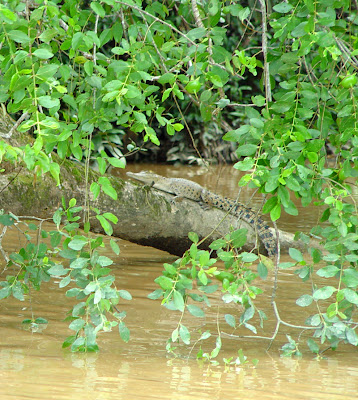
One night in the longhouse we asked if there had been any crocodile attacks on the Tulai River. The answer was a resounding NO - crocodiles are friends to the Iban people, and they live in harmony with the crocodiles. One day Ley, with young Jabu and Beretin, was coming back from town in the dinghy. They passed one of the smaller crocs sunning itself near the river bank. Jabu waved and said hello to the crocodile, maintaining that respectful relationship. Note that it took us five days of serious effort to eventually capture a photograph of that animal (about 2.5m long), as seen at right.

The Iban don't kill crocodiles, unless absolutely necessary. When we said we had actually eaten crocodile flesh (back in Australia) there was some consternation amongst our hosts....was this a bad omen ? The Iban who catch fish further upstream told us the crocodiles up there often damage their nets - so now we knew there were beasties both up and down the river. Yet we continued swimming, as did the locals, content that the respect between the animals and the people was real. Sitting back now, I can't tell you how we rationalised that, but it worked for us.

Service That Shines .... From Pelican

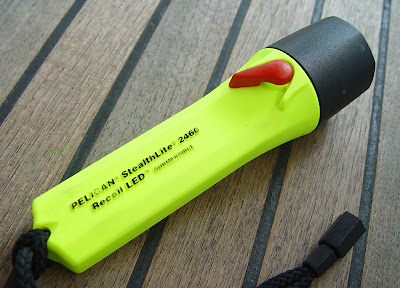
About 6 years ago we purchased the first of three Pelican re-chargeable torches. They're waterproof, lightweight, robust, very bright and have a lifetime guarantee. Best of all, the model we chose comes with a small 12volt re-charging cradle, which we installed at the Nav. station and wired into the switchboard supply. So the torch was always fully charged when we needed it.

After several years of service we experienced a few charging problems, and one torch stopped working after its first salt water immersion. So we sent all three units back to the manufacturer. To our delight they agreed to replace all three units at no charge - and they let us upgrade to the new LED versions for a small fee. Full points to Pelican for honouring the lifetime warranty without any questions - service like that is hard to find these days.

We use the Pelican Stealthlite 2460 Recoil LED (see the manual here). Its waterproof, though they say its not a diver's light - they have other models for that. Our thanks to Pelican Australia for the prompt service and great support.

Friday, 25 July 2008

BIYC & Borneo Cruising Update

With a little under 4 weeks to go, preparations for this years event are moving ahead. Two local entries in the racing division will have local Sarawak Sail Team crews on board. A record number of visiting boats (over 20!) were anchored at Santubong for the Rainforest World Music Festival, with most now heading on to Miri and Labuan for the race start.
Dancing On The Tulai River

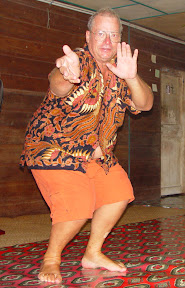
SV Harrier and SV Quoll 2 visited Sungai Tulai late in June for the "End Of Gawai" celebrations at longhouse Rumah Lidam. The local population worked hard to welcome everyone, and the Tuak was flowing. Harrier have moved on to Miri after Dennis stole the show with his own unique Ngajat (dance, at left), while Quoll 2 moved back to Santubong for the music festival. Ask Tim about his sumpit (blowpipe) skills - he placed third in a competition among many locals last week.

Unusual Weather

Some boats have experienced unusually heavy conditions on the crossing from Singapore and West Malaysia, with some damage to sails and canvas reported. On the Rajang Delta we've had an unusually wet two months. I'm told the south west monsoon is stronger than usual. Some dry season! With only two sailboats registered in the whole state, there are no sailmakers or sail repair services in Sarawak. Canvas workshops are available in Miri and Kuching, but straight stitch only. If you want zig-zag, you'll need to find a boat with a suitable machine onboard.

Santubong Wrecks

SV Blue Tango, one of many vessels to visit this year, had the bad luck to pick up a wreck on their anchor chain. We're told this happened off the Marine Police jetty, an area suggested to us for anchoring by the locals....and we've seen fishing boats anchored there in the past year. Never the less they had a serious problem, resolved only after hiring a diver and barge etc. Most unfortunate. We're now told there are two wrecks in that area, plus a sunken Japanese aircraft on the other side of the river.

A Visit To Sibu, Sarawak's Second Biggest City

Anchor opposite the express boat terminal, immediately downstream of the sawmill on the opposite bank. Sibu produce markets are exceptional, with unique packaging for live chickens. We recommend a visit to The Fisherman Restaurant, on the waterfront near the water taxi depot (downstream from the express boat terminal). They serve a unique blend of Chinese and Melanau cooking, lots of seafood, and the special Assam Prawn Soup is a must. In daylight hours your dinghy can be left safely on the long express boat pontoon - go around the upstream end of the pontoon and then come back towards the terminal building between the river bank and the pontoon. However that dock is locked up each evening, so at night we use the public dock immediately downstream from the water taxi depot (its right opposite The Fisherman Restaurant). Again we use the shore-side of the floating pontoon, leaving the river side open for commercial traffic. Be sure that your dinghy is locked in both places. Fresh water can be obtained from a tap at the water taxi / fuel depot - if you go in at high tide the tap is only a few metres from your dinghy (I wouldn't recommend putting your yacht anywhere near that dock).
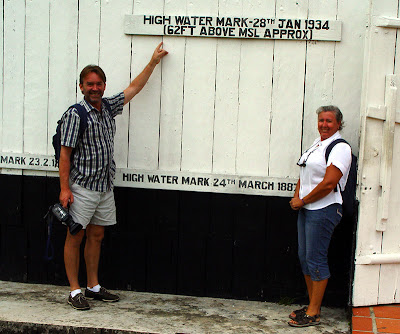
The night market in Sibu is a delight, with many types of local food, clothing, jewellery, gadgets etc. We shop at the council market in the heart of town for vegetables and fruit - the range is fantastic. If you want to see the country further up river, you can take an express boat from here to Song and Kapit, 120km inland. I recommend a visit to the Tun Jugah Museum at Fort Sylvia in Kapit. Coincidentally, it is Datuk Linggi, son of Tun Jugah, who makes available the floating dock at Santubong that is so valuable to visiting cruising boats.

Haul Out Facilities

SV Court Jester arrived in Santubong with a persistent leak - they needed to dry out to access the source. In the end they careened on the piles at Santubong, quite successfully. There is a concrete hard stand area at Miri Marina, serviced by mobile crane. Whilst it is quite full at the moment, Captain Fin advises they would do everything possible to help a distressed vessel. Next stop after Miri for haulout is the big travel lift at Kudat. Prices there have risen recently, but are still reasonable. Check our Marine Services Directory (right hand column) for contact details.

More Boats Visit Sungai Tulai
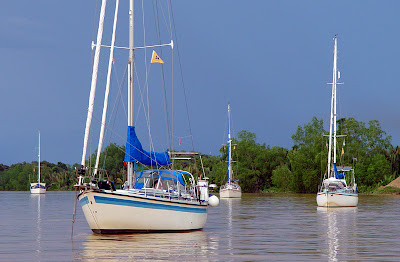
Whilst the annual Gawai festival is officially over, our Iban friends on Sungai Tulai continue to extend hospitality to visiting boats. Last week we met cruising yachts Circe, Dream Catcher, Millenium and Callala in Bintangor and arranged for them to visit. They came up stream in convoy the next day. Donations from the boats to the fire victim at Rumah Suring were graciously accepted, then the crews were hosted with traditional wine, music and dance at Rumah Labang. That evening the Rumah Lidam families provided a traditional Iban meal inside the longhouse, followed by hours of conversation and tuak (rice wine).

Miri Marina Arrival Information
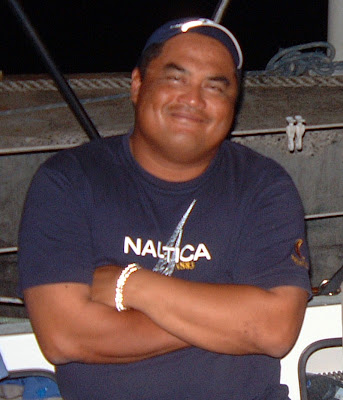
Head for the giant Seahorse - if you miss that, the next most obvious landmark will be the big smile on Capt. Fin's face (just joking). We sounded the entrance to Miri Marina on October 10 last year, and measured 1.45m on a 0.0m tide (this depth occuring well within the sea walls). Captain Fin recommends using a minimum 1.0 metre tide for entry, and believes there is more water now than we measured last year. The bottom shelves gradually on approach to the entrance. We recommend keeping around 75m clear (SSW) of the sea walls before turning into the entrance. Plenty of water in the pond itself, but don't swim there - I've personally seen a crocodile in the canals beyond the marina, though Capt. Fin tells me thay caught that one a few months ago....

Brunei Anchorage Update

Patrick & Elizabeth on SV Labarque have confirmed that Allan Riches' notes (offered via Sailmail and also included in Envy's compilation) seem to be out of date. According to the Brunei Police, the only authorised anchorage in the Brunei River is now off the Royal Brunei Yacht Club at Serasa (05-00.2N, 115-04.1E, or thereabouts). Labarque tried anchoring up river (in town) but met problems with garbage, officialdom and locals. The holding at Serasa is very good and the club welcomes visitors. From the anchorage you can take the dinghy to the ferry terminal to check in.

Fuel is available at the Shell marine station some five miles inland from Serasa (04-55.98N, 115-01.12E). Subsidised fuel is no longer available. Diesel for foreign vessels costs B$1.30 a litre. You'll need a barge board to lie alongside the fuel wharf comfortably. We've re-fueled Crystal Blues there many times - best to arrive at high tide, slack water. Brunei is well worth a visit. We know of one boat that was hit by a barge when anchored in town, so the yacht club anchorage at Serasa is definitely the place to be. Do lock your dinghy and outboard motors though .... we lost an outboard motor there last year. See our stories here & here.
Saturday, 12 July 2008

Blowpipes, Mushrooms & Friendship

Seven weeks have passed since our arrival on the Tulai River. The first few weeks were frantic, including a wedding here at longhouse Rumah Lidam plus the Gawai Dayak celebrations. In early June we were also invited to our first Gawai Antu (Festival Of The Dead), held at nearby longhouse Rumah Labang. The images from Gawai Antu are available here, and in the photo gallery in the right hand column.

Life settled down just a little after that. With help from local friends Hillary & Jampie we were able to acquire a good quantity of hand made "laja" (blowpipe darts), and the people of Rumah Lidam turned their hands and lungs to a very unusual competition. This was a first for almost all of them - a blowpipe hadn't been used by these people for more than a generation. After the first day's entertainment several old blowpipes appeared out of the local biliks (homes), though all were warped or damaged, and unuseable. Using Neil's new (& straight) blowpipe, the competition final was held on June 30.

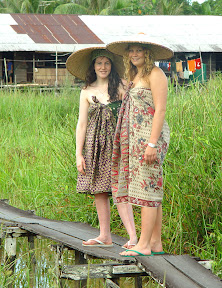
On June 28 the world turned upside down again with the arrival of family friend Diana Farrell and her friend Charlotte (at left). Two 18 year old aussie girls certainly caused a stir on the river, and in the local towns. They were delivered to the longhouse in great style, carried aboard an Iban longboat. That night was the end of Gawai, and the celebrations included dressing Ley and both girls in traditional Iban costume. Thats "Princess" Ley in the photo at right.

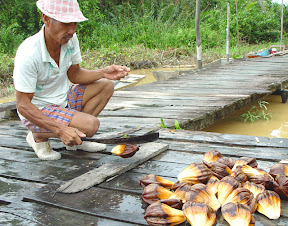
Our friends here keep us well supplied with local foods and are eager for us to sample everything from local river snails to Pangolin and tapioca leaf. The wild mushrooms shown here look red and dangerous to the newcomer, but taste delicious when cooked (lightly spiced). Last week Jampie cut a large bunch of fruit from the Napa Palm along the river bank. The nuts were separated from the bunch and then cut open on the dock. Inside is a delicious clear milk, just like coconut milk. Surrounding the milk is a clear gelatinous layer that can be scraped out with your finger nail. To our surpise it tastes like Lychee fruit, only milder. Two days in a row we slurped and scraped our morning tea of fresh nappa fruit, sitting on the dock, with Jampie wielding his long knife to keep everyone fed. Incidentally, if you want a knife sharpened really well, give it to an Iban ... Jampie has honed our large galley knife to a very fine and dangerous edge. His own long knife knocks the top off green coconuts in a flash, as Charlotte & Diana saw last week. The girls returned to Australia yesterday, though the local boys are still asking after them...see the photo's here, or in the gallery at right.

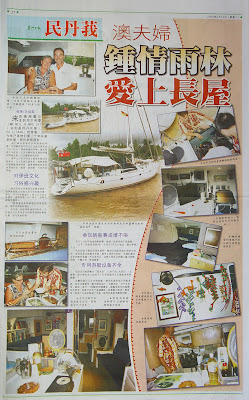
Our presence on this river sometimes generates an unusual amount of interest - in the past month we've been visited twice by local Chinese language newspapers, who each devoted a full page in colour to our presence here. Read about it here, & here. The courtesy and generosity of the local people is difficult to describe - I've lost count of the food and drink we've been offered by locals, both Chinese and Iban. Even in local restaurants we sometimes find our meal is paid for before we even finish it .... Sarawak is unique.